I want to learn more about…

How Mathematical Systems Work

Mathematics and Language

Have you ever wondered how mathematics came to be – how human beings moved from naming and describing the world to creating the mathematical systems we use today?

These nine articles trace that journey from the formation of meaning through words and experience to the emergence of formal mathematical reasoning and abstraction. As you begin to understand how language developed into mathematical thought, you gain a glimpse of how mathematicians across the millennia gradually shaped the systems upon which modern mathematics is built. The articles follow a clear sequence, so I recommend reading them in the following order.

  1. Pathways that Formed Our Way of Knowing
    Explore the historical and philosophical pathways that have shaped how we understand knowledge, truth and mathematics.
  2. How Meaning is Formed with Words
    Discover how language gives form to experience and allows meaning to become clear, shareable and open to thought.
  3. How the Body, Language and Experience Create the Foundations of Mathematical Thinking
    Explore how movement, perception, language and lived experience prepare the ground from which mathematical thought can grow.
  4. Language and Formal Mathematical Reasoning
    Follow the movement from ordinary language into the more precise forms of language required for mathematical reasoning.
  5. Logical Operators in Mathematics
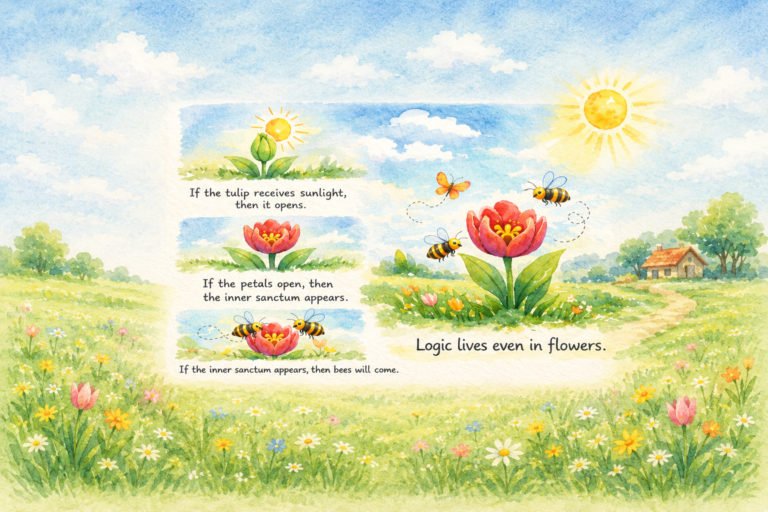
    Learn how words such as and, or, not and if shape the logical relationships upon which mathematical arguments depend.
  6. How Axioms Determine the Foundation of Mathematical Reasoning
    Consider how the assumptions we accept at the beginning of a system determine what can be reasoned, constructed and understood within it.
  7. Euclid’s Common Notions or Axioms: The Ground of Geometric Reasoning
    Enter the foundations of Euclid’s geometry by examining the shared principles upon which his proofs and propositions are built.
  8. From Words to Symbols: How Abstraction Clarifies Rather than Escapes Reality
    Explore how mathematical thinking moves from experience and language into symbols, and why symbols become meaningful only when they hold ideas already understood.
  9. Making Peace with Abstraction
    Bring the journey together by exploring why abstraction can feel unsettling and how understanding its development can make it more accessible.

I would like to receive Sacred Mathematics articles in my inbox.

We don’t spam! Read our privacy policy for more info.

Exploring the Foundations of Euclidean Geometry

This series of articles is intended for teachers introducing students to geometry and for older students and adult readers who would like to explore the fundamental meaning of the foundations laid down in Euclid’s Elements.

The articles look deeply into the process of abstraction. They reveal how Euclid gathered fundamental geometrical ideas, expressed them with remarkable precision and organized them into a structure from which formal geometry could proceed.

In the Mathematics and Language section, we have already explored the nature of axioms and Euclid’s Common Notions. Here, we follow the development of geometry itself as it is presented in Book I of the Elements: beginning with definitions, moving through the principles upon which geometrical construction and reasoning depend and finally entering the world of formal proof.

This is a subject that is often presented in a dry and purely academic manner. Yet when we pause over Euclid’s words and consider what each definition is doing, the depth and brilliance of his work become increasingly visible. These articles follow a clear sequence, and I recommend reading them in the following order.

  1. Euclid’s Definitions 1–7: A Deeper Exploration
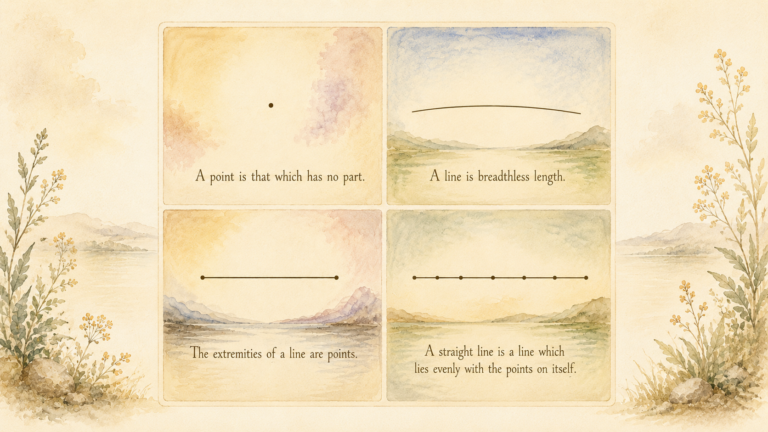
    Begin with Euclid’s first definitions and explore how the point, line, surface and angle emerge through increasingly precise acts of abstraction.
  2. Euclid’s Definitions 8–12: Discover the Hidden Power of Angles
    Examine how Euclid distinguishes between different kinds of angles and establishes the language needed to reason about their relationships.
  3. Euclid’s Definitions 13–15: Boundary, Figure and Circle
    Explore how boundary gives rise to figure and how the relationship between a center and its circumference brings the circle into being.
  4. Euclid’s Postulates: The Foundations of Geometry
    Euclid’s postulates establish the conditions under which geometry can become active. While definitions determine what geometric objects are and axioms govern how reasoning holds together, the postulates grant the fundamental permissions through which lines may be drawn, circles formed and constructions extended. From these few carefully chosen beginnings, the entire structure of Euclidean geometry is able to unfold.
  5. How Axioms Determine the Foundation of Mathematical Reasoning
    This article explores Euclid’s axioms, or Common Notions, and the role they play in forming the foundation of mathematical reasoning. Before geometry can move with certainty, it must rest on truths that are accepted as self-evident. But this raises a question beyond mathematics: what are the axioms beneath our own thinking? What hidden assumptions determine the way we reason, choose and meet the world?
  6. Euclid’s Common Notions or Axioms: The Ground of Geometric Reasoning
    This article explores Euclid’s axioms, also known as the Common Notions. These simple statements form the foundation beneath geometric reasoning. They speak about equality, comparison and the way thought can move from one truth to another with certainty.
  7. Equilateral Triangle: Classic Proof that the Sides Are Equal
    This article explores Euclid’s first proposition: the construction of an equilateral triangle on a given straight line. What looks like a simple triangle is actually the first full movement of Euclidean proof. Using only a straightedge, compass and the equality created by two circles, Euclid shows how a figure can be constructed with certainty.

In Book I of the Elements, Euclid presents twenty-three definitions. Articles exploring Definitions 16–23 will be published in due course. In the meantime, these first three articles offer a wider lens through which the remaining definitions can be approached. As you read them, consider the deeper question: what acts of observation, distinction and abstraction must have taken place before each definition could be expressed?

Teaching Mathematics with Meaning

Teaching mathematics with meaning begins by respecting the passage from not knowing to knowing. Understanding cannot always be hurried into existence through explanation, repetition or memorization. Learners need time to observe, question, experiment and remain with uncertainty until a relationship begins to reveal itself.

The articles in this section explore how mathematics can be taught through lived experience, movement, perception, imagination and careful reasoning. Concrete activity does not replace abstraction or proof; it prepares the ground for them. When a learner has first encountered a mathematical truth physically and perceptually, formal language can give precision to something that has already begun to make sense.

This approach restores mathematics to a more human rhythm. The body participates, emotional responses are acknowledged, intuition is allowed to recognize pattern and the intellect is then called upon to clarify, test and prove. Mathematics becomes more than a set of rules to remember: it becomes a disciplined way of meeting relationships that can be experienced, examined and understood.

Spatial Development for Children

A child’s earliest mathematical understanding begins in the experience of space. Before geometry becomes a diagram or measurement becomes calculation, the child must first discover what it means to be above or below, near or far, inside or outside, moving toward or away, turning left or right.

The articles and stories in this section explore how spatial awareness develops through movement, language, observation, imagination and lived experience. As children learn to notice and name position, direction, distance, sequence and change, they begin to perceive the relationships that later become the foundations of geometry, measurement and mathematical reasoning.

The Mat the Math Mouse stories were created to support this awakening gently and imaginatively. Through Mat’s journeys, children encounter mathematical relationships as part of a meaningful world: something to move through, wonder about and gradually understand. Mathematics begins not with rules imposed from outside, but with the child becoming more awake to the order and relationships already present in experience.

Healing Our Relationship with Mathematics

Many people turn away from mathematics not because they lack the ability to understand it, but because somewhere along the way mathematics became associated with pressure, confusion, comparison or shame.

A lesson moved too quickly. A question was dismissed. A symbol appeared before the idea beneath it had become clear. Speed was mistaken for intelligence, and a natural moment of uncertainty began to feel like evidence of failure. Over time, the thought I do not understand this yet hardened into I am not a mathematical person.

The articles in this section explore how that relationship can be restored. Healing begins by creating space for uncertainty, curiosity and thought to unfold without judgment. It means returning to mathematics through pattern, movement, language, geometry, rhythm and meaningful experience, so that ideas can be encountered before they are compressed into rules and symbols.

This is not a rejection of rigor, abstraction or formal reasoning. It is an attempt to rebuild the foundations that allow them to become meaningful. When learners are given time to observe, question, experiment and recognize relationships for themselves, mathematics can gradually stop feeling like an external authority and become a way of seeing, thinking and understanding once again.

Philosophical Reflections

Mathematics has never been only a collection of techniques. Across history, it has also been a way of asking how the world is ordered, how change can contain pattern, how the mind forms abstractions and why reality is intelligible at all.

The reflections in this section explore the deeper ideas that surround mathematical thought: the relationship between pattern and meaning, the role of language and logic, the movement from lived experience into abstraction and the limits of formal systems. They draw on philosophy, history and spiritual traditions to consider how human beings have learned to recognize order and express it with increasing precision.

These writings do not treat mathematics as separate from life. They ask what mathematics reveals about perception, consciousness, truth and the structure of the world—and how clear mathematical thinking can deepen our participation in that larger order.


Our Educational Foundation

Sacred Mathematics is a serious educational website. All content is grounded in established mathematical knowledge and informed by sound educational principles. The educational approach draws inspiration from Waldorf Education and other major pedagogical streams, while remaining attentive to current research into child development, mathematical thinking and how children learn.

The name Sacred Mathematics points to the ancient Greek philosophical tradition, where mathematics was seen as a way of contemplating order, pattern, proportion, and the Logos – the deeper intelligibility of the universe.