From the Center of the Circle to Parallel Lines
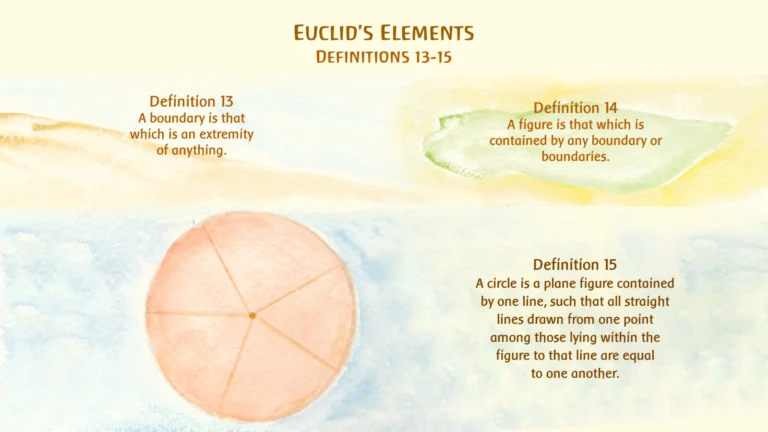
In the previous article, we explored Euclid’s Definitions 13–15. A boundary marks the extremity of something. A figure arises when a region is contained by boundary or boundaries. The circle then appears as a particular kind of contained plane figure: one whose boundary is held in equal relation to a point lying within it.
Yet Euclid has not completed the circle. The inner point has been described through its relationship to the circumference, but it has not yet been named. The straight line that passes through this point and crosses the entire circle has not yet been defined. Nor has Euclid explained what happens when that line divides the circle into two equal figures.
Definitions 16–18 complete this first unfolding of the circle. The point is named as the center. The diameter carries a straight line through that center and divides the circle. The semicircle then appears as a new figure contained by part of the circumference and the diameter.
After this, Euclid turns from the circle to figures contained entirely by straight lines. Definition 19 introduces rectilinear figures and distinguishes them by the number of straight lines that contain them. Definitions 20 and 21 classify triangles according to two different kinds of relationship: the equality of their sides and the nature of their angles. Definition 22 does something similar for quadrilaterals, combining equality of sides with the presence or absence of right angles.
Finally, Definition 23 moves away from the classification of individual figures and returns to the relationship between straight lines. Parallel lines lie in the same plane and, however far they are extended, never meet.
There is a clear movement through these definitions. Euclid begins with the inward order of the circle, divides the circle into equal parts, moves outward into the classification of rectilinear figures and ends with a relationship between lines that must be understood through indefinite extension.
The earlier definitions are present throughout. The point, straight line, plane, angle, boundary, figure and circle do not disappear once they have been defined. They return in new combinations. Euclid’s language grows by carrying earlier ideas forward and allowing them to take on new functions.
Here follow Definitions 16–23 exactly as they appear in Thomas L. Heath’s standard English translation:
Definition 16
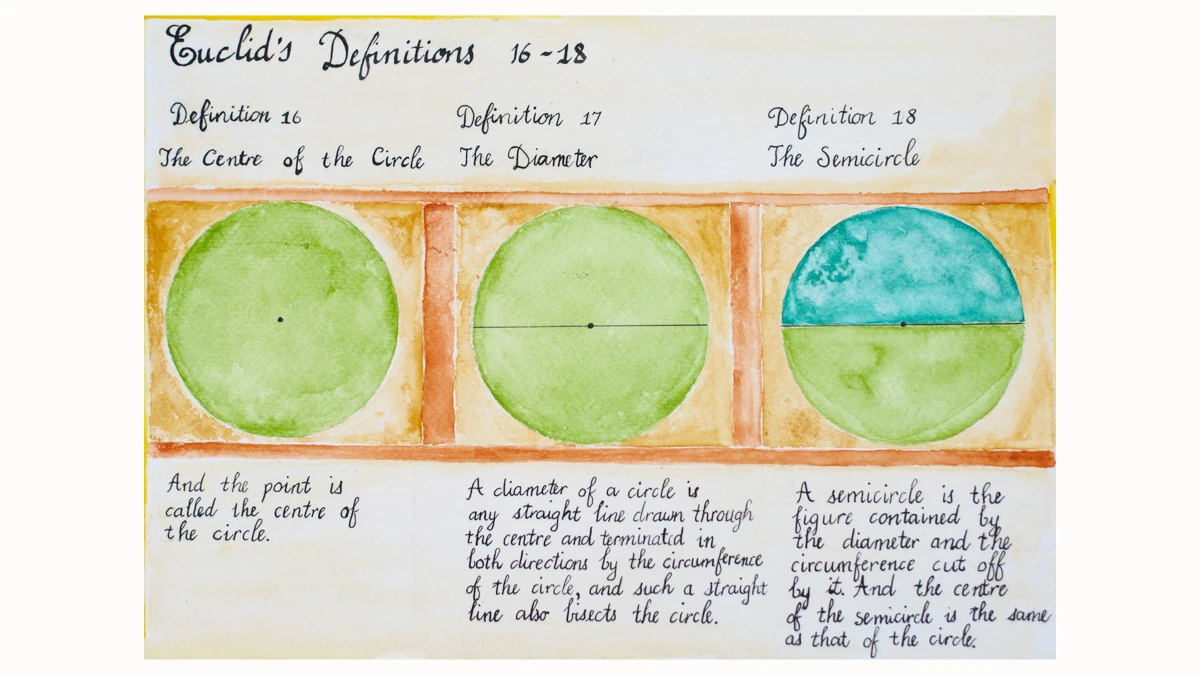
And the point is called the centre of the circle.
Definition 17
A diameter of the circle is any straight line drawn through the centre and terminated in both directions by the circumference of the circle, and such a straight line also bisects the circle.
Definition 18
A semicircle is the figure contained by the diameter and the circumference cut off by it. And the centre of the semicircle is the same as that of the circle.
Definition 19
Rectilineal figures are those which are contained by straight lines, trilateral figures being those contained by three, quadrilateral those contained by four, and multilateral those contained by more than four straight lines.
Definition 20
Of trilateral figures, an equilateral triangle is that which has its three sides equal, an isosceles triangle that which has two of its sides alone equal, and a scalene triangle that which has its three sides unequal.
Definition 21
Further, of trilateral figures, a right-angled triangle is that which has a right angle, an obtuse-angled triangle that which has an obtuse angle, and an acute-angled triangle that which has its three angles acute.
Definition 22
Of quadrilateral figures, a square is that which is both equilateral and right-angled; an oblong (rectangle) that which is right-angled but not equilateral; a rhombus that which is equilateral but not right-angled; and a rhomboid that which has its opposite sides and angles equal to one another but is neither equilateral nor right angled. And let quadrilaterals other than these be called trapezia.
(It is important not to translate Euclid’s trapezia simply as the modern American word trapezoids. In modern American geometry, a trapezoid usually means a quadrilateral with at least one pair of parallel sides, or sometimes exactly one pair, depending on the convention. Euclid’s category is much wider.)
Definition 23
Parallel straight lines are straight lines which, being in the same plane and being produced indefinitely in both directions, do not meet one another in either direction.
Let us now look at each definition more closely.

Definition 16: The Center of the Circle
Euclid’s sixteenth definition gives a name to the point already described in Definition 15:
And the point is called the centre of the circle.
This definition cannot be understood in isolation. It refers directly back to the circle. Euclid has just defined a circle as a plane figure contained by one line, with all the straight lines drawn from one point within the figure to the circumference equal to one another. Definition 16 now identifies that point as the center.
The center therefore does not enter geometry as an arbitrary dot placed somewhere inside a round figure. It is identified through a relationship of equality. It is the point from which every straight line drawn to the circumference has the same length.
This also takes us back to Euclid’s first definition:
A point is that which has no part.
The center is a point. It has no length, breadth or depth. A center marked on paper will always have some physical size, but the mathematical center does not. Like every Euclidean point, it indicates position without extension.
Yet this dimensionless point organizes the entire circle.
The center does not form part of the visible boundary. It lies within the figure, but its relationship to the boundary determines the nature of the figure. If the distances from the inner point to the surrounding line were unequal, the figure would not satisfy Euclid’s definition of a circle.
This gives the center a distinctive geometrical role. It is not simply inside the figure. It is the position from which the figure’s equality can be understood.
A point may be placed almost anywhere inside an irregular enclosed form, but this does not make it a center. The center of a circle is discovered through an invariant relationship: every point on the circumference is equally distant from it.
Here the meaning of center becomes more exact than the ordinary meaning of “middle.” We often use the word middle approximately. We speak of standing in the middle of a room or placing an object near the middle of a table. Euclid’s center is not approximate. It is defined by equality of distance.
This is why a compass is such an important geometric instrument. One point remains fixed while the other moves around it at a constant distance. The center is held still, but the circumference comes into being through its relationship to that still point.
The circle therefore reveals an interplay between rest and movement. The center remains fixed. The moving point describes the boundary. What holds the movement in order is the unchanging distance between them.
Educationally, the center is best understood through this relationship. A child may draw around a circular object and then guess where the center lies, but the center becomes mathematically meaningful when it is found or constructed. Folding a paper circle along two different diameters, for example, reveals that their lines of folding meet at one point. A compass makes the relationship even clearer: the center is the point that remains fixed while the equal distance is carried around it.
Definition 16 is brief because the real work has already been done in Definition 15. The point has been characterized before it is named.
Euclid does not first give us the word and then ask us to attach meaning to it. He gives us the relationship and then names the point that holds that relationship.
The center is the point from which the circle’s equality is ordered.
Definition 17: The Diameter
Euclid now draws a straight line through the center:
A diameter of the circle is any straight line drawn through the centre and terminated in both directions by the circumference of the circle, and such a straight line also bisects the circle.
Several earlier definitions are gathered into this one.
The diameter is a straight line, which takes us back to Definition 4. It lies evenly with the points on itself. It passes through a point, the center introduced in Definition 16. It ends at the circumference, the one boundary that contains the circle in Definition 15.
The diameter therefore connects the internal point of organization with the external boundary.
Not every straight line that crosses a circle is a diameter. A line may enter the circle at one point on the circumference and leave it at another without passing through the center. In modern geometry, such a line segment is called a chord. A diameter is a special case because it must pass through the center.
This condition is decisive. The center is the point from which the circumference is everywhere equally distant. When a straight line passes through that point and reaches the circumference in opposite directions, the two parts of the line extending from the center to the circumference are equal.
The diameter makes the inner order of the circle visible.
Before the diameter is drawn, the center remains a single point surrounded by a continuous boundary. The diameter carries a straight relationship through that point and across the whole figure. It joins two points on the circumference through the center.
The straight line now performs more than one function. In Definition 4, straightness gave extension a consistent direction. In Definition 6, lines appeared as the extremities of surfaces. In Definition 13, boundary was defined as the extremity of something. Here the straight line passes through the interior of a figure and divides it.
The diameter therefore introduces division without destroying the original order of the circle. It cuts the circle into two equal parts.
Here Euclid places a geometrical result inside one of these definitions. The statement that the diameter bisects the circle does more than explain what the word diameter means. It asserts something that follows from the circle’s structure. Richard Fitzpatrick notes that this clause should be considered more as a postulate than part of a strict definition.
That distinction matters. A definition gives meaning to a term. It tells us what kind of object we are speaking about. A proposition establishes that something is true of that object. The first part of Definition 17 identifies the diameter. The final part states what a diameter does: it divides the circle into equal halves.
Euclid’s sequence nevertheless allows us to see why this division is natural. The straight line passes through the center. The two parts of the circumference lie on opposite sides of the line, while the equal relationship to the center is preserved throughout.
The diameter becomes an axis of balance.
A physical circle can be folded along a diameter so that the two halves coincide. This provides a visible and bodily experience of the equality Euclid states. The fold is not the proof, but it gives the mind an inner reference for the geometrical relationship.
A wheel also gives an intuitive picture. A straight line drawn through its hub from one side of the rim to the other is a diameter. The hub marks the center, while the rim marks the circumference. The line reaches equally from the organizing point to the surrounding boundary in both directions.
The importance of the diameter extends far beyond the naming of a line. It reveals that the circle can be divided through its center without losing its symmetry. It translates the equality surrounding the center into the equality of two parts.
The center orders the circle from within. The diameter carries that order across the whole figure.
Definition 18: The Semicircle
Once the diameter has divided the circle, a new figure appears:
A semicircle is the figure contained by the diameter and the part of the circumference cut off by it. Its center is the same as the center of the circle.
The word semicircle means half a circle, but Euclid does not leave the idea at the level of naming. He tells us how the figure is contained.
This takes us directly back to Definition 14:
A figure is that which is contained by boundary or boundaries.
The semicircle is a figure because it is contained. Yet its boundary is different from that of the full circle.
The circle is contained by one continuous line. The semicircle is contained by two different kinds of boundary: the straight diameter and the curved part of the circumference lying between its endpoints.
Something subtle has happened. In the full circle, the diameter lies inside the figure. Once the circle is divided, that same line becomes part of the boundary of each semicircle.
The function of the line changes according to the figure being considered.
For the circle, the diameter is an internal division. For the semicircle, it is an extremity. It helps determine where the new figure ends.
This is an important geometrical lesson. A line does not carry one fixed role in every context. It may connect, divide, extend or contain. Its meaning depends partly on the relationship in which it is placed.
The semicircle also joins straightness and curvature within one figure. One part of its boundary is straight. The other is curved. It is therefore not a rectilinear figure, because it is not contained entirely by straight lines. Definition 19 will make that distinction explicit.
Euclid also states that the center of the semicircle is the same as the center of the original circle.
In the full circle, the center lies inside the figure. In the semicircle, the same point lies on the diameter, which is now part of the figure’s boundary. The center has not moved, but its position relative to the newly defined figure has changed.
This reveals another important feature of mathematical thought. A relationship may remain invariant even when the surrounding structure changes. The circle is divided, but the organizing point remains the same. Each semicircle inherits its center from the complete circle.
The whole has become two equal parts, yet each part still bears the order of the whole from which it arose.
This can be experienced through drawing or folding. A paper circle folded along a diameter produces two semicircular regions. The center lies on the fold. The curved boundaries coincide, and the two figures are equal.
Again, the physical experience is not the final mathematical abstraction, but it prepares the mind to understand it. The semicircle is not merely “half of something round.” It is a precise figure contained by one straight boundary and one curved boundary.
Definition 18 also prepares us to understand that figures may be classified according to the nature of their boundaries. A semicircle is contained, but it is not contained solely by straight lines. A triangle is also contained, but all three of its boundaries are straight.
The distinction between these forms is not merely visual. It lies in how they are constituted.
The circle is contained by one curved line.
The semicircle is contained by a straight line and a curved line.
The rectilinear figure is contained by straight lines alone.
Through the semicircle, Euclid moves from the complete unity of the circle toward a world in which figures can be divided and distinguished through different kinds of boundary.

Definition 19: Rectilinear Figures
Euclid now turns from the circle and semicircle to figures contained entirely by straight lines:
Rectilineal figures are those which are contained by straight lines, trilateral figures being those contained by three, quadrilateral those contained by four, and multilateral those contained by more than four straight lines.
The word rectilinear comes from words associated with straightness and line. A rectilinear figure is therefore a figure whose boundaries are straight lines.
This definition returns to three earlier ideas.
First, there is the straight line of Definition 4.
Second, there is the figure of Definition 14.
Third, there is the principle of containment. A collection of separate straight lines does not necessarily form a figure. They must be arranged so that they contain a region.
This is important. Three disconnected lines are not a trilateral figure. Four lines scattered across a page are not a quadrilateral. The lines must meet in such a way that a contained form arises.
The figure is more than the sum of its boundaries. It is the region held by their relationship.
Definition 19 also recalls Definition 9, where Euclid introduced the rectilinear angle. A rectilinear angle is contained by straight lines. A rectilinear figure is contained by straight lines. In both cases, straightness determines the kind of geometric object being considered.
Yet the figure introduces something beyond the angle. Two straight lines may meet and create an inclination without enclosing a region. A rectilinear figure requires enough straight lines to return the boundary to itself and contain a part of the plane.
This is why the first category contains three straight lines. Two straight lines can meet and form an angle, but they cannot by themselves form a closed rectilinear figure. With three suitably arranged straight lines, enclosure becomes possible.
Euclid calls such a figure trilateral: literally, three-sided.
A figure contained by four straight lines is quadrilateral. A figure contained by more than four is multilateral.
At this stage, Euclid does not name the pentagon, hexagon, heptagon and other polygons individually. His concern is to establish a general classification according to the number of straight boundaries.
This is a significant movement in abstraction. The particular appearance of the figure may vary enormously. A triangle may be wide or narrow, upright or inverted, regular or irregular. A quadrilateral may be balanced or distorted. Yet the number of straight lines containing it remains unchanged.
The mind learns to separate essential structure from accidental appearance.
A trilateral figure remains trilateral when it is rotated. It remains trilateral when it is enlarged or reduced. It remains trilateral when its angles and side lengths change, provided that it is still contained by three straight lines.
The number of containing lines becomes an invariant property.
This is one of the fundamental acts of mathematical classification. Many visible features may change while one defining relationship remains the same. Mathematics learns to hold that relationship steady.
For a child, counting sides may appear simple, but the deeper thought is not merely numerical. The child is learning to recognize what counts as a side, where one side ends and another begins and how the sides work together to enclose a region.
The child must distinguish the figure from its size, color, position and decoration. A small blue triangle and a large red triangle belong to the same class because each is contained by three straight lines.
Definition 19 therefore brings together boundary, straightness, containment and number.
The figure has become something that can be classified by the structure of its boundary.
Definition 20: Triangles Classified by Their Sides
Euclid now looks more closely at trilateral figures:
Of trilateral figures, an equilateral triangle is that which has its three sides equal, an isosceles triangle that which has two of its sides alone equal, and a scalene triangle that which has its three sides unequal.
The word triangle is more familiar to us than trilateral figure, but the underlying meaning is the same: a figure contained by three straight lines.
Definition 19 established the family. Definition 20 now distinguishes members within that family.
The basis of distinction is equality.
The number of sides no longer changes. Every figure under consideration has three. What changes is the relationship among the lengths of those sides.
An equilateral triangle has all three sides equal.
An isosceles triangle, in Euclid’s wording, has two equal sides only.
A scalene triangle has three unequal sides.
The classification is therefore based on three possible patterns of equality:
All three sides are equal.
Exactly two sides are equal.
No two sides are equal.
This is a mathematically ordered system. Euclid is not simply collecting three common shapes and attaching names to them. He is distinguishing all three possibilities produced by comparing the sides of a triangle with one another.
The triangle is now understood through internal relationship.
This takes us back to the Common Notions, where equality allows reasoning to proceed. Equality is no longer only a general principle applied during proof. It has become a means of classifying form.
An equilateral triangle may be large or small. It may point upward, downward or sideways. It may be drawn in ink, formed with sticks or imagined without any physical representation. Its classification depends on one thing: the equality of its three sides.
This is abstraction at work. The mind leaves aside everything that does not affect the defining relationship.
Euclid’s classification is also exclusive. Because he says that an isosceles triangle has two equal sides “alone,” an equilateral triangle is not included within the isosceles class. Each triangle belongs to one of the three categories.
Some modern mathematical treatments use an inclusive definition and describe an isosceles triangle as having at least two equal sides. Under that convention, every equilateral triangle is also isosceles. Euclid’s wording keeps the categories separate. The difference is one of classification rather than geometric substance, but it matters when reading the text.
Neither convention changes the actual properties of the triangle. The difference lies in how the classes are organized.
This is an important reminder that mathematical definitions are precise agreements about how terms will be used. A definition must be read carefully before conclusions are drawn from it.
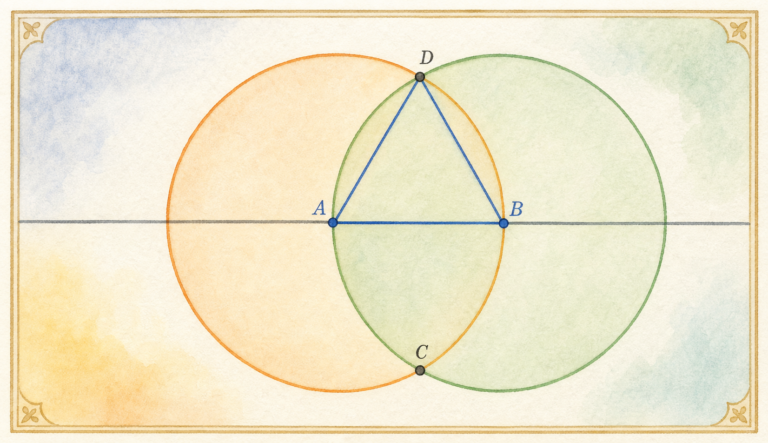
Definition 20 also prepares for Euclid’s first proposition, where an equilateral triangle is constructed on a given finite straight line. The construction depends on circles because a circle carries equal distance around a center. The equal sides of the triangle arise from this preservation of distance.
The circle and triangle are therefore already connected. The circle makes equality constructible; the equilateral triangle gives that equality a rectilinear form.
From an educational perspective, the three classes are best understood through active comparison. Students can construct triangles from equal or unequal lengths and observe which combinations close. They can rotate the figures and see that orientation does not alter classification. They can enlarge them and discover that size does not alter the relationship among the sides.
The definition is not asking, “What does the triangle look like?”
It is asking, “How do its sides stand in relation to one another?”
Through this question, the visible figure becomes an intelligible structure.
Definition 21: Triangles Classified by Their Angles
Euclid now classifies triangles a second time:
Further, of trilateral figures, a right-angled triangle is that which has a right angle, an obtuse-angled triangle that which has an obtuse angle, and an acute-angled triangle that which has its three angles acute.
The triangle has not changed, but the principle of classification has.
Definition 20 looked at the relationship among the sides. Definition 21 looks at the nature of the angles.
This takes us directly back to Definitions 8–12.
A plane angle arises from the inclination of two meeting lines. When the containing lines are straight, the angle is rectilinear. The right angle is established through the equality of adjacent angles. An obtuse angle is greater than a right angle, while an acute angle is less than a right angle.
All these earlier definitions are now carried into the triangle.
A triangle is contained by three straight lines. Where one boundary meets another, an angle is formed. The three-sided figure therefore contains three angular relationships.
Euclid now asks how those angles compare with the right angle.
A right-angled triangle contains a right angle.
An obtuse-angled triangle contains an angle greater than a right angle.
An acute-angled triangle contains three angles smaller than a right angle.
The wording is carefully chosen. Euclid does not say that an acute-angled triangle merely contains an acute angle. Euclid’s later propositions show that a right-angled or obtuse-angled triangle must also contain acute angles. One acute angle is therefore not enough to classify a triangle as acute-angled: all three of its angles must be acute.
By contrast, one right angle is enough to make the triangle right-angled, and one obtuse angle is enough to make it obtuse-angled.
The definitions do not yet prove how many right or obtuse angles a triangle can contain. Those relationships emerge through later propositions. A definition classifies an object; it does not by itself establish every theorem concerning that object.
Definitions 20 and 21 give every triangle two possible descriptions.
One description concerns its sides.
The other concerns its angles.
A triangle may therefore be described, for example, as isosceles and right-angled, or as scalene and acute-angled. The two systems of classification do not replace one another. They reveal different aspects of the same figure.
This is mathematically important. One object can belong to several systems of classification depending on which properties are being considered.
The same triangle can be approached through length, angle, symmetry, area, orientation or construction. Each approach makes certain relationships visible while leaving others in the background.
This teaches a wider lesson about mathematical understanding. To know a figure is not merely to recognize its outline. It is to understand the network of relationships through which it can be described.
The right angle remains the standard. Euclid does not classify triangles by numerical degree measure. The triangle is understood through whether its angles are equal to, greater than or less than a right angle.
Comparison precedes numerical measurement.
Educationally, this distinction matters. Students can often identify a familiar right triangle when it is shown in its usual position, with one side horizontal and another vertical. Yet they may fail to recognize the same triangle after it has been rotated.
The difficulty shows that the student has attached the concept to appearance rather than relationship.
A right angle remains right when the figure turns. An obtuse angle remains obtuse when the figure is enlarged. An acute-angled triangle remains acute-angled when it is inverted.
The position of the figure changes. Its defining relationships do not.
Through Definition 21, the inclination between lines becomes a property by which an entire figure can be understood.

Definition 22: The Classification of Quadrilaterals
Euclid now turns to figures contained by four straight lines:
Of quadrilateral figures, a square is that which is both equilateral and right-angled; an oblong (rectangle) that which is right-angled but not equilateral; a rhombus that which is equilateral but not right-angled; and a rhomboid that which has its opposite sides and angles equal to one another but is neither equilateral nor right angled. And let quadrilaterals other than these be called trapezia.
This definition gathers together much of the geometrical language already established.
The figures are quadrilateral because they are contained by four straight lines.
Their sides can be compared for equality.
Their angles can be compared with right angles.
Their opposite sides and angles can be compared with one another.
Definition 22 therefore classifies quadrilaterals through combinations of properties rather than through appearance alone.
The square
The square is both equilateral and right-angled.
All four sides are equal, and all four angles are right angles.
Two forms of equality are present at once: equality of side length and equality of angle.
The square holds these relationships in a particularly balanced form. Yet its definition does not depend on its being placed upright. A square resting on one corner remains a square. The orientation changes, but its sides remain equal and its angles remain right.
The oblong (rectangle)
Euclid’s oblong is right-angled but not equilateral.
All its angles are right angles, but its four sides are not all equal. In modern terminology, this corresponds to a rectangle from which the square has been excluded.
The oblong and square therefore share one defining property: both are right-angled. They differ in the relationship among their sides.
The rhombus
The rhombus is equilateral but not right-angled.
All four sides are equal, but its angles are not right angles.
The rhombus and square share equality of sides. They differ in their angles.
The rhomboid (parallelogram)
The rhomboid has its opposite sides and opposite angles equal, but it is neither equilateral nor right-angled.
In modern terminology, this is broadly what we would call a parallelogram after excluding squares, rectangles and rhombi.
The rhomboid introduces a different pattern of equality. All four sides are not equal, but each side is equal to the side opposite it. All four angles are not equal, but each angle is equal to its opposite angle.
Equality is distributed across the figure in pairs.
The underlying system
The first four categories can be understood through combinations of two principal properties:
The square has equal sides and right angles.
The oblong has right angles but not four equal sides.
The rhombus has four equal sides but not right angles.
The rhomboid has neither four equal sides nor four right angles, but its opposite sides and opposite angles are equal.
This reveals the mathematical structure of Euclid’s classification. The figures are distinguished by how the conditions of equality and right-angularity combine.
The system is exclusive. A square is not placed inside the class of oblongs or rhombi, even though it shares properties with both. Each named category is separated from the others by the qualifications Euclid includes.
Modern geometry often uses a hierarchical classification. A square is commonly regarded as a special rectangle because it has four right angles, and as a special rhombus because it has four equal sides. Euclid instead reserves the words oblong and rhombus for figures that do not satisfy the square’s complete combination of properties.
This does not mean that one system is geometrically true and the other false. They organize the same figures differently. The modern inclusive system emphasizes how one class can be contained within another. Euclid’s system emphasizes mutually distinct kinds.
The terminology must therefore be understood historically.
Euclid’s “trapezia” also differs from the modern use of trapezoid or trapezium. He applies the term broadly to all quadrilaterals that fall outside the four classes he has named. It does not mean only a quadrilateral with one pair of parallel sides. Heath draws attention to this broader ancient classification.
There is another interesting feature. Euclid later makes extensive use of parallelograms, but he does not formally define the parallelogram in this list. The rhomboid is one kind of parallelogram in modern terms, but Euclid’s later use of parallelogram includes the special forms as well. David Joyce notes this gap between the formal list of Definition 22 and Euclid’s later working terminology.
For the modern reader, Definition 22 requires patience. Familiar words do not always carry their familiar modern meanings.
Yet beneath the terminological difference lies a powerful method of thought. Euclid is learning to classify figures by asking precise questions:
Are the sides equal?
Are the angles right?
Are opposite sides equal?
Are opposite angles equal?
The figure becomes intelligible through the answers.
This is more valuable educationally than asking students merely to memorize a collection of shapes. The quadrilaterals can be investigated as a system of relationships. Students can change one property while holding another steady and observe when one class becomes another.
Begin with a square and move one pair of opposite sides outward while preserving the right angles. The figure becomes an oblong.
Begin again with a square and allow the angles to lean while preserving all four side lengths. The figure becomes a rhombus.
Allow both the side lengths and angles to vary while preserving equality between opposite pairs. The figure becomes a rhomboid.
The classes are then no longer unrelated labels. They become different outcomes produced by changes in mathematical conditions.
Definition 22 reveals that classification is a way of seeing structure.
Definition 23: Parallel Straight Lines
Euclid ends the definitions of Book I with parallel lines:
Parallel straight lines are straight lines which, being in the same plane and being produced indefinitely in both directions, do not meet one another in either direction.
This definition returns us to the straight line and the plane.
A parallel line must be straight, recalling Definition 4.
The lines must lie in the same plane, recalling Definition 7.
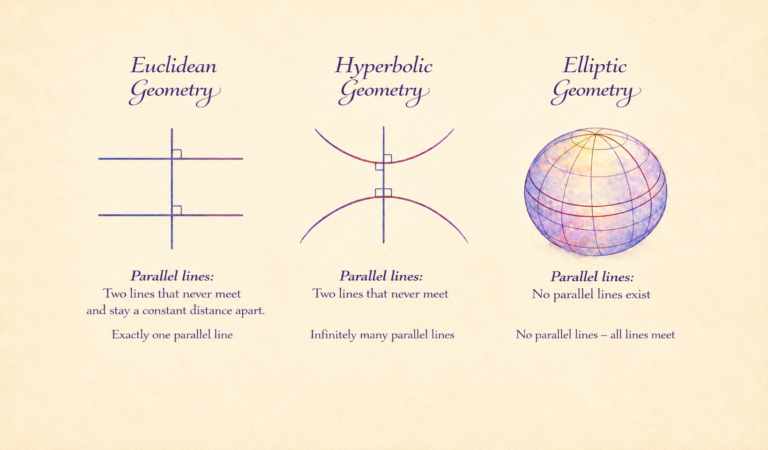
This requirement is essential. In three-dimensional space, two straight lines may fail to meet simply because they lie in different planes. Such lines are called skew lines. They are not parallel in Euclid’s sense because parallelism requires coplanarity.
The lines must also be considered as extended indefinitely.
A short pair of line segments may fail to meet within the part that has been drawn, yet meet when extended. The visible segments alone are therefore not enough to establish parallelism.
Definition 23 asks the mind to follow the lines beyond the page.
This is a significant step in abstraction. Every physical line we draw is finite. The pencil stops. The paper ends. Yet the mathematical straight line can be conceived as continuing without limit in both directions.
Parallelism is not defined by what happens within the small portion we can see. It is defined by what would never happen, however far the lines were produced.
They would not meet.
The relationship is therefore understood through indefinite extension and permanent non-intersection.
This makes parallelism different from the angle. An angle begins when two lines meet. Parallel lines are defined by the fact that they do not meet, even when extended without limit.
Geometry can therefore describe a relationship through an event that never occurs.
The lines are not unrelated. Their non-meeting is itself a precise relationship.
Euclid does not define parallel lines by saying that they remain the same distance apart, although constant perpendicular separation is a familiar property of parallel lines in the Euclidean plane. His definition rests on coplanarity, straightness and non-intersection under indefinite extension.
This distinction is important. Equal spacing may help us draw or recognize parallel lines, but it is not the wording Euclid uses to define them.
Railway tracks often provide an intuitive picture, although perspective makes them appear to converge in the distance. Their apparent meeting at the horizon belongs to visual projection. In the geometric model, the rails are treated as lying in the same plane and maintaining directions that do not intersect.
This shows again why geometry cannot remain at the level of immediate appearance. The eye sees convergence. The mind understands the spatial relation.
Definition 23 also anticipates the second postulate, which permits a finite straight line to be extended continuously in a straight line. The definition tells us what parallel lines are; the postulate permits straight lines to be produced as part of geometrical construction.
The definition must also be distinguished from Euclid’s fifth postulate.
Definition 23 says that parallel lines do not meet.
The fifth postulate gives a condition under which two straight lines will meet:
That, if a straight line falling on two straight lines make the interior angles on the same side less than two right angles, the two straight lines, if produced indefinitely, meet on that side on which are the angles less than the two right angles.
The fifth postulate therefore does not simply repeat the definition of parallel lines. It connects angular relationships with the future meeting of extended lines.
Later propositions will develop this connection. Euclid will establish conditions for recognizing parallel lines, investigate the angles formed when a straight line crosses them and construct a parallel through a given point.
Definition 23 is the threshold to that work.
It is also a fitting conclusion to the definitions. Euclid began with a point having no part. From the point came the line. From the line came surface, plane, angle, boundary and figure. The circle introduced equality around a center. Rectilinear figures brought straight boundaries into contained form. Triangles and quadrilaterals were classified by internal relationships.
Now the straight line returns once more, but in relation to another straight line.
The two lines share a plane. They share no point. Their directions remain distinct without ever bringing them into contact.
Parallelism is ordered separation carried toward infinity.
Closing Thoughts
Euclid’s Definitions 16–23 complete the foundational vocabulary of Book I.
The center names the point from which the circle’s equal distances are ordered.
The diameter carries a straight line through that point and divides the circle into equal parts.
The semicircle appears when the diameter becomes part of a new boundary.
Rectilinear figures arise when a region is contained entirely by straight lines.
Triangles are classified first through the equality of their sides and then through the nature of their angles.
Quadrilaterals are classified through more complex combinations of side equality, angle equality and right-angularity.
Parallel lines complete the sequence by introducing a relationship that extends beyond every finite diagram.
Throughout these definitions, earlier ideas continually return.
The point becomes a center.
The straight line becomes a diameter, a side and a parallel.
The angle becomes a means of classifying triangles and quadrilaterals.
The boundary becomes a diameter, an arc or a system of straight sides.
The figure becomes circular, semicircular, trilateral, quadrilateral or multilateral.
Euclid does not build geometry with separate ideas. He builds it by allowing each idea to enter increasingly complex relationships.
This is why the definitions should not be treated as isolated vocabulary. Each one carries a history within the sequence. The diameter cannot be understood without the center. The center cannot be understood without the circle. The circle depends on figure, boundary, line, point and plane. The triangle depends on straightness, containment and angle. Parallel lines depend on both the plane and the possibility of indefinite extension.
By Definition 23, the world of Euclidean plane geometry has been prepared. Its basic objects and principal kinds of figures have been named. Its language of equality, comparison, containment, direction and non-intersection is in place.
The postulates can now tell us what may be done within this world.
Geometry is ready to move from definition into construction.
References
[1] Euclid. Euclid’s Elements, Book I, Definitions 16–23. Translated and edited by David E. Joyce, Clark University.
[2] Euclid. Euclid’s Elements of Geometry. Greek text edited by J. L. Heiberg; modern English translation by Richard Fitzpatrick, revised 2008. Book I, Definitions 16–23.
[3] Heath, Thomas L. The Thirteen Books of Euclid’s Elements. Commentary on Book I, Definition 22.
[4] OpenStax. Contemporary Mathematics, “Polygons, Perimeter, and Circumference,” for comparison with common modern quadrilateral terminology.
This article was conceptualised and directed by L J van Vuuren. ChatGPT assisted with research, source identification and editorial refinement. The factual content was checked against reputable sources.