
Sacred Mathematics
The Why Behind Mathematics
Do you long to understand mathematics rather than simply know what steps to follow? You may sense that something is missing without being able to identify exactly where the gap lies — or even what questions to ask.
Understanding mathematics may be closer than you think. Sacred Mathematics is developing pathways to help you recognise those gaps, strengthen your mathematical thinking and move toward reasoning, proof and independent study.
Explore the ideas, structures and reasoning that lie beneath mathematical procedures and symbols.
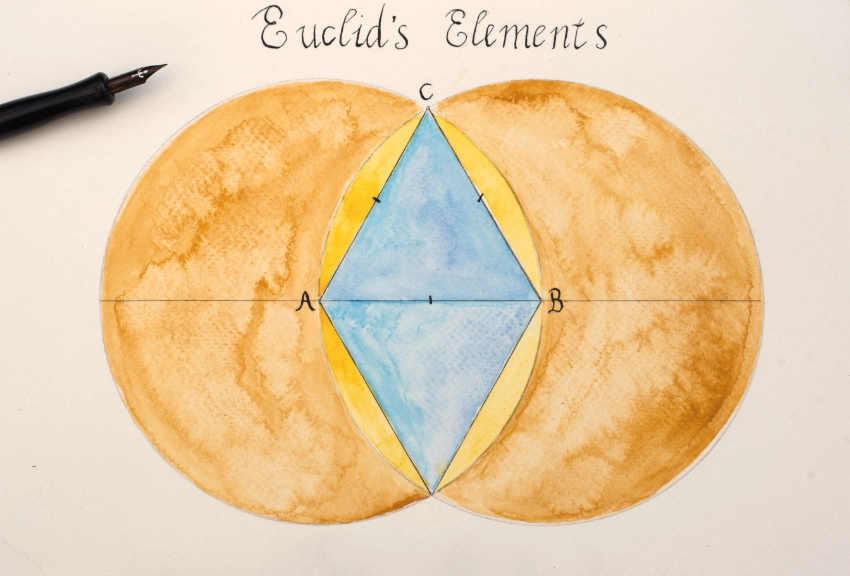
Start Exploring
Enter Sacred Mathematics through one of the existing Study Pathways.
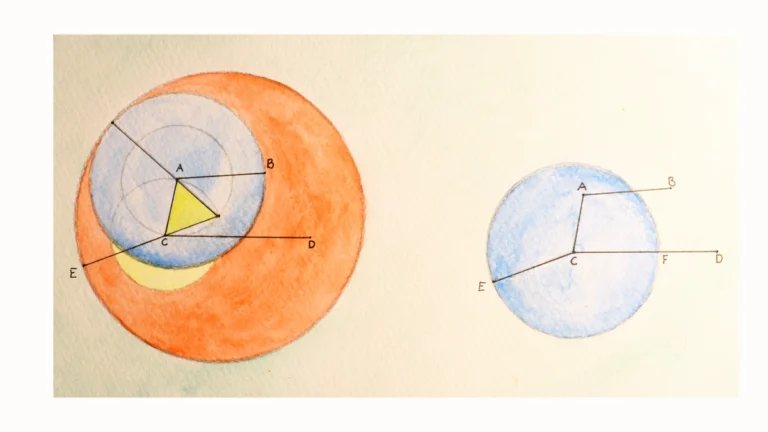
Euclid and Geometry
Explore construction, definition and proof through Euclid’s Elements.
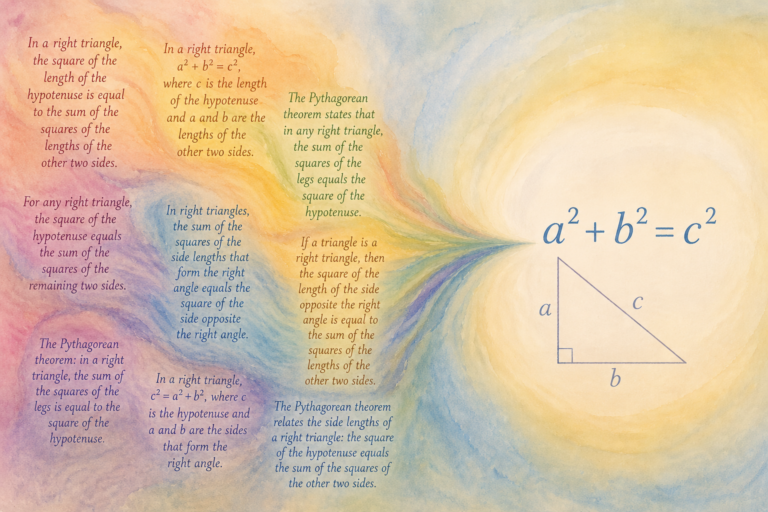
Mathematics and Language
Follow the movement from experience and words toward symbols, precision and abstraction.
Healing Our Relationship with Mathematics
Explore mathematical understanding as a human process of perception, thought and meaning.
Latest from Sacred Mathematics
Recent articles from the continuing exploration of mathematical thought, reasoning and proof.
-
The Mind Before Numbers
In the next series of articles, we are going to look at the development of the kinds of human reasoning that eventually made mathematical thought possible. How did humans move from a prehistoric way of experiencing the world to the abstraction of numbers? Our ability to reason symbolically and build knowledge across generations gave the human race unprecedented power. We became able to understand processes, predict outcomes and find ways of protecting ourselves and improving our lives. Over time, these abilities helped us move far beyond mere survival and gave us an extraordinary capacity to shape the world around us.
-
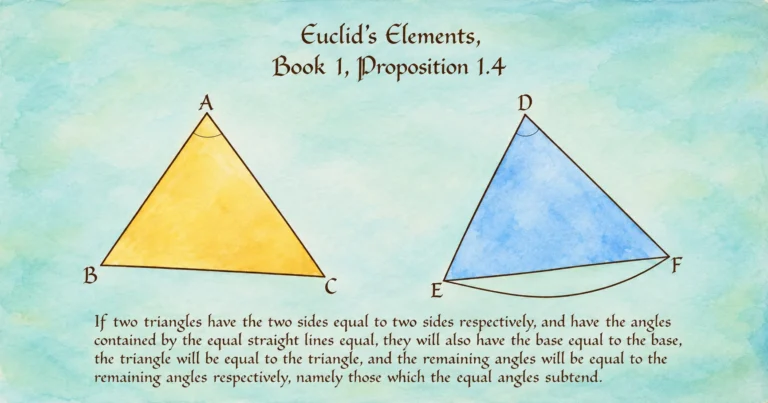
Euclid’s Elements, Book I, Proposition 4. From Geometric Construction to Deductive Reasoning
Euclid’s Elements – Proposition 1.4. Consider two triangles drawn on a piece of paper. They may appear to be identical, but how can we establish with certainty that they are equal? What conditions would be sufficient to prove that their corresponding sides and angles are equal, regardless of how the triangles are positioned?
-
Sacred Mathematics – The Journey Ahead
A reflection on the longing to understand the why behind mathematics and the journey ahead for Sacred Mathematics. The development of mathematical thought, reasoning and proof will be explored through history, alongside the study of Euclid’s Elements.


In Development
Awaken Your Inner Mathematician
A Course in Mathematical Reasoning
Sacred Mathematics is developing a learning programme for anyone who wants to understand mathematics more deeply. It is especially suited to Grade 11 and 12 students, students preparing for university-level mathematics, and adults returning to mathematics who want to strengthen conceptual understanding, reasoning and proof.
From procedure to reasoning
What changes when mathematics becomes something a student must explain, justify and connect?
Learning to read and write proofs
How definitions, assumptions and intermediate steps begin to form a readable mathematical argument.
Course architecture in progress
The emerging sequence moves through mathematical language, logic, proof, abstraction and independent mathematical study.
Where the Course Is Heading
01
Mathematical Thinking Diagnostic
Help identify where your mathematical thinking is strong, where conceptual gaps may lie, and what you need to work on next.
02
Introductory Learning
Begin strengthening the mathematical language, reasoning and conceptual understanding that deeper study depends on.
03
Mini-course
Develop these skills through a focused introduction to conceptual mathematical thinking.
04
Flagship Programme
Develop the reasoning, proof and independent study skills needed for deeper mathematical study.
The Sacred Mathematics learning programme is in development.
Follow Sacred Mathematics
Receive new Sacred Mathematics articles and occasional updates as the course develops.