Introduction
In the previous article, we explored Euclid’s Definitions 1–7. Since this article builds on these definitions, you can click on the link above if you need to refresh your memory.
In this article, we will take a deeper look at Euclid’s Definitions 8–12. They bring something remarkable to the table. They introduce the relationship between two lines on a plane in the form of an angle.
An angle cannot appear in emptiness. It needs a plane. It needs lines. Euclid has first prepared the world in which the angle can come into being. Only once the plane is present can lines meet within it, and only when lines meet can a new kind of geometric relationship arise.
A line on its own gives direction. But when two lines meet in a plane, direction is no longer considered alone. One line now stands in relation to another. Their meeting creates an inclination: an opening between the two lines that can be recognised, compared and named. This relationship was not present in either line by itself. It arises through their meeting. Euclid calls this relationship a plane angle.
An angle is often introduced to children as a corner, and this is a useful beginning. We see corners in rooms, books, tables, windows, doors, paths and buildings. But Euclid’s definition takes us beneath the visible corner and asks us to notice the relationship that gives the corner its form. The angle is not merely the place where two lines meet. It is the inclination of those lines towards one another.
This word, inclination, is important. It suggests leaning, tending, turning and opening. It shows that an angle is not only a shape to be seen, but a relationship to be understood. Through the angle, geometry begins to speak about how one direction stands in relation to another.
In Definitions 1–7, Euclid prepared the field of geometry: position, extension, extremity, surface and plane. In Definitions 8–12, he begins to show what can happen inside that field. Lines can meet within a plane. Their meeting does not simply create a point of contact. It introduces a new relation: the inclination of one line to another. This inclination can now be recognised, compared and named.
This is the birth of the angle: the moment when geometry moves from isolated extension into relationship.
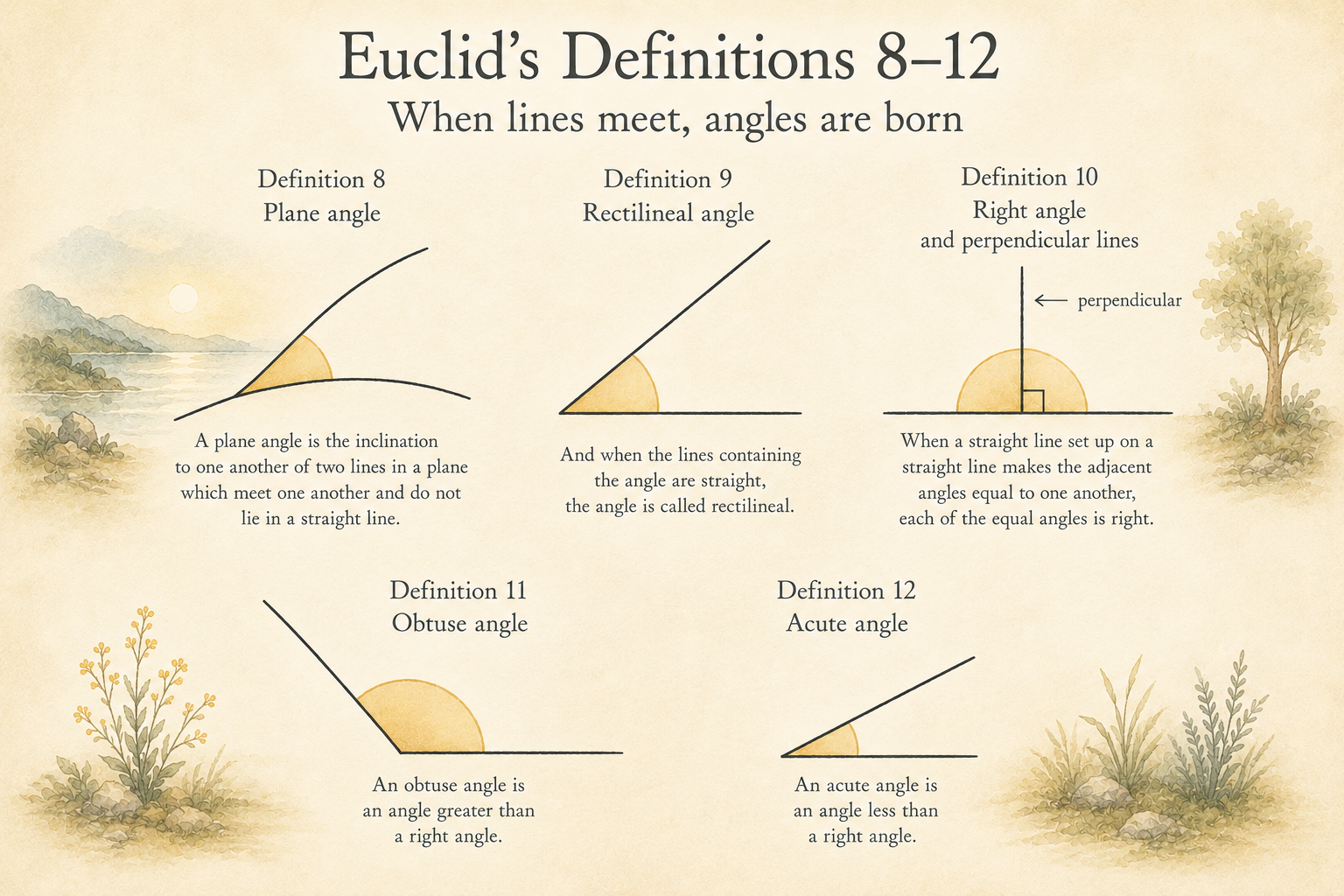
Euclid’s next five definitions state:
- A plane angle is the inclination to one another of two lines in a plane which meet one another and do not lie in a straight line.
- And when the lines containing the angle are straight, the angle is called rectilineal.
- When a straight line set up on a straight line makes the adjacent angles equal to one another, each of the equal angles is right.
- An obtuse angle is an angle greater than a right angle.
- An acute angle is an angle less than a right angle.
There is again a careful order in this sequence. Euclid first defines the angle as an inclination between two meeting lines in a plane. He then narrows this to the rectilineal angle, where the lines containing the angle are straight. After this, he introduces the right angle through equality. Only once the right angle has been established can the obtuse and acute angles be defined as greater than or less than a right angle.
There is a beautiful movement: the plane allows lines to meet; meeting gives rise to inclination; inclination becomes angle; the right angle gives comparison a standard; and acute and obtuse angles complete the first language of angular form.
With this understanding, let us now look at each of the definitions in more detail.
Definition 8: A plane angle is the inclination of two lines
In Heath’s English translation, Euclid’s Definition 8 states:
A plane angle is the inclination to one another of two lines in a plane which meet one another and do not lie in a straight line.
With Definition 8, geometry begins to speak more directly about relationship.
A line on its own gives direction. But when two lines meet in a plane, direction is no longer considered in isolation. One line now stands in relation to another. Between them there is an inclination: an opening formed by their meeting. This meeting gives us a new geometric relation. Euclid calls this relation a plane angle.
Euclid’s wording is precise here. The two lines must be in a plane. This keeps the definition within plane geometry. They must meet one another, because without meeting there is no angle of the kind Euclid is defining. They must also not lie in a straight line, because if the two lines simply continue in the same straight direction, there is no opening between them in the ordinary sense required by this definition. The angle appears when there is a difference of direction at the point of meeting.
The word inclination carries the heart of the definition. It points to the way one line is placed with respect to another. It suggests leaning, sloping, opening or tending towards. In mathematical terms, it allows us to speak about the relation between two directions. One line may meet another narrowly or widely. The opening may later be compared, named and classified. But before comparison can happen, Euclid first gives us the underlying idea: two lines meet, and their meeting creates an inclination.
This is the first moment in Euclid’s definitions where relation becomes more important than isolated form. The point, line, surface and plane prepared the field. Now, through the angle, geometry begins to describe how elements within that field stand in relation to one another.
The angle is therefore not merely a corner drawn on a page. A drawn corner may help us see it, just as a drawn point or line helps us think. But the mathematical angle is the relation itself: the inclination of two meeting lines in a plane. Through this definition, Euclid gives geometry a new language – the language of direction, meeting and comparison.
Definition 9: When the containing lines are straight, the angle is rectilineal
Euclid’s ninth definition states:
And when the lines containing the angle are straight, the angle is called rectilineal.
After defining a plane angle as the inclination of two meeting lines in a plane, Euclid now makes the definition more specific. He gives a name to the kind of angle formed when the lines containing the angle are straight. This kind of angle is called rectilineal.
This matters because Euclid is now naming the kind of angle formed when straight lines meet. Triangles and quadrilaterals are later defined as rectilineal figures because they are contained by straight lines; their angles are therefore rectilineal angles.
Yet this does not mean that the angle belongs to a world of straight lines alone. In Euclid’s geometry, straight lines and circles work together from the beginning of construction. The first proposition uses two circles to construct an equilateral triangle on a given finite straight line.
The rectilineal angle is a clarification of the angle’s boundaries: the angle is contained by straight lines. But around the point where those lines meet, the surrounding plane remains present, and the circle will later become one of the most powerful ways to make that surrounding field measurable and constructible.
So Definition 9 should be understood carefully. It simply identifies a particular kind of angle: an angle contained by straight lines. This is the angle needed when Euclid later speaks about triangles, quadrilaterals, right angles, acute angles, obtuse angles and rectilineal figures.
Definition 10: The right angle
Euclid’s tenth definition states:
When a straight line standing on a straight line makes the adjacent angles equal to one another, each of the equal angles is right, and the straight line standing on the other is called a perpendicular to that on which it stands.
With this definition, Euclid gives the right angle a special place in the geometric world. He does not introduce it by saying that a right angle measures 90 degrees. He does not begin with a number. He begins with a relationship of equality.
A straight line stands on another straight line. At the point where they meet, two adjacent angles are formed. If those two adjacent angles are equal to one another, then each of them is called a right angle. The right angle is therefore not first presented as a fixed numerical amount, but as one of two equal angles made when one straight line stands on another.
This is a powerful shift for the modern reader. Many students first meet the right angle as “90°”, and although this is useful, it can hide the deeper structure of the idea. In Euclid’s definition, the right angle arises from balance. One straight line meets another in such a way that the angular space on one side is divided into two equal adjacent angles. Equality is doing the defining work.
This also connects the right angle to the idea of perpendicularity. When the straight line standing on another creates equal adjacent angles, the two lines are said to be perpendicular. So Euclid is not only naming a kind of angle; he is also naming a particular relation between straight lines. The right angle and the perpendicular line belong together.
This is important because the right angle becomes a standard for comparison. Once the right angle has been defined, Euclid can define an obtuse angle as greater than a right angle and an acute angle as less than a right angle. Without the right angle, those next two definitions would have no clear reference point. The right angle becomes the measure against which other angles can first be recognised.
Here again, Euclid’s order is important. He moves from inclination, to rectilineal angle, to right angle, and only then to greater than and less than. The right angle gives angular comparison its first stable standard. It is the point at which the language of angle begins to organise itself.
The circle is still not part of this definition. Euclid is defining the right angle through straight lines and equality. Yet, as with Definition 9, the surrounding plane remains present. The meeting of the lines occurs within a plane, and the equal adjacent angles are formed around a point of meeting.
This is what makes the definition so meaningful. Before the right angle becomes 90 degree it is a balanced structure.
Through Definition 10, the angle becomes more than an opening between two lines. It becomes something that can be equal, compared and used as a standard. The right angle gives geometry one of its most enduring forms of order: the meeting of straight lines in a balanced relationship.
Definition 11: The obtuse angle
Euclid’s eleventh definition states:
An obtuse angle is an angle greater than a right angle.
This definition is brief, but it depends on everything Euclid has just prepared. An obtuse angle can only be understood after the right angle has been defined. The right angle gives geometry a standard, and the obtuse angle is then recognised by comparison with that standard.
It is important to notice that Euclid does not define the obtuse angle by saying that it is “more than 90 degrees”. That is the modern numerical way of speaking. In Euclid’s sequence, the obtuse angle is defined more structurally: it is greater than a right angle. The right angle comes first as a relation of equality between adjacent angles; the obtuse angle then appears as an angle whose opening exceeds that standard.
So the obtuse angle is not recognised by appearance alone. It is recognised through comparison. One angle has already been established as right; another angle may open more widely than that. The word greater now enters the language of angular form. Geometry is no longer only naming inclination. It is beginning to compare one inclination with another.
This also prepares the way for Euclid’s later classification of triangles. A triangle can be called obtuse-angled when it contains an obtuse angle. In other words, the definition of the obtuse angle becomes part of the language through which figures themselves are later understood. Euclid’s later definition of an obtuse-angled triangle depends directly on this earlier definition of the obtuse angle.
The obtuse angle therefore shows that angular form can now be compared. One opening may be greater than another. The right angle gives the standard, and the obtuse angle marks the movement beyond it.
Definition 12: The acute angle
Euclid’s twelfth definition states:
An acute angle is an angle less than a right angle.
Like the obtuse angle, the acute angle depends on the right angle. Without the right angle, the phrase “less than a right angle” would have no clear standard. Euclid first establishes the right angle through equality, and only then can other angles be compared with it.
In the same way as in the definition of the obtuse angle, Euclid does not say that an acute angle is an angle less than 90 degrees. That is the later numerical language of angle measure. In Euclid’s order, the acute angle is defined through comparison: it is less than a right angle. The right angle remains the standard, and the acute angle is recognised as an angle whose opening is smaller than that standard.
The word acute often suggests something sharp or narrow, and this can be helpful as an image. But the mathematical definition does not depend on appearance alone. A narrow-looking angle is not called acute merely because it looks sharp. It is acute because it is less than a right angle. Once again, comparison is doing the work.
With the acute angle, Euclid completes the first basic language of angular comparison. An angle may be equal to a right angle, greater than a right angle, or less than a right angle. These three possibilities give geometry a way to recognise and name angular form before numerical measurement enters the discussion.
This also prepares the way for Euclid’s later classification of triangles. A right-angled triangle is one that has a right angle. An obtuse-angled triangle is one that has an obtuse angle. An acute-angled triangle is one that has three acute angles. So the language introduced in Definitions 10–12 becomes part of the way figures themselves are later understood.
Angles in the Physical World: Movement, Weight and Force
Euclid defines the angle as an inclination between lines in a plane. At first this may seem like a purely geometric idea, something belonging to diagrams, definitions and proofs. But the relationship of angles is not confined to the page. In the physical world, angles shape how forces act, how weight is distributed, how movement becomes possible and how machines such as ramps, levers and pulleys do their work.
This is because force has direction. In physics, force is treated as a vector: it has both magnitude and direction. Once direction matters, angles matter too. The angle at which a force acts can change how much of that force contributes to movement in one direction, how much presses into a surface and how much produces rotation. OpenStax summarises force as a vector quantity with both magnitude and direction, and vector components can be found from an angle using sine and cosine.
A simple inclined plane shows this beautifully. Gravity still pulls the block vertically downward, but the slope changes the relationship between that downward force and the surface on which the block rests. On a flat surface, the block’s weight is directed into the surface. On a slope, the same weight can be understood in two parts: one part presses the block into the plane, and another part pulls it down the plane. As the angle of the incline becomes larger, the pull down the slope increases, while the pressure into the slope decreases.
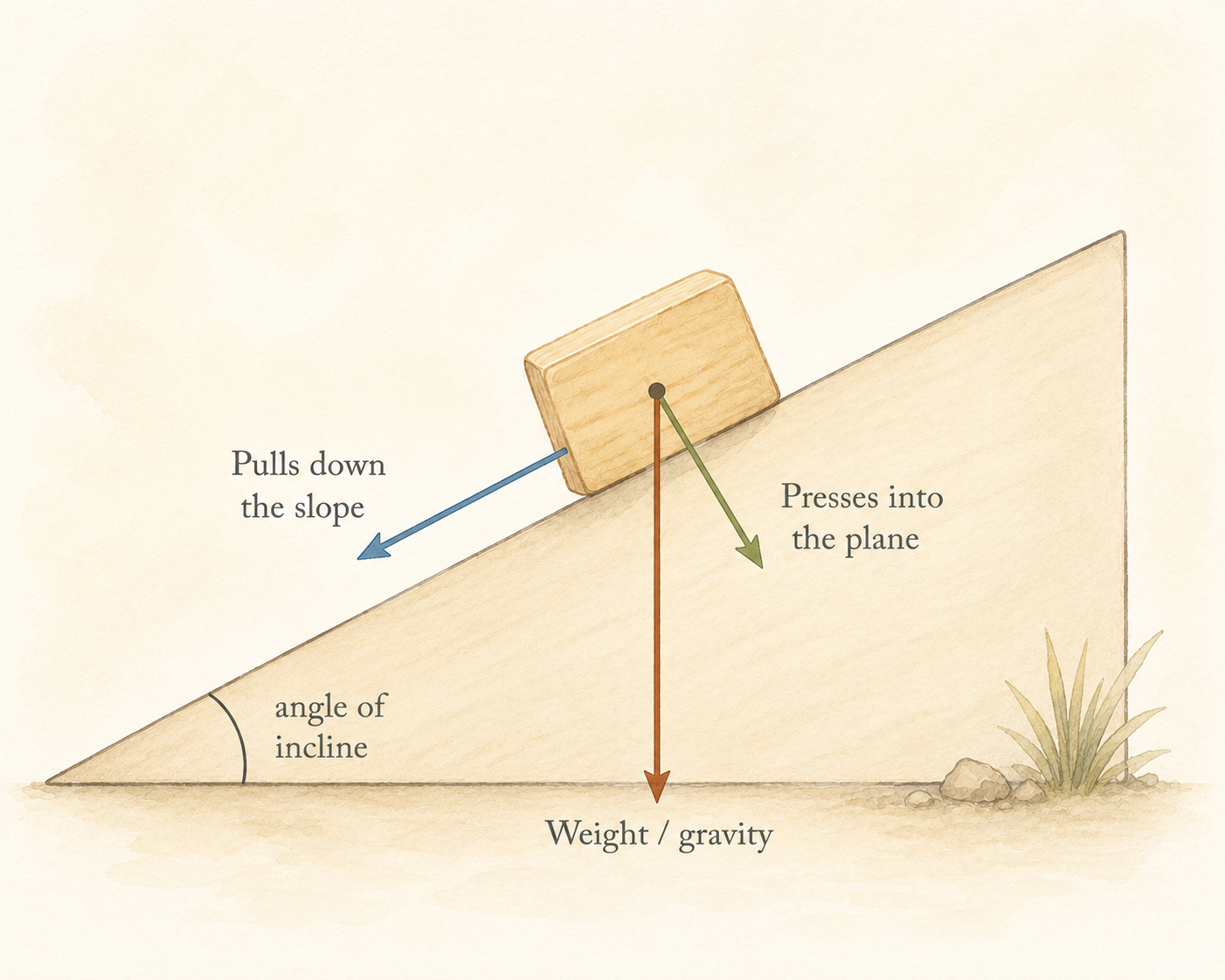
This is one of the physical consequences of angular relation. The weight has not changed, but its effect has changed because the surface is inclined. A shallow ramp and a steep ramp do not ask the body to deal with weight in the same way. The angle alters the relationship between the object, gravity and the supporting surface. In this sense, an angle is not merely a visible opening. It becomes a condition for movement.
The same principle appears in levers and rotation. When a force is applied to something that can turn around a pivot, the effect of the force depends not only on how strong the force is, but also on the angle at which it is applied. In physics, this turning effect is called torque. The magnitude of torque depends on the force, the distance from the pivot and the angle between the force and the lever arm. A force applied at a more effective angle can produce more rotation than the same force applied poorly.
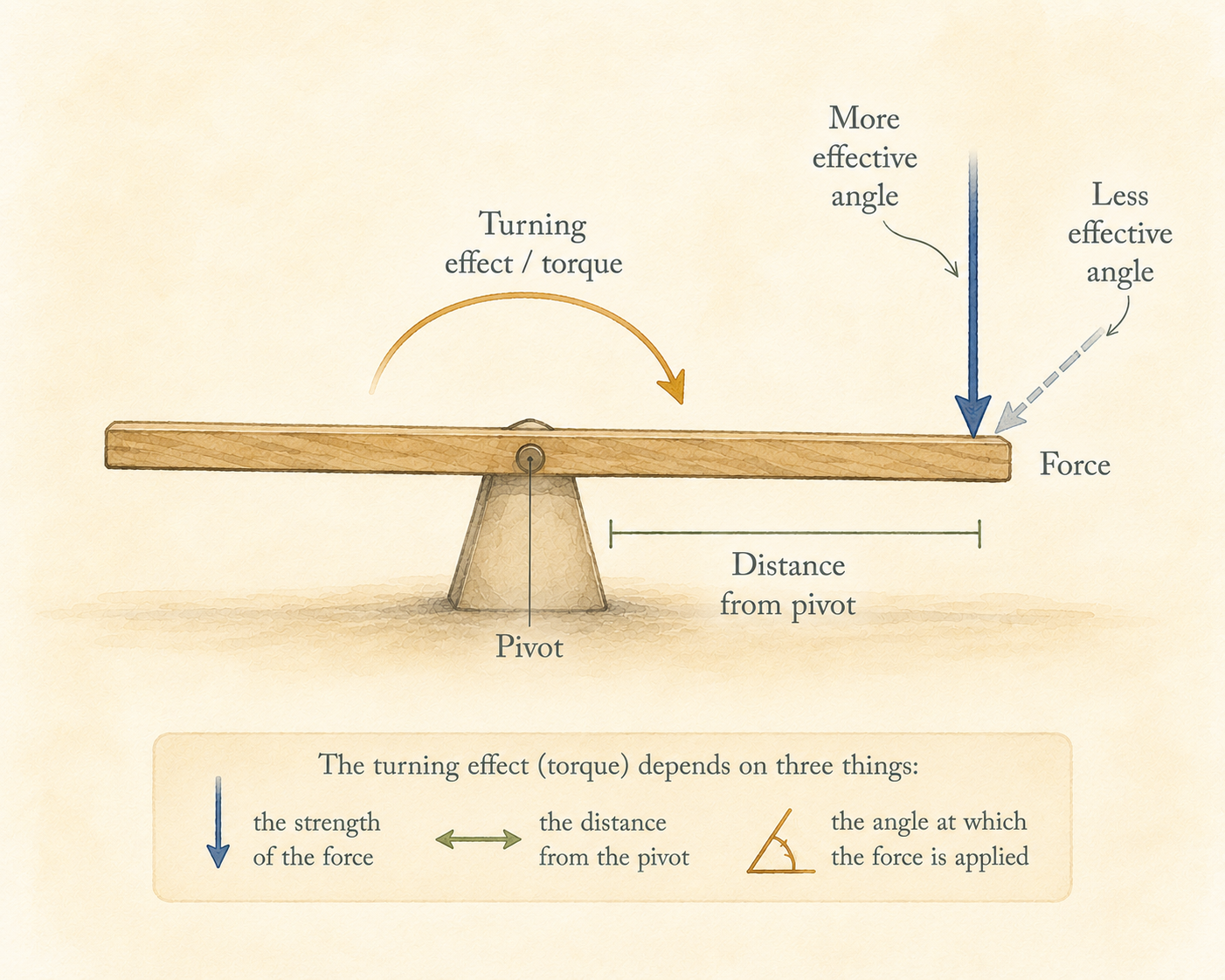
This is why doors, spanners, seesaws and joints in the body all reveal the reality of angles. Push a door near its hinge and it is difficult to move. Push it near the handle and it opens easily. Push in a direction that is poorly aligned and much of the effort is wasted. Push at a better angle and the same body can produce a greater turning effect. The angle now has a measurable physical effect.
Pulleys give another example. A pulley can change the direction in which a rope applies a force. In an ideal pulley system, with a massless rope and frictionless pulley, the tension is treated as having the same magnitude throughout a continuous rope, even though the rope path changes direction. More complex pulley systems can create mechanical advantage when several rope segments support the movable load. The geometry of the rope path matters because each segment pulls along its own direction, and the combined effect depends on those directions.
Here again, angles are not ornamental. The rope may carry tension, but that tension acts along the direction of the rope. If the rope passes over a pulley, the direction in which the rope can exert tension changes. If several rope segments meet a load from different angles, their vertical and horizontal components must be considered. In a symmetrical arrangement, sideways components may cancel; in an asymmetrical one, they may not. The physical result depends on the geometry of direction.
This is why the angle is such a profound step in Euclid’s definitions. Once two lines meet, the mind begins to see relation between directions. In physics, that relation becomes force, balance, movement, resistance and rotation. The right angle becomes especially important because perpendicular directions allow us to separate effects clearly: one component may act along a surface, while another acts into it; one force may create rotation, while another may contribute less.
So the angle belongs both to thought and to the world. On the page, it allows geometry to compare inclination. In the body, in tools and in machines, it helps determine what moves, what holds, what turns and what bears weight.
Euclid gives us the formal language of angular relation; the physical world shows us its consequences.