Euclid’s Proposition 2: Reproducing a Length at Another Point
Introduction
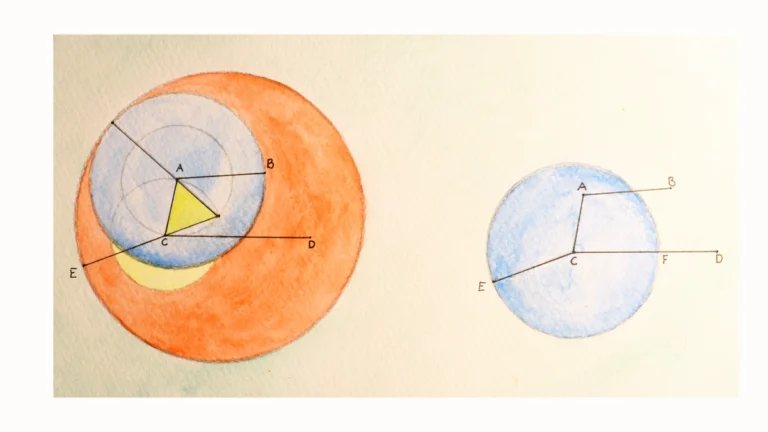
At first glance, Euclid’s second proposition in Book I appears deceptively simple. We are given a point A and a straight line BC. The task is to construct a new straight line with A as one of its endpoints, and to make this new line exactly equal in length to BC. The original segment BC remains where it is. Euclid’s problem is to reproduce its length from the given point A.
The problem seems easy enough to modern eyes, yet Euclid solves it through a surprisingly intricate and elegant construction involving the equilateral triangle established in Proposition I.1, two circles and a chain of equal lengths. In doing so, he begins to reveal one of the great strengths of the Elements: each new construction grows from what has already been established, and a seemingly simple task becomes an opportunity to show how equality can be preserved and demonstrated through geometric relationships.
1. The Proposition
Let’s start with the actual wording of the second proposition in Heath’s translation:
“To place at a given point (as an extremity) a straight line equal to a given straight line.”
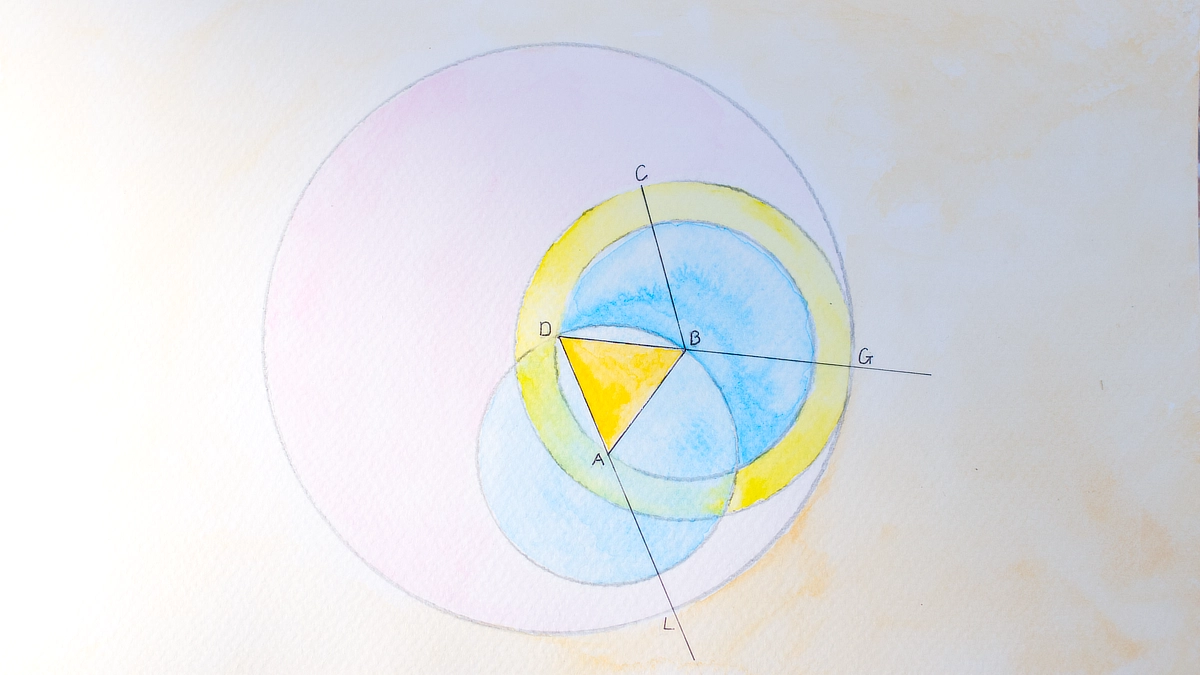
Euclid makes the task more explicit immediately afterwards: “Let A be the given point, and BC the given straight line.” The task at hand is to construct a straight line beginning at point A, whose length is equal to the length of BC. In the completed construction this new straight line will be AL, so the proposition ultimately establishes that
AL=BC
The point A and the given straight line BC are not required to share an endpoint or specify that they occupy any particular position relative to one another.
The proposition sounds simple once the wording is understood. What makes it interesting is the question of how Euclid is going to establish that equality using only the constructions and principles available to him at this early point in the Elements.
2. A Problem That Seems Almost Too Simple
To a modern reader, the problem may seem to have an immediate solution. We can set a compass to the length BC, carry that opening to the point A, and reproduce the same distance there. In practical terms, this is straightforward. The equality of the two lengths is preserved through the physical instrument: we trust that the compass opening remains unchanged as it is moved from one position to another.
Euclid approaches the problem from within the logical structure he is building in the Elements. He still relies extensively on geometric construction, including circles, yet each new step proceeds from what has already been given, postulated or proved. The required equality emerges through a sequence of relationships established within the construction itself.
This gives Proposition I.2 a deeper significance than its simple statement first suggests. Euclid is working from two givens – a point A and a straight line BC – and must bring them into a single geometric structure from which the required length can arise. The construction develops step by step, with each relationship creating the conditions for the next.
What makes the proposition so compelling is the way the desired equality grows out of the structure Euclid creates. Rather than treating the length BC as something simply carried from one place to another, he builds a configuration in which an equal length must eventually appear at the given point A.
3. What Euclid Already Has Available
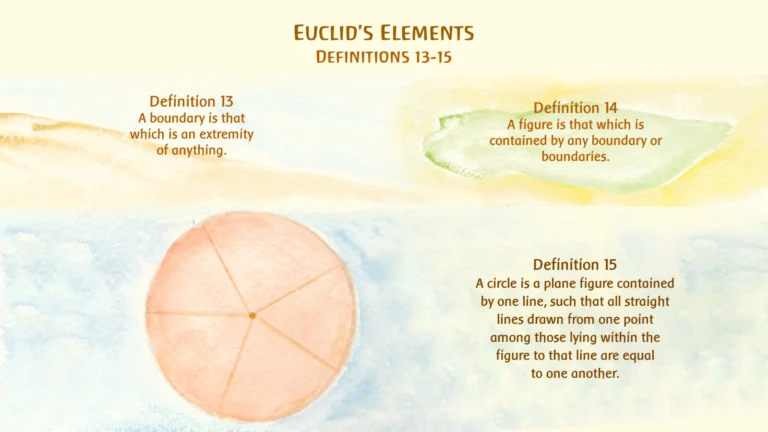
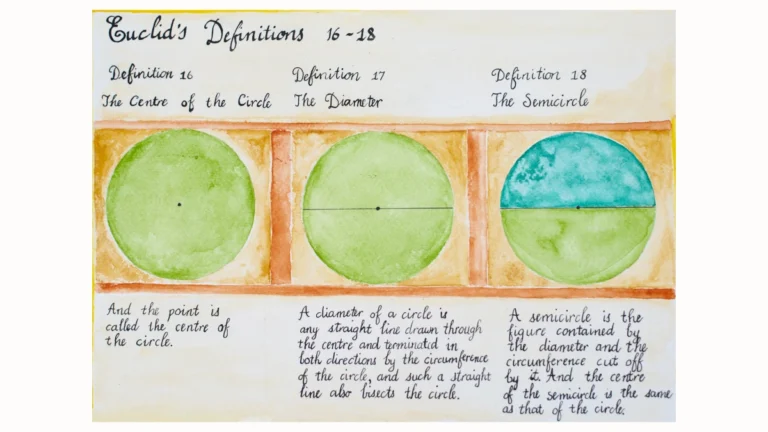
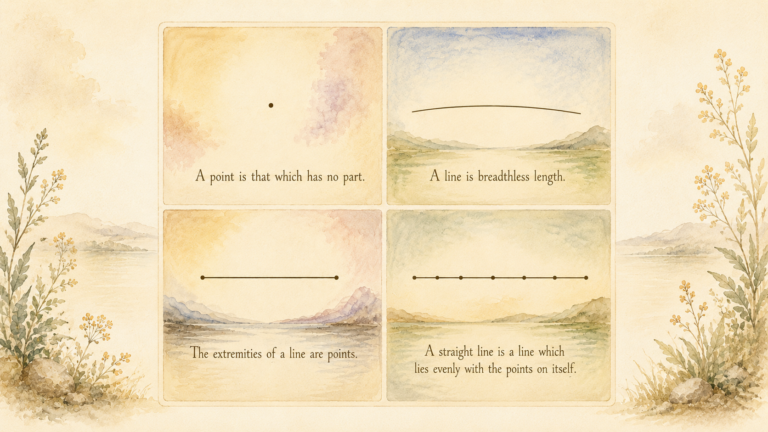
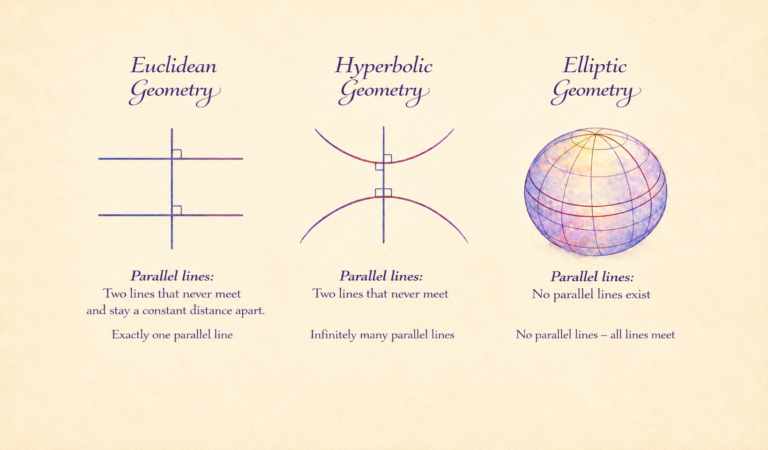
Let us take a closer look at what Euclid already has available at this point in the Elements:
- The definitions – the basic geometric concepts used in Book I, including point, line, straight line, circle, centre, diameter and rectilinear figures.
- The five postulates – including the ability to draw a straight line between two points, extend a finite straight line, and describe a circle with any centre and distance.
- The Common Notions – general principles of equality and reasoning, such as “things which are equal to the same thing are also equal to one another” and “if equals be subtracted from equals, the remainders are equal.”
- Proposition I.1 – the construction of an equilateral triangle on a given finite straight line.
The definitions give Euclid the basic geometric concepts with which he is working, while the postulates state the constructions and assumptions he is permitted to use. The Common Notions provide general principles of equality and reasoning that apply beyond geometry itself. Proposition I.1 then adds the first demonstrated construction: on a given finite straight line, an equilateral triangle can be constructed.
In Proposition I.2 we are beginning to see the architecture of the Elements take shape. Euclid does not treat each proposition as an isolated problem. Earlier definitions, assumptions and demonstrated constructions become resources that later propositions can draw upon. Proposition I.2 therefore offers an early glimpse of the cumulative structure that will characterise the work as a whole: each result becomes part of the foundation from which further results can be established.
4. The Construction
Drawing 1: Connecting the Givens and Establishing Equality
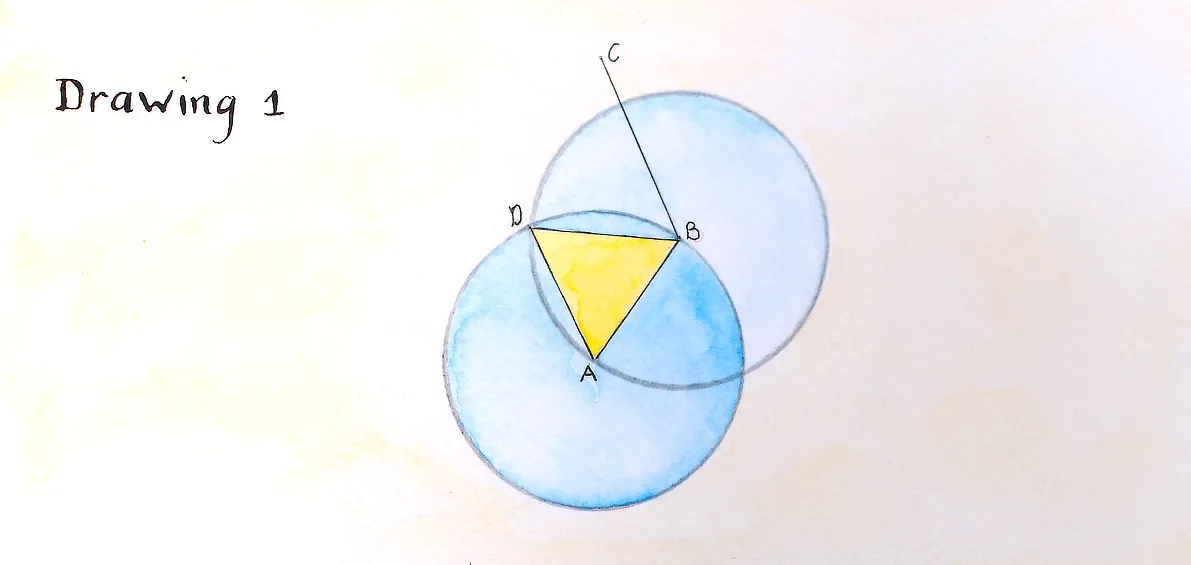
Euclid begins with two givens: the point A and the straight line BC. His first move is to join A to B, one extremity of BC, with the straight line AB. In doing so, the given point and the given straight line are brought into a single connected construction. He then uses Proposition I.1 to construct the equilateral triangle DAB on AB.
The equilateral triangle introduces the first essential equality:
DA=DB
From the new point D, the points A and B now lie at equal distances. This gives Euclid two equal starting lengths DA = DB from which the rest of the construction can develop.
This is the foundation for everything that follows. Euclid has first connected the two givens and then created an equal geometric framework around the points A and B. The next step will be to bring the magnitude of BC into that framework.
Drawing 2: Extending the Equality by the Given Magnitude
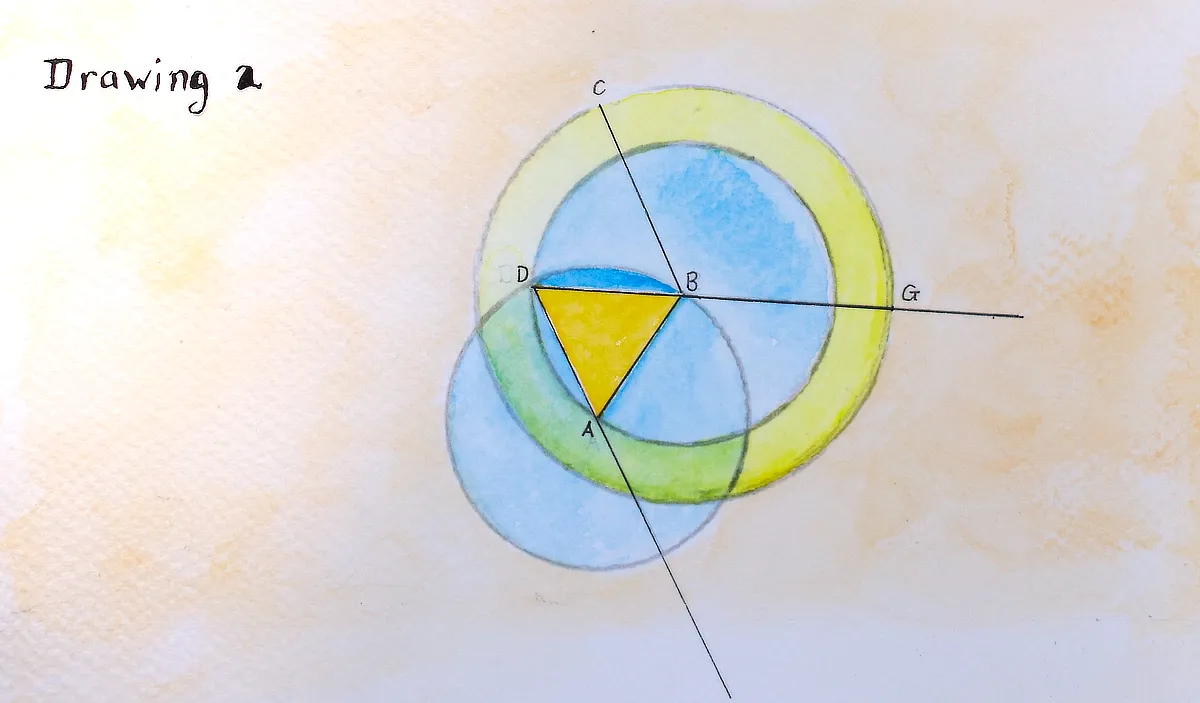
Euclid now extends the side DB of the equilateral triangle beyond B. He then constructs a circle with center B and radius BC. The extended line DB meets this circle at G. Because B is the center of the circle, BC and BG are equal radii.
BC=BG
This is the next essential step in the construction. The given magnitude BC has now been introduced directly into the geometric framework created by the equilateral triangle. The equal starting length DB has effectively been extended by a further length BG equal to the original segment BC.
The whole distance from D to G is therefore made up of
DB + BG = DG
Since BG=BC, the given magnitude has effectively been added to one side of the equality established by the equilateral triangle. Euclid himself does not formulate the construction in this additive way, but the interpretation helps make the underlying structure visible.
Drawing 3: Creating Equal Wholes and Revealing the Required Length
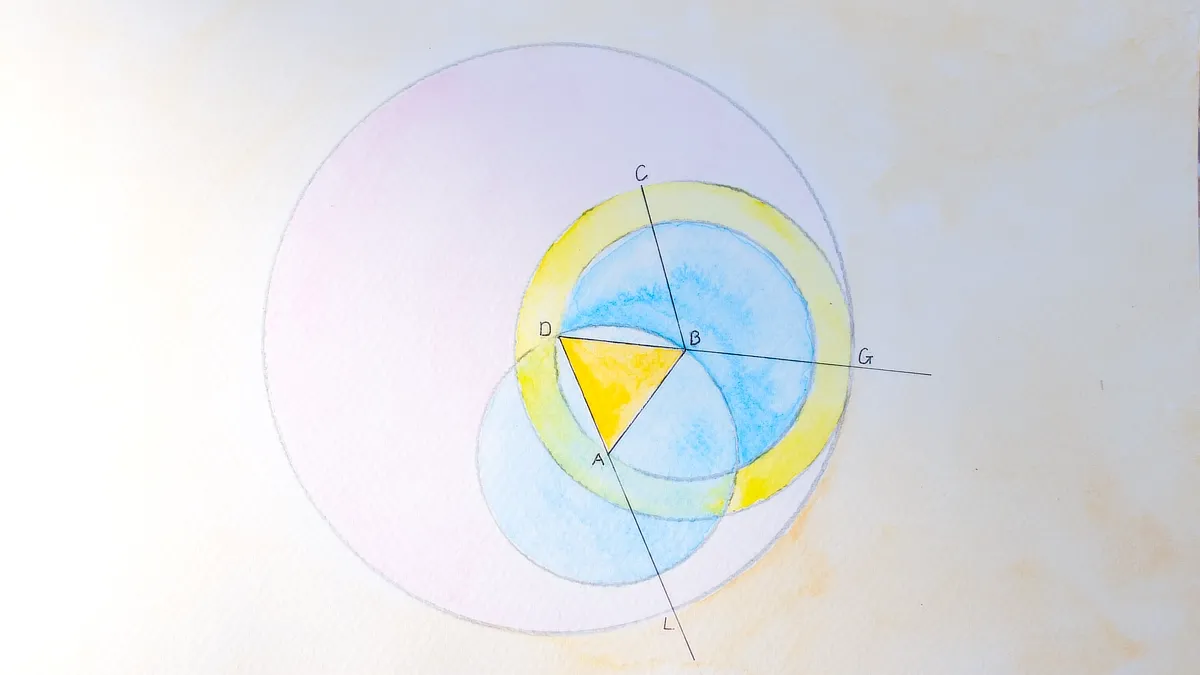
Euclid now extends DA beyond A. With center D and distance DG he constructs a second circle. The extended line meets this circle at L. Because D is the centre of the circle, the two radii are equal:
DL=DG
The significance of this step lies in the way the new circle reproduces the whole distance DG on the other side of the construction. We already know from the equilateral triangle that
DA=DB.
The two equal wholes DL and DG therefore contain equal initial parts, DA and DB. What remains beyond those equal parts must also be equal. Euclid invokes Common Notion 3: if equals are subtracted from equals, the remainders are equal. Hence,
AL=BG.
But the first circle has already established that
BG=BC
Therefore, by Common Notion 1, things equal to the same thing are equal to one another,
AL=BC.
The construction is complete. The given magnitude BC, which was first added to the equal length DB, now appears as the corresponding remainder beyond the equal length DA. The equality established at the beginning of the construction has allowed the original magnitude to emerge at the required point A.
It is interesting to note that the pattern may feel familiar to us from algebra, although Euclid’s reasoning here is entirely geometric.
Another way of understanding
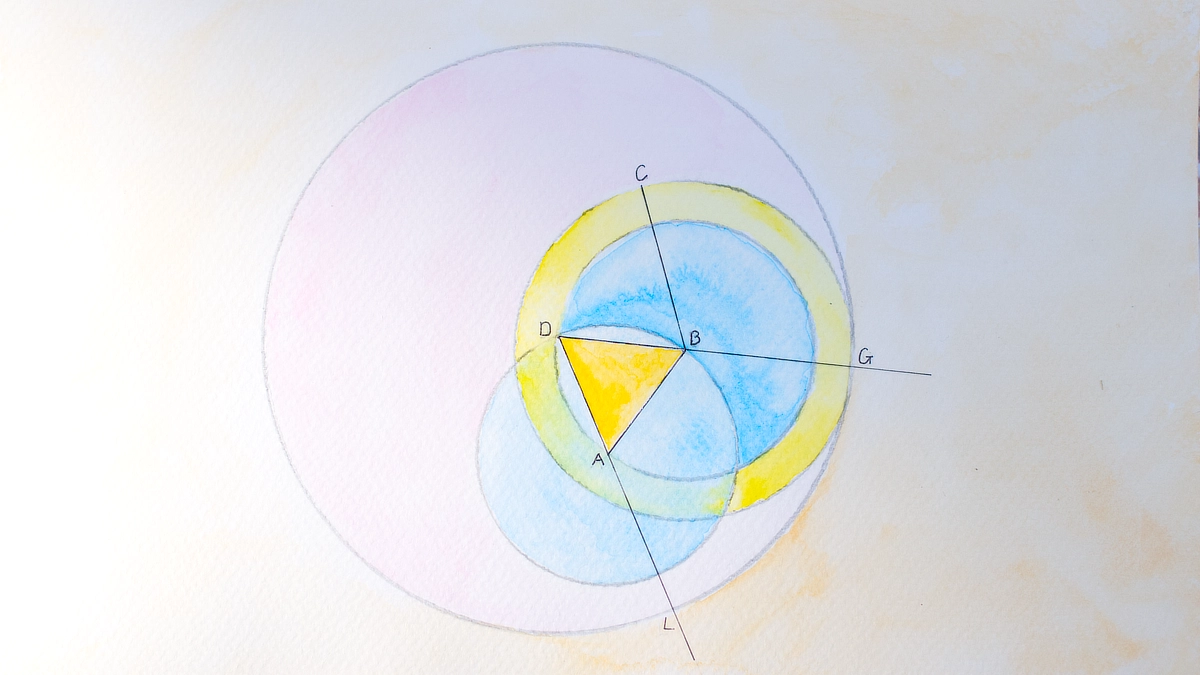
Another way of understanding the construction is to look at the equal structure created by the equilateral triangle. Since DA=DB, if DB is extended by a further length equal to BC, then a circle drawn from D with the resulting whole length as its radius will create an equal whole on the other side. In modern explanatory terms, this gives
DA+AL=DB+BC,
and because DA=DB it follows that
AL=BC.
Euclid achieves the extension of DB by drawing a circle with center B and radius BC. The extended line DB meets this circle at G, so BG=BC. The whole length DG therefore consists of DB together with a further length equal to BC.
Closing thoughts
Proposition I.2 is a small construction with a surprisingly rich internal logic. Euclid begins with a point and a given length, establishes equality between two starting distances, extends one side by the given magnitude, and then creates an equal whole from which the required length emerges as the corresponding remainder. The construction shows how carefully prepared relationships can make a result inevitable.
It also gives us an early glimpse of the architecture of the Elements. Proposition I.1 has already become a tool for Proposition I.2, and Proposition I.2 is immediately drawn upon in Proposition I.3. Euclid’s geometry develops cumulatively, with each established result opening the way to further constructions and proofs.
References
Euclid. The Thirteen Books of Euclid’s Elements. Translated from the text of Heiberg, with introduction and commentary by T. L. Heath. Vol. I: Introduction and Books I–II. Cambridge: Cambridge University Press, 1908. Proposition I.2.
Joyce, David E. “Euclid’s Elements, Book I, Proposition 2.” Department of Mathematics and Computer Science, Clark University. Commentary on the construction, its dependence on Postulates 1–3 and Proposition I.1, and the traditional “collapsing compass” interpretation.
Wilkins, David R., ed. “Euclid, Elements of Geometry, Book I, Proposition 2 (Heath, 1908).” Trinity College Dublin. Digital transcription of Heath’s 1908 edition.
OpenAI. ChatGPT (GPT-5.6 Sol). Assisted with research, source identification, fact-checking and editorial refinement under the direction of the author. All mathematical claims were checked against reputable primary and secondary sources.
Continue exploring the Euclid series on Study Pathways.