
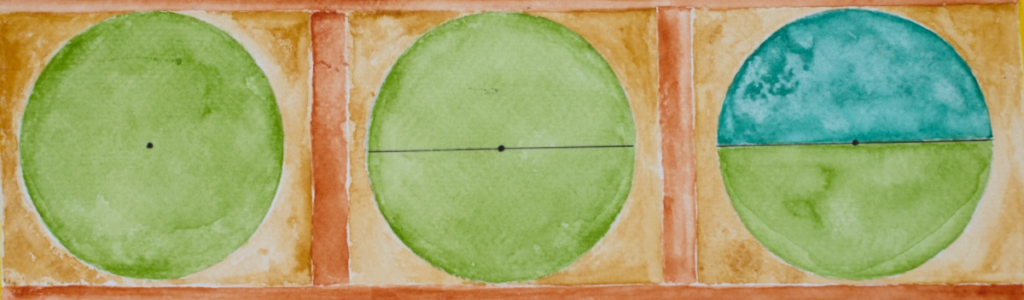
Euclid and Geometry
A progressive exploration of the foundations of Euclidean geometry
These articles are arranged as a reading path through Book I of Euclid’s Elements. Beginning with the definitions, the sequence moves through the foundations of geometric reasoning and into Euclid’s first propositions. Each article builds upon ideas established earlier, so the pathway is best followed in order.
Definitions
Point, line, angle, boundary, figure and form
Foundations
Postulates, axioms and common notions
Propositions
Construction, proof and deductive reasoning
The Reading Path
Follow the sequence from the first definitions through to Euclid’s third proposition.
-
Geometry: Euclid’s Definitions 1 – 7: A Deeper Exploration
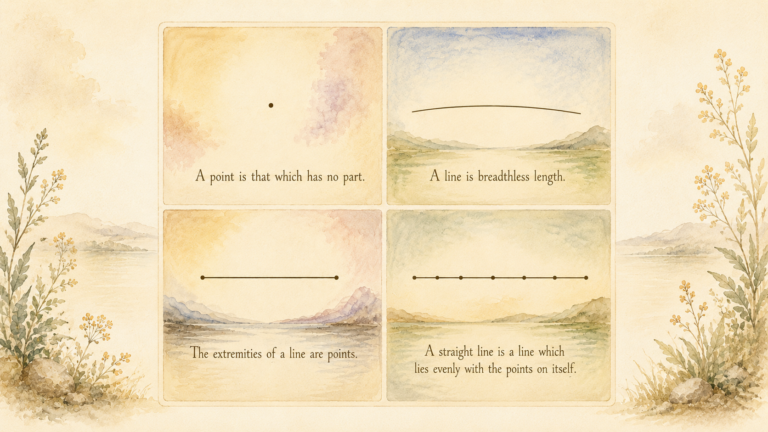
This article explores Euclid’s Definitions 1–7, where geometry begins with the most fundamental ideas: point, line, surface and plane surface. These definitions may seem simple at first, but they prepare the mind for the whole structure of geometry. Step by step, Euclid leads us from the smallest conceivable position toward extension, boundary and form. These early definitions show that geometry does not begin with complicated shapes, but with learning how to think clearly about space itself.
-
Euclid’s Definitions 8–12: Discover the Hidden Power of Angles
Explore Euclid’s Definitions 8–12 and discover how angles arise from the relationship between meeting lines, shaping geometry, force, movement and mechanics. A line on its own gives direction. But when two lines meet in a plane, direction is no longer considered alone. One line now stands in relation to another. Their meeting creates an inclination: an opening between the two lines that can be recognised, compared and named. This relationship was not present in either line by itself. It arises through their meeting.
-
Euclid’s Definitions 13–15: Boundary, Figure and Circle
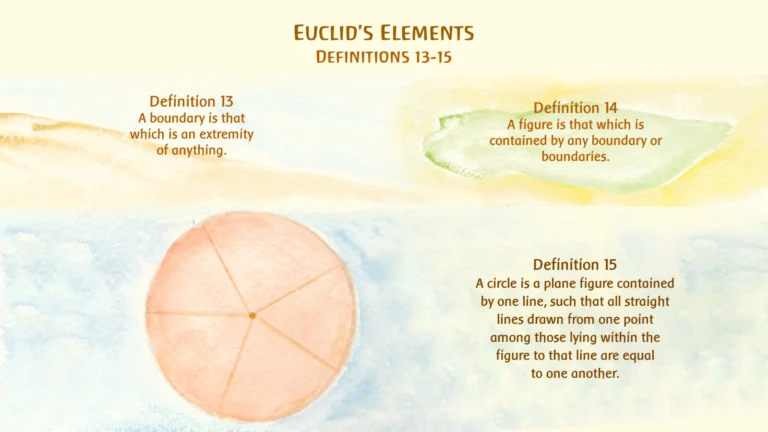
In Euclid’s Definitions 13-15, geometry begins with three profound ideas: boundary, figure and circle. A boundary gives form its limit, a figure gathers space into wholeness and the circle reveals one of the most beautiful acts of abstraction – equality around a centre.
-
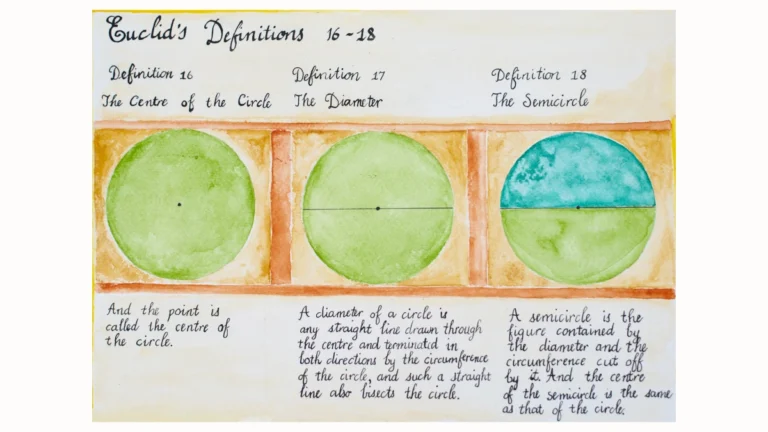
Euclid’s Definitions 16–23
Euclid’s Definitions 16–23 move from the parts of a circle to the classification of rectilinear figures. Through the diameter, semicircle, triangles, quadrilaterals and parallel lines, Euclid establishes the precise language needed to distinguish geometric forms and reason about their relationships.
-
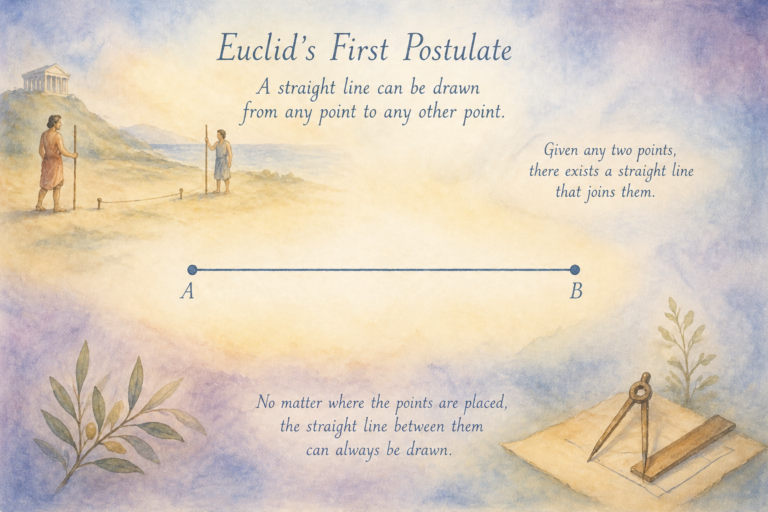
Euclid’s Postulates: The Foundations of Geometry
Euclid’s postulates establish the conditions under which geometry can become active. While definitions determine what geometric objects are and axioms govern how reasoning holds together, the postulates grant the fundamental permissions through which lines may be drawn, circles formed and constructions extended. From these few carefully chosen beginnings, the entire structure of Euclidean geometry is able to unfold.
-
How Axioms Determine the Foundation of Mathematical Reasoning
This article explores Euclid’s axioms, or Common Notions, and the role they play in forming the foundation of mathematical reasoning. Before geometry can move with certainty, it must rest on truths that are accepted as self-evident. But this raises a question beyond mathematics: what are the axioms beneath our own thinking? What hidden assumptions determine the way we reason, choose and meet the world?
-
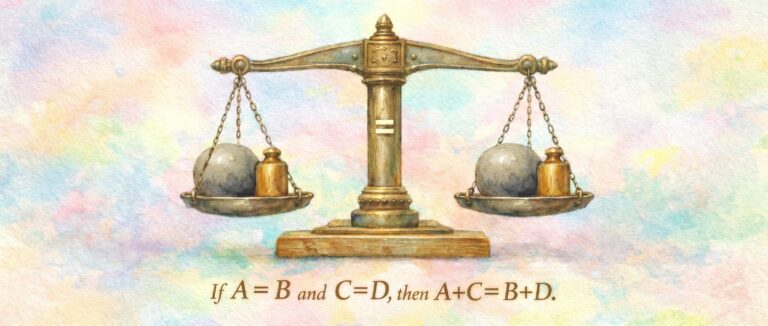
Euclid’s Common Notions or Axioms: The Ground of Geometric Reasoning
This article explores Euclid’s axioms, also known as the Common Notions. These simple statements form the foundation beneath geometric reasoning. They speak about equality, comparison and the way thought can move from one truth to another with certainty. Before Euclid constructs complex figures or proves difficult propositions, he first asks us to accept these basic relationships. The axioms show that geometry is not built from diagrams alone. It is built from clear thinking.
-
Equilateral Triangle: Classic Proof that the Sides Are Equal
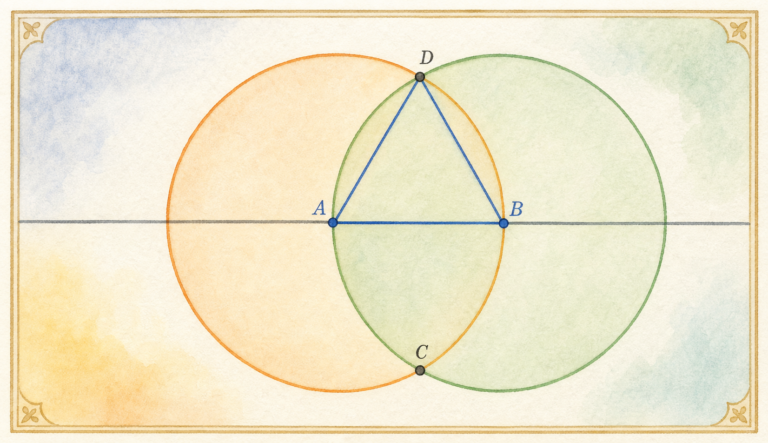
This article explores Euclid’s first proposition: the construction of an equilateral triangle on a given straight line. What looks like a simple triangle is actually the first full movement of Euclidean proof. Using only a straightedge, compass and the equality created by two circles, Euclid shows how a figure can be constructed with certainty. The proof reveals how geometry moves from definition and postulate into reasoned construction, where each step follows clearly from what has already been granted.
-
Euclid’s Proposition 2: The Same Length, Somewhere Else
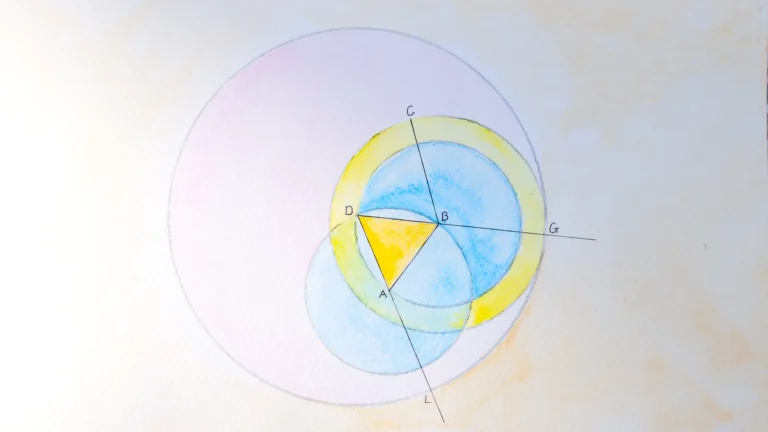
Follow Euclid’s second proposition as an equilateral triangle and two circles reproduce a given length from a new point, showing how geometric relationships preserve and establish equality.
-
Euclid’s Elements, Book I, Proposition 3
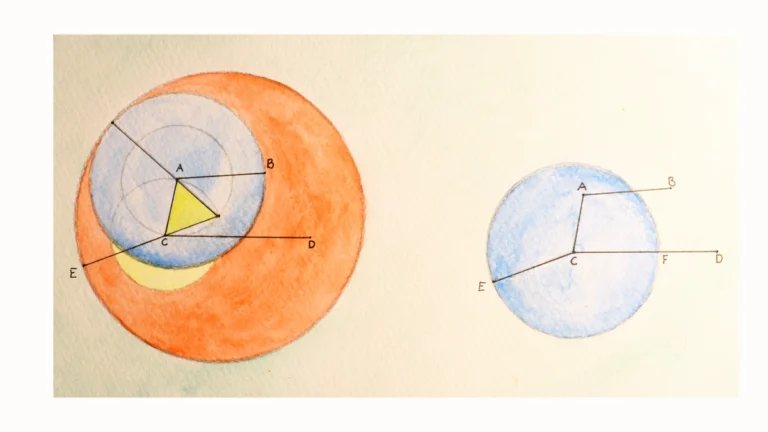
In Euclid’s Proposition I.3, a length is cut from a greater straight line so that it equals a lesser one. Follow the construction and proof, and explore how the first three propositions develop equality, the transfer of length and geometric subtraction.
When you are ready to explore another area of Sacred Mathematics, return to the Study Pathways page.