From Words to Symbols
Symbols are often misunderstood as a departure from reality – as if abstraction were a form of distancing or simplification that strips experience of its richness. In mathematics especially, symbols are sometimes treated as cold replacements for meaning, a shorthand that sacrifices depth for efficiency. Yet this view mistakes what symbols actually do.
A symbol does not replace experience; it condenses it.
Symbols emerge when words reach their limit. Words carry texture, history, and ambiguity. This makes them powerful, but also unstable. When thought needs to move with greater precision – when relationships must hold across many situations without drifting – language begins to refine itself. At this point, symbols appear not as an escape from meaning, but as its careful distillation.
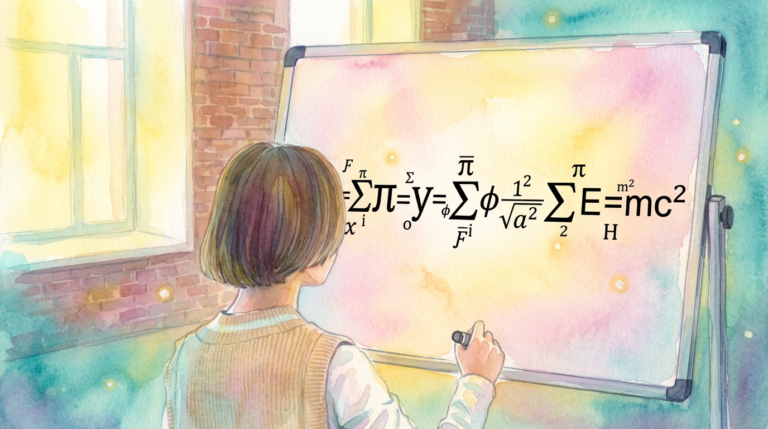
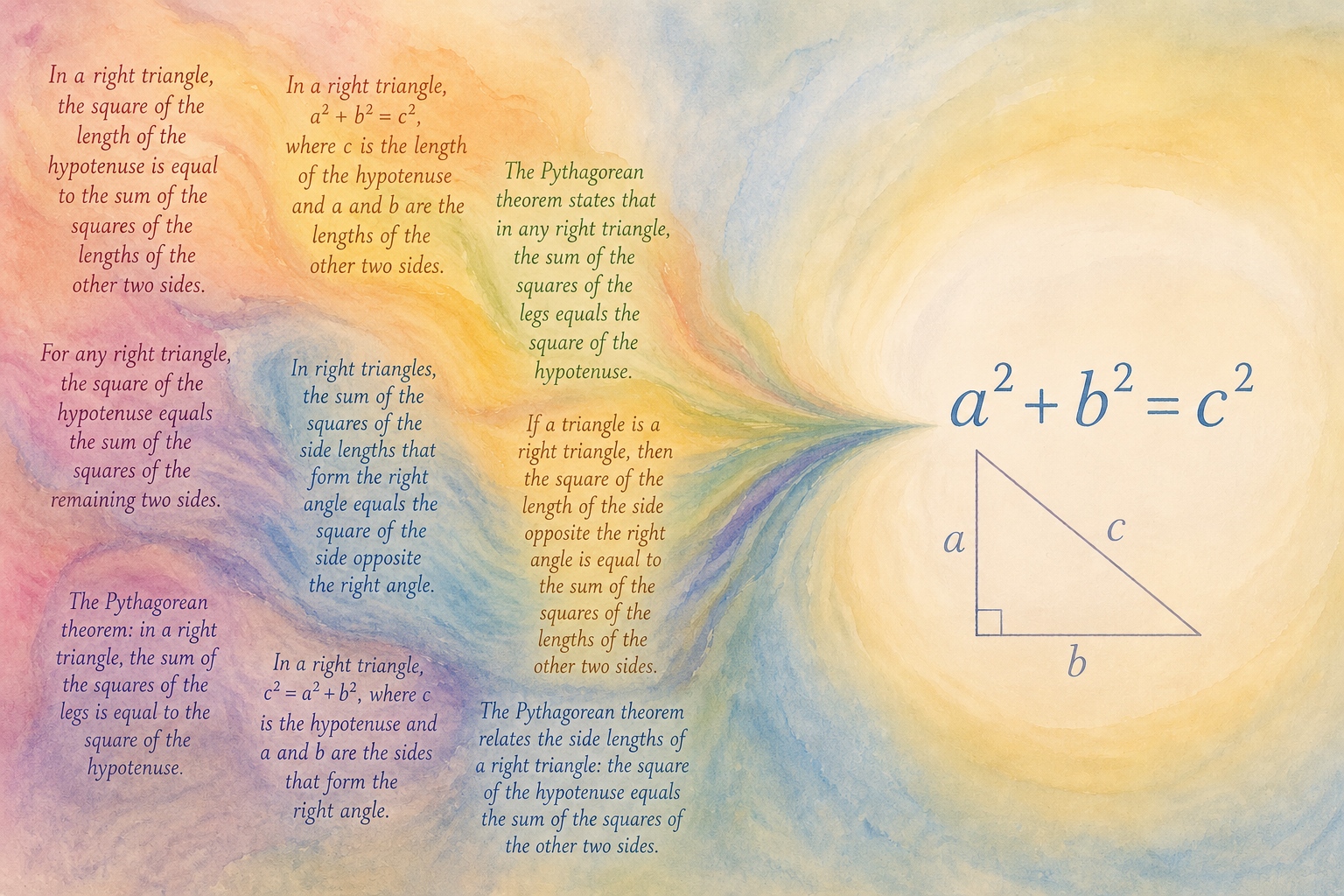
In mathematics, a symbol gathers a relationship rather than an object. Consider a simple expression. It does not describe a particular thing; it holds a pattern that can be instantiated again and again. The symbol is not meaningful because it looks like something familiar, but because it behaves consistently. Meaning here is not visual or emotional first, but relational.
This is where abstraction reveals its true nature. To abstract is not to remove oneself from reality, but to isolate a structure that persists across many concrete cases. The abstraction is anchored in experience, even if that anchor is no longer visible on the surface. When abstraction is done well, it allows thought to move without losing coherence.
The danger arises when symbols are introduced too early, before their experiential roots have been formed. Then they feel empty, arbitrary, or oppressive. This is not a failure of abstraction itself, but of timing. A symbol without lived grounding becomes a shell. It demands manipulation without offering understanding.
Mathematical education often stumbles here. Symbols are presented as starting points rather than culminations. Students are asked to operate within a symbolic system before they have felt the need for it. The result is alienation, not because mathematics is inhuman, but because its language has been detached from its origin in meaning-making.
When symbols are allowed to emerge organically, they feel different. They feel inevitable. They arrive as a relief – a way to hold complexity without drowning in detail. At this point, abstraction does not thin reality; it clarifies it. It reveals what is invariant beneath surface change.
This is why mature mathematical thinking often circles back toward simplicity. Not because it has become naïve, but because it has learned how little needs to be said for meaning to remain intact. A well-chosen symbol can carry more truth than many paragraphs of explanation, precisely because it respects the structure it represents.
Seen in this light, mathematics is not a flight from the world, but a deep listening to it. Symbols are not barriers to understanding; they are vessels forged through long attention. They allow thinking to move freely without forgetting where it began.
To learn mathematics in this way is to participate in a discipline of care: care for meaning, care for structure, care for the fragile bridge between experience and expression. Abstraction, then, is not the opposite of intuition. It is intuition that has learned how to hold itself steady.
This article forms part of a series of nine articles tracing how language becomes mathematics. All nine articles are now available together in a 57-page PDF for your convenience – for the price of a coffee, US$4.