Introduction
In the first three propositions of Euclid’s Elements, we explored how geometric figures can be constructed using only a compass and straightedge. We also began to see how Euclid builds his reasoning upon a small number of definitions, postulates and common notions.
As we move on to Proposition I.4, we encounter some particularly interesting developments in the way mathematical reasoning unfolds.
Consider two triangles drawn on a piece of paper. They may appear to be identical, but how can we establish with certainty that they are equal? What conditions would be sufficient to prove that their corresponding sides and angles are equal, regardless of how the triangles are positioned?
So let us take a closer look at Proposition I.4, where Euclid introduces a method of proof that has also raised some interesting questions about the logical foundations of geometry.
Proposition I.4 – The Equality of Two Triangles
Euclid begins by considering two triangles in which two sides of the one are respectively equal to two sides of the other, and the angles contained between these sides are also equal.
He sets out to prove that the bases of these triangles must be equal, that the remaining corresponding angles are equal, and that the two triangles themselves are equal.
Today, we recognise this as the Side-Angle-Side (SAS) congruence theorem.
The proposition may seem quite obvious when we look at a diagram. But Euclid is concerned with establishing why the conclusion necessarily follows from the given conditions.
His approach is particularly interesting. He imagines placing one triangle upon the other and shows that, because of the given equalities, the corresponding sides and vertices must coincide.
This method is known as superposition.
At this point, a deeper question arises. Euclid’s postulates allow us to draw straight lines and circles, but do they explicitly allow us to move a geometric figure from one position to another without changing its size or shape?
This question is worth exploring, because it brings us directly to the relationship between what appears self-evident in geometry and what has actually been established through logical reasoning.
Following Euclid’s Proof
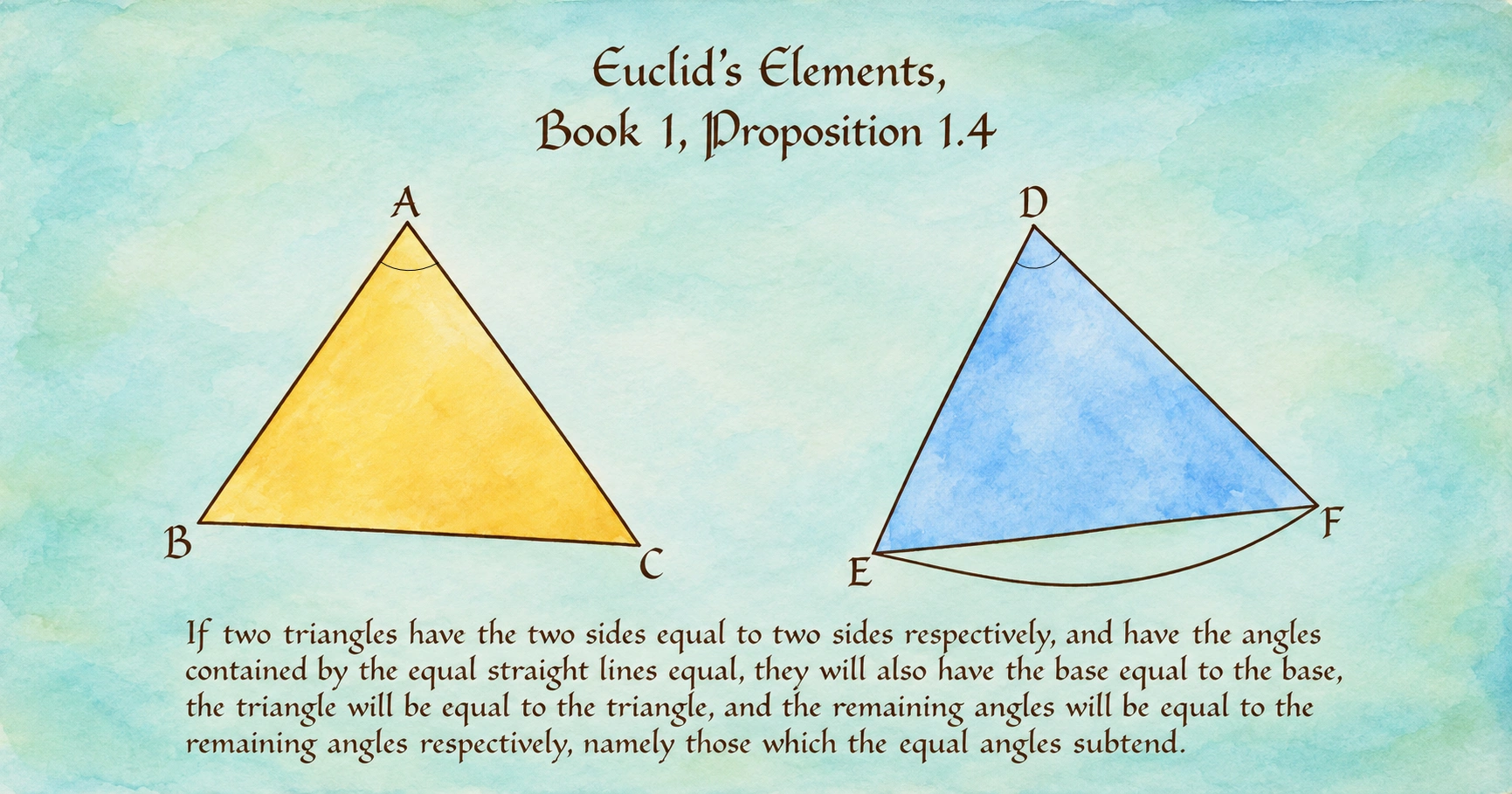
Let us consider two triangles, ABC and DEF.
We are given that two sides of triangle ABC are equal to two corresponding sides of triangle DEF:
AB = DE
AC = DF
We are also given that the angles contained between these sides are equal:
∠BAC = ∠EDF
From these three conditions, Euclid sets out to prove that the remaining sides and angles are also equal.
How does he proceed?
He asks us to imagine placing triangle ABC upon triangle DEF, so that point A coincides with point D and side AB lies directly upon side DE.
Since AB and DE are equal in length, point B must coincide with point E.
Now consider the second pair of sides, AC and DF.
Because the angles BAC and EDF are equal, AC will lie along DF when the triangles are placed in the corresponding orientation. And because these two sides are also equal in length, point C must coincide with point F.
We have now established that all three vertices of the triangles coincide.
But what about their bases?
Since B coincides with E and C coincides with F, the straight line joining B to C must coincide with the straight line joining E to F.
Euclid reasons that if the two bases did not coincide, two distinct straight lines would enclose a space between the same endpoints, which is impossible.
He can therefore conclude that:
BC = EF
The triangles themselves coincide, and their remaining corresponding angles must also be equal.
Here Euclid invokes his fourth common notion:
Things which coincide with one another are equal to one another.
The proof is complete.
A Closer Look at Superposition
There is something worth examining more carefully in Euclid’s argument.
If we draw two triangles on separate pieces of paper, cut them out and place one upon the other, it seems perfectly reasonable that we can establish their equality by seeing whether their sides and vertices coincide.
But Euclid is working within a deductive mathematical system. Every conclusion must follow from what has already been established or accepted as a starting principle.
This raises an interesting question.
What allows us to move a geometric figure from one position to another while assuming that its lengths and angles remain unchanged?
Euclid’s first three postulates permit us to draw straight lines, extend them and construct circles. They do not explicitly establish that a geometric figure can be moved without changing its dimensions.
His fourth common notion tells us that things which coincide are equal. But this is a different statement from saying that figures satisfying certain conditions can always be brought into coincidence.
The distinction is subtle, but important.
Euclid’s proof depends upon the possibility of superposition, and the justification for this operation is not fully developed within his stated postulates.
Mathematicians and philosophers have subsequently examined this question in considerable depth. Some have interpreted superposition as the actual movement of one figure upon another, while others have understood it as an ideal comparison of geometric figures.
In modern geometry, the preservation of lengths and angles under rigid transformations can be treated explicitly, while alternative axiomatic approaches establish triangle congruence through carefully stated assumptions.
This does not diminish the importance of Euclid’s proposition. It gives us an opportunity to examine the foundations upon which mathematical reasoning rests.
A proof can appear perfectly convincing when we follow its geometric construction. Yet a closer examination may reveal assumptions that we have accepted without recognising them.
This is one of the valuable disciplines of studying Euclid: we learn to ask precisely what has been given, what has already been established, and why each conclusion must follow.
The Importance of Proposition I.4
With Proposition I.4, Euclid establishes a result that will be used repeatedly throughout the Elements.
We now know that if two triangles have two corresponding sides equal and the included angles equal, then their remaining corresponding sides and angles must also be equal.
This is what we call the Side-Angle-Side congruence theorem.
It means that we need only establish three particular equalities to deduce several others.
This is a powerful development in mathematical reasoning. Once a relationship has been proved, we can use it as a foundation for further conclusions without having to establish it again each time.
We shall see this immediately in Proposition I.5, where Euclid uses the equality of triangles to prove a property of the isosceles triangle.
The reasoning now begins to build upon itself.
Direct translation of Euclid’s Elements, Book 1, Proposition 1.4 – Thomas L. Heath’s English Translation (1908).
Proposition 4
If two triangles have the two sides equal to two sides respectively, and have the angles contained by the equal straight lines equal, they will also have the base equal to the base, the triangle will be equal to the triangle, and the remaining angles will be equal to the remaining angles respectively, namely those which the equal angles subtend.
Let ABC, DEF be two triangles having the two sides AB, AC equal to the two sides DE, DF, respectively, namely AB to DE and AC to DF, and the angle BAC equal to the angle EDF.
I say that the base BC is also equal to the base EF, the triangle ABC will be equal to the triangle DEF, and the remaining angles will be equal to the remaining angles respectively, namely those which the equal sides subtend, that is, the angle ABC to the angle DEF, and the angle ACB to the angle DFE.
For, if the triangle ABC be applied to the triangle DEF,
and if the point A be placed on the point D
and the straight line AB on DE,
then the point B will also coincide with E, because AB is equal to DE.
Again, AB coinciding with DE, the straight line AC will also coincide with DF, because the angle BAC is equal to the angle EDF;
hence the point C will also coincide with the point F, because AC is again equal to DF.
But B also coincided with E;
hence the base BC will coincide with the base EF.
[For if, when B coincides with E and C with F, the base BC does not coincide with the base EF, two straight lines will enclose a space: which is impossible.
Therefore the base BC will coincide with EF] and will be equal to it. [C.N. 4]
Thus the whole triangle ABC will coincide with the whole triangle DEF,
and will be equal to it.
And the remaining angles will also coincide with the remaining angles and will be equal to them,
the angle ABC to the angle DEF,
and the angle ACB to the angle DFE.
Therefore etc.
(Being) what it was required to prove.
What Does Q.E.D. Mean?
Did you notice the change in Euclid’s closing words?
In the first three propositions, where Euclid is concerned with geometric constructions, Heath’s translation ends with the words “(Being) what it was required to do.”
But Proposition I.4 is a theorem. This time the conclusion is “(Being) what it was required to prove.”
This is where our familiar mathematical abbreviation Q.E.D. comes from. It stands for the Latin quod erat demonstrandum, meaning “which was to be demonstrated.” The Latin phrase translates the Greek ὅπερ ἔδει δεῖξαι (hoper edei deixai).
It marks the completion of the proof. What was set out to be demonstrated has now been established.
Heath’s preceding words, “Therefore etc.”, are his own abbreviation. Rather than repeat the entire statement of the proposition, he indicates that the original conclusion follows.
Closing Thoughts
When reading the above, I became aware of how wonderful it is that we can still read the thoughts of such a great mind who lived more than 2,000 years ago. This human being has shaped humanity’s way of thinking in ways I am sure he could not even have begun to imagine at the time.
References
- Euclid. (1908). The Thirteen Books of Euclid’s Elements, Volume I, Books I–II. Translated with introduction and commentary by Sir Thomas L. Heath. Cambridge University Press. Read Book I, Proposition 4 – Heath’s translation.
- Joyce, D. E. Euclid’s Elements – Book I, Proposition 4. Online edition with mathematical commentary, including a discussion of superposition and its logical foundations. Read the proposition and commentary.
- MacTutor History of Mathematics, University of St Andrews. Earliest Known Uses of Some of the Words of Mathematics (Q). Historical discussion of Q.E.D., its Greek origin and its use in mathematical proofs. Read the historical reference.
AI Assistance
OpenAI’s ChatGPT (2026) was used to assist with research, mathematical explanations, drafting and proofreading. The conceptual framework, final interpretations, wording and editorial decisions remain my own.
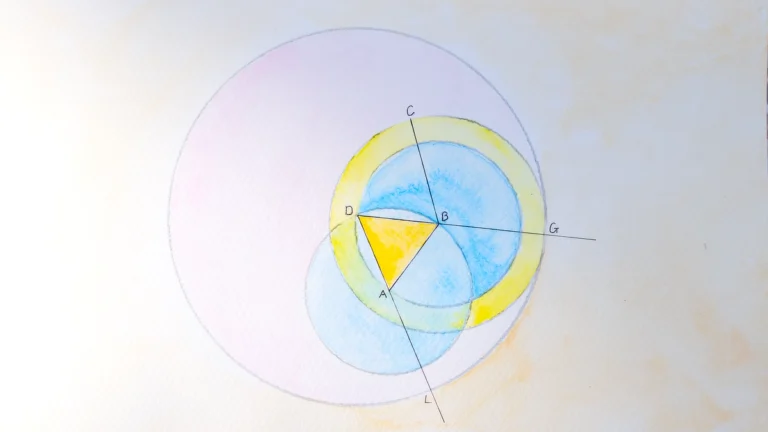
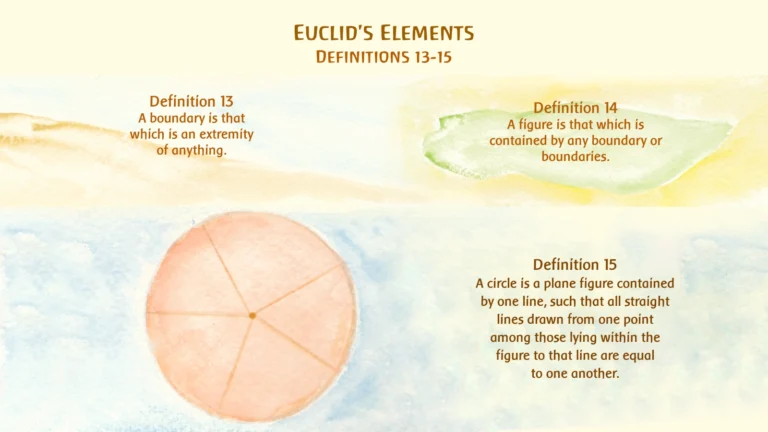
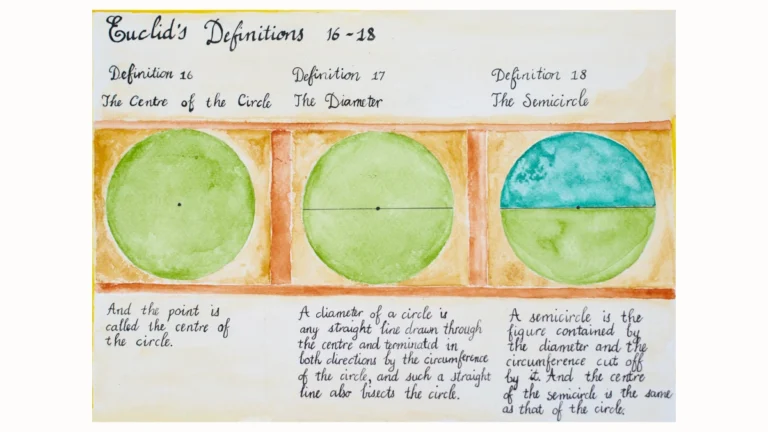
Watercolour illustration: Original artwork created by Lydia J van Vuuren