Introduction
Euclid’s Proposition I.3 appears, at first, to be a very simple construction. Given two unequal straight lines, Euclid asks us to cut off from the greater a length equal to the lesser. Yet this small step marks an important development in the logic of the Elements.
In Proposition I.2, Euclid established how a given length could be reproduced at a new point. Proposition I.3 immediately puts that ability to use. Once a length can be transferred, it can be brought into relation with another length, compared with it, and used to divide it. What begins as a geometric construction starts to reveal something more general: magnitude can be preserved even when position changes.
The proposition therefore introduces an idea that will become increasingly important throughout Euclid’s work. A length is no longer tied only to the particular line on which it first appears. Its magnitude can be carried into a new construction and used to determine an equal segment on another straight line. In modern terms, we might recognise here the beginnings of geometric subtraction – expressed through construction rather than through symbolic notation.
What Is Euclid Asking Us to Do?
Thomas L. Heath translates Proposition I.3 as:
“Given two unequal straight lines, to cut off from the greater a straight line equal to the less.”
Euclid’s task is therefore very precise. We are given two straight lines of unequal length, and from the greater we must cut off a segment equal to the lesser.
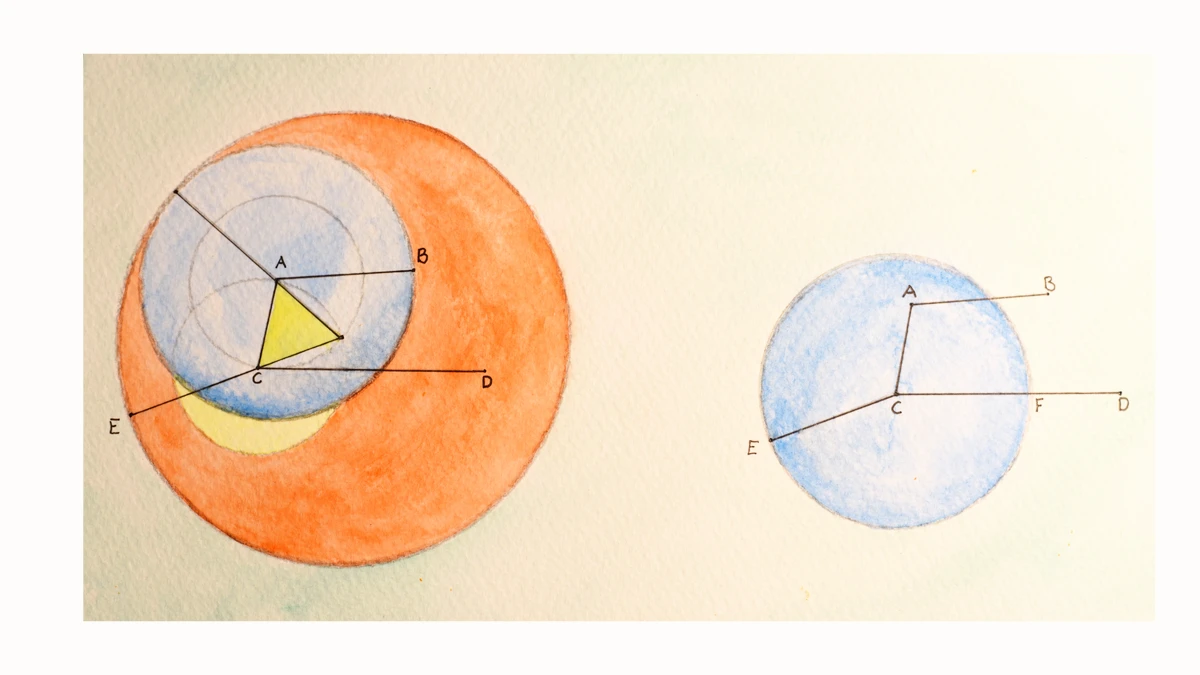
In our diagram, AB is the lesser straight line and CD the greater. We therefore need to find a point F on CD such that
CF = AB.
The problem is simple to state, yet it is important to notice what must actually be constructed. The magnitude of AB is given, but that magnitude does not yet appear on the greater straight line CD. A point must therefore be found on CD that marks off exactly the same length.
To a modern reader, it may seem natural simply to set a compass to the length AB and transfer that distance directly onto CD. Euclid does not proceed in this way. Instead, he builds carefully on Proposition I.2, where he has already established a geometrical method for constructing, from a given point, a straight line equal to a given straight line.
Proposition I.3 therefore depends directly on the construction that came before it. Before the lesser length can be cut off from the greater, the magnitude of AB must first be reproduced from the point C.
The Construction
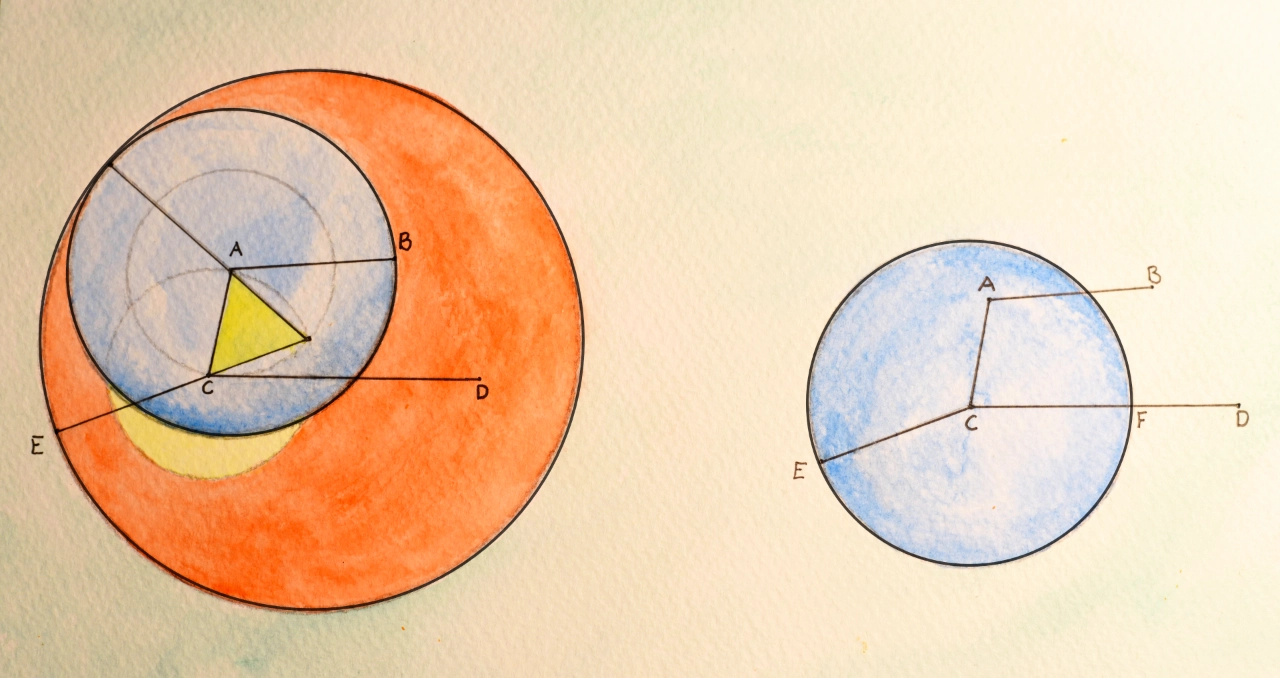
Euclid begins by using Proposition I.2. From the point C, construct a straight line CE equal to the lesser given straight line AB (See Euclid’s Elements, Book I, Proposition 2):
CE = AB.
This is the crucial first step. The length of AB has now been reproduced from the endpoint C of the greater straight line CD.
Next, with C as center and CE as radius, draw a circle. This follows directly from Euclid’s third postulate, which allows a circle to be drawn with any center and distance.
Let the circle intersect the greater straight line CD at F.
Because F lies on the circumference of the circle whose centre is C,
CF = CE.
But CE was constructed equal to AB. Therefore,
CF = CE = AB.
The segment CF has consequently been cut off from the greater straight line CD, and it is equal to the lesser straight line AB, exactly as the proposition requires.
What is striking is how little new construction Proposition I.3 requires. The essential work was already accomplished in Proposition I.2. Once the length AB can be reproduced from C, the circle determines precisely where that same magnitude falls on CD.
Why the Construction Works
The logic is contained in the chain
AB = CE = CF
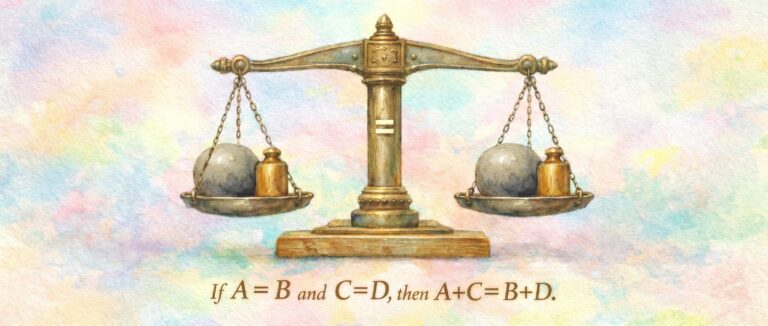
The first equality comes from Proposition I.2. The second follows because CE and CF are radii of the same circle. By Common Notion 1 – things equal to the same thing are equal to one another – we conclude that
AB = CF
The significance lies in the preservation of magnitude. The original segment AB and the constructed segment CF occupy different positions, yet their lengths are equal. Euclid is therefore working with length as a magnitude that can be reproduced and carried from one part of a construction to another.
Watch the construction animation on Substack.
Closing Thoughts
Proposition I.3 is a small step from Proposition 1.2, but it marks an important development in Euclid’s geometry. A given length can now be reproduced and used to cut an equal length from another straight line.
From a modern perspective, this begins to resemble subtraction. If CF = AB, then the remaining segment FD represents what is left when the length AB is removed from CD. Euclid expresses this relationship geometrically, through actual segments and constructions, rather than through symbolic notation.
The first three propositions of the Elements are therefore already building upon one another. Proposition I.1 establishes a fundamental construction of equality, Proposition I.2 shows how a given length can be reproduced from another point, and Proposition I.3 puts that ability to use. Step by step, Euclid is developing the tools from which the later propositions will grow.
References
Euclid. The Thirteen Books of Euclid’s Elements. Translated from the text of J. L. Heiberg, with introduction and commentary by Thomas L. Heath. Vol. 1. Cambridge: Cambridge University Press, 1908.
Fitzpatrick, Richard, trans. Euclid’s Elements. Based on the Greek text edited by J. L. Heiberg. Lulu, 2007.
Joyce, David E. Euclid’s Elements. Department of Mathematics and Computer Science, Clark University. Book I, Proposition 3.
Research and Editorial Assistance
OpenAI, ChatGPT. Research assistance, source identification, fact-checking and editorial refinement under the direction and conceptualisation of L. J. van Vuuren, September 2026.
Continue exploring the Euclid series on Study Pathways.