Euclid’s Definitions 8–12: Discover the Hidden Power of Angles
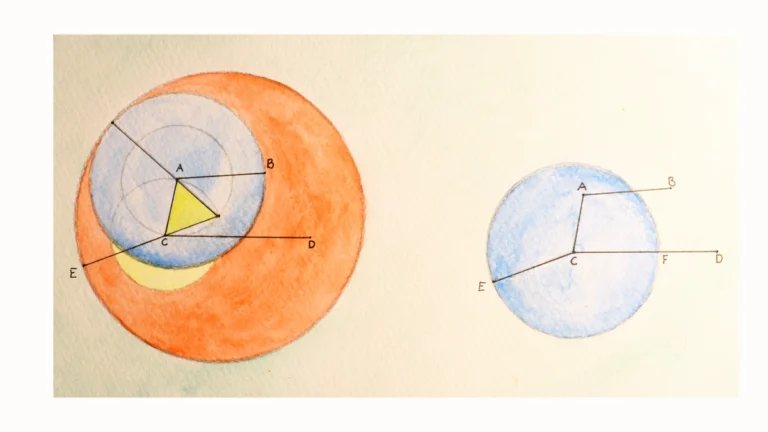
Explore Euclid’s Definitions 8–12 and discover how angles arise from the relationship between meeting lines, shaping geometry, force, movement and mechanics.
No products in the cart.
Explore Euclid’s Definitions 8–12 and discover how angles arise from the relationship between meeting lines, shaping geometry, force, movement and mechanics.
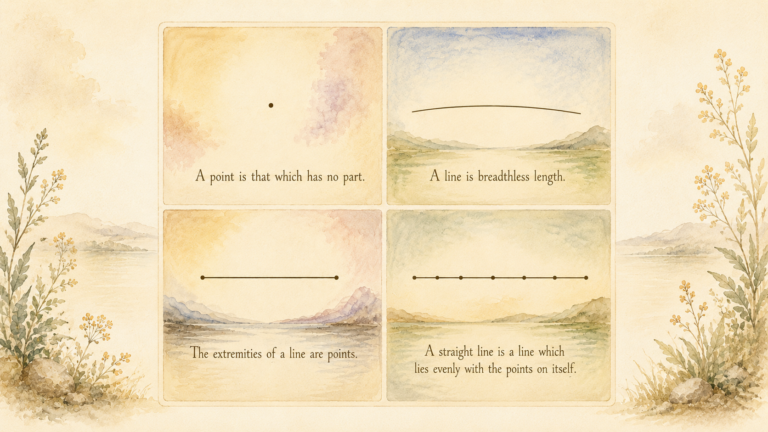
This article explores Euclid’s Definitions 1–7, where geometry begins with the most fundamental ideas: point, line, surface and plane surface. These definitions may seem simple at first, but they prepare the mind for the whole structure of geometry. Step by step, Euclid leads us from the smallest conceivable position toward extension, boundary and form. These early definitions show that geometry does not begin with complicated shapes, but with learning how to think clearly about space itself.
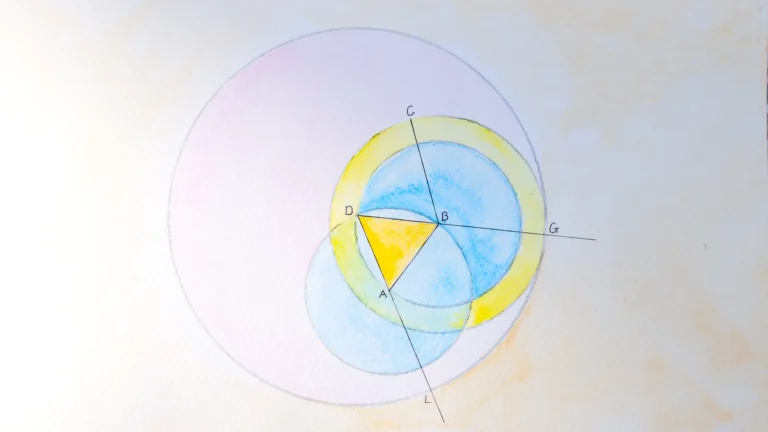
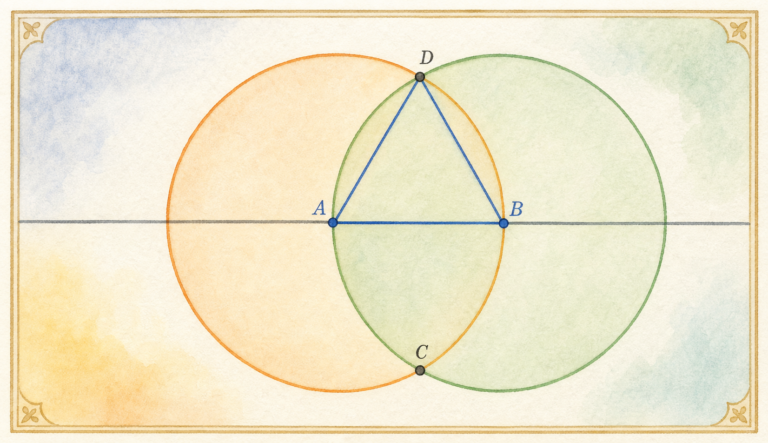
This article explores Euclid’s first proposition: the construction of an equilateral triangle on a given straight line. What looks like a simple triangle is actually the first full movement of Euclidean proof. Using only a straightedge, compass and the equality created by two circles, Euclid shows how a figure can be constructed with certainty. The proof reveals how geometry moves from definition and postulate into reasoned construction, where each step follows clearly from what has already been granted.
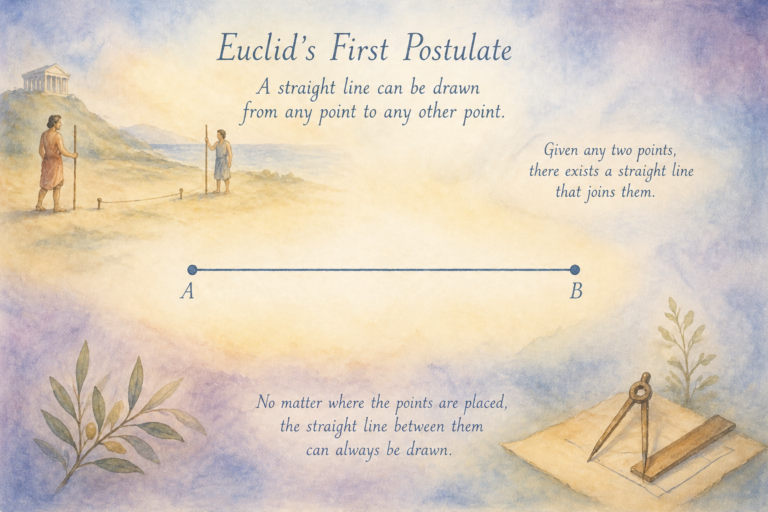
Euclid’s postulates establish the conditions under which geometry can become active. While definitions determine what geometric objects are and axioms govern how reasoning holds together, the postulates grant the fundamental permissions through which lines may be drawn, circles formed and constructions extended. From these few carefully chosen beginnings, the entire structure of Euclidean geometry is able to unfold.
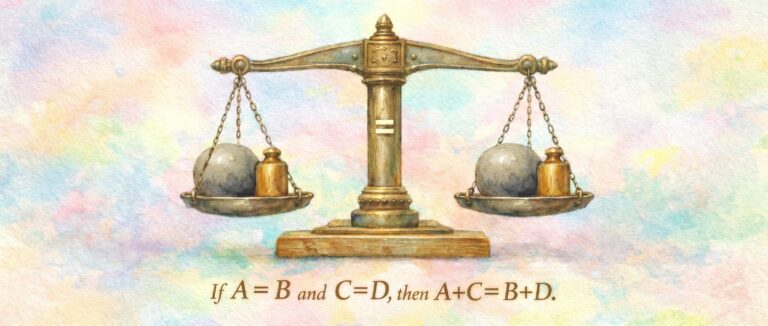
This article explores Euclid’s axioms, also known as the Common Notions. These simple statements form the foundation beneath geometric reasoning. They speak about equality, comparison and the way thought can move from one truth to another with certainty. Before Euclid constructs complex figures or proves difficult propositions, he first asks us to accept these basic relationships. The axioms show that geometry is not built from diagrams alone. It is built from clear thinking.