Euclid’s Definitions 13-15
In my article “Making Peace with Abstraction,” I explored how abstraction comes into being.
It begins in awareness. We first become conscious of something. Then awareness deepens through noticing and observation. We begin to see more clearly what is present. From there, we name what we have noticed.
As we reflect on it, comprehension begins to form. We start to recognize what is essential, what varies and what remains the same. Through this process, generalization becomes possible.
Only then do we arrive at symbolic representation: the point at which we can name, draw, write or symbolize something that remains true across many different situations. From there, abstract reasoning can begin.
Mathematics can easily appear as if it begins in abstraction. Most of us were never taught what it means to abstract something. At school we were given the definition, the symbol, the diagram or the theorem often without understanding that these had been derived from a world of experience. Perhaps we had an intuitive sense of this, but that intuition was never verbalized and brought into conscious knowledge.
Now we need to look at this very carefully. Before the mind can truly hold an abstraction, it needs an inner reference point. It needs to know, in some way, what the abstraction is pointing to in the embodied world.
For this reason, before we enter Euclid’s Definitions 13–15, we will first look at the real-life principles he captures with these definitions. We will look at how they appear in the world around us and how they appear within our own experience.
The central ideas in these definitions are boundary, enclosed figure and the relationship between inside and outside.
With all this in mind lets take a closer look at how the human mind has defined and experienced boundaries and their properties across various disciplines.
Definition 13: Boundaries
A place of meeting and relationship
A boundary is the place, surface, edge or region through which one thing becomes distinguishable from another. In geometry, it may be treated as an extremity. In the physical sciences, it may appear as an interface between phases or materials. In biology, it may take the form of a membrane. In psychology, it may describe a demarcation that protects the integrity of a person or group. In spiritual and religious life, it may appear as a marked-off place, threshold or enclosure. In the mineral world, it may be seen in the external form of a crystal, where an ordered inner structure becomes visible as an outward shape. [1–6]
In physics and chemistry, boundaries are often described through the idea of an interface. In the IUPAC Gold Book, an interface is the ideally marked boundary between two phases. This is what we encounter where air meets water, oil meets water, a solid meets a liquid or two materials meet each other. Such a boundary is not simply a wall. It is the region of contact where properties change and where interaction becomes possible. Forces, motion, heat, charge, pressure, adhesion and chemical processes may all be affected by what happens at the boundary. [2]
In biology, the plasma membrane separates the interior of the cell from its environment and also helps define internal compartments within more complex cells. It is selective and organised. It allows some substances to pass, restricts others and helps maintain the conditions required for cellular life. Here the boundary is neither a mere line nor a rigid block. It is a regulating surface through which the organism maintains distinction while remaining in exchange with its surroundings. [3]
In psychology, boundaries are understood in terms of personal and relational integrity. The American Psychological Association defines a boundary as a psychological demarcation that protects the integrity of an individual or group and helps set realistic limits in relationships or activities. This brings the same principle into human life. A person needs some sense of where they end and where another begins. Without such demarcation, relationship can become confused, intrusive or overwhelming. Through healthy boundaries, relationship becomes possible without loss of self. [4]
In spiritual and religious traditions, boundaries often appear through sacred places, thresholds, enclosures and marked-off spaces. A shrine, temple, church, forest grove or other place of worship may be symbolically set apart as sacred. This does not need to be treated as a scientific claim about the sacred itself. It is enough to recognise the verified human fact that religious communities have repeatedly used boundary, threshold and enclosure to create spaces of meditation, worship and reverence. [5]
In the mineral world, boundary appears through surface, face and external form. A crystal is not only a solid object. Its outward form reflects an ordered internal arrangement. Under favourable conditions, minerals may express their inner crystalline structure through visible external morphology. Crystal faces and habits show how internal order can become outward form. Here again, boundary is the place where hidden structure becomes visible. [6]
Across these fields, a boundary is never only an ending. It is also a place of relation. It distinguishes one region from another. It allows an inside and an outside to emerge. It may protect, regulate, separate, connect, reveal or organise. Through boundary, something becomes identifiable. It can be seen, named, approached, measured or contemplated.
Euclid gives us the abstract mathematical form of an experience that appears throughout the world. A boundary marks an extremity, yet that extremity is also the place where distinction, relationship and form begin.
This gives us a richer reference point for Euclid’s abstraction:
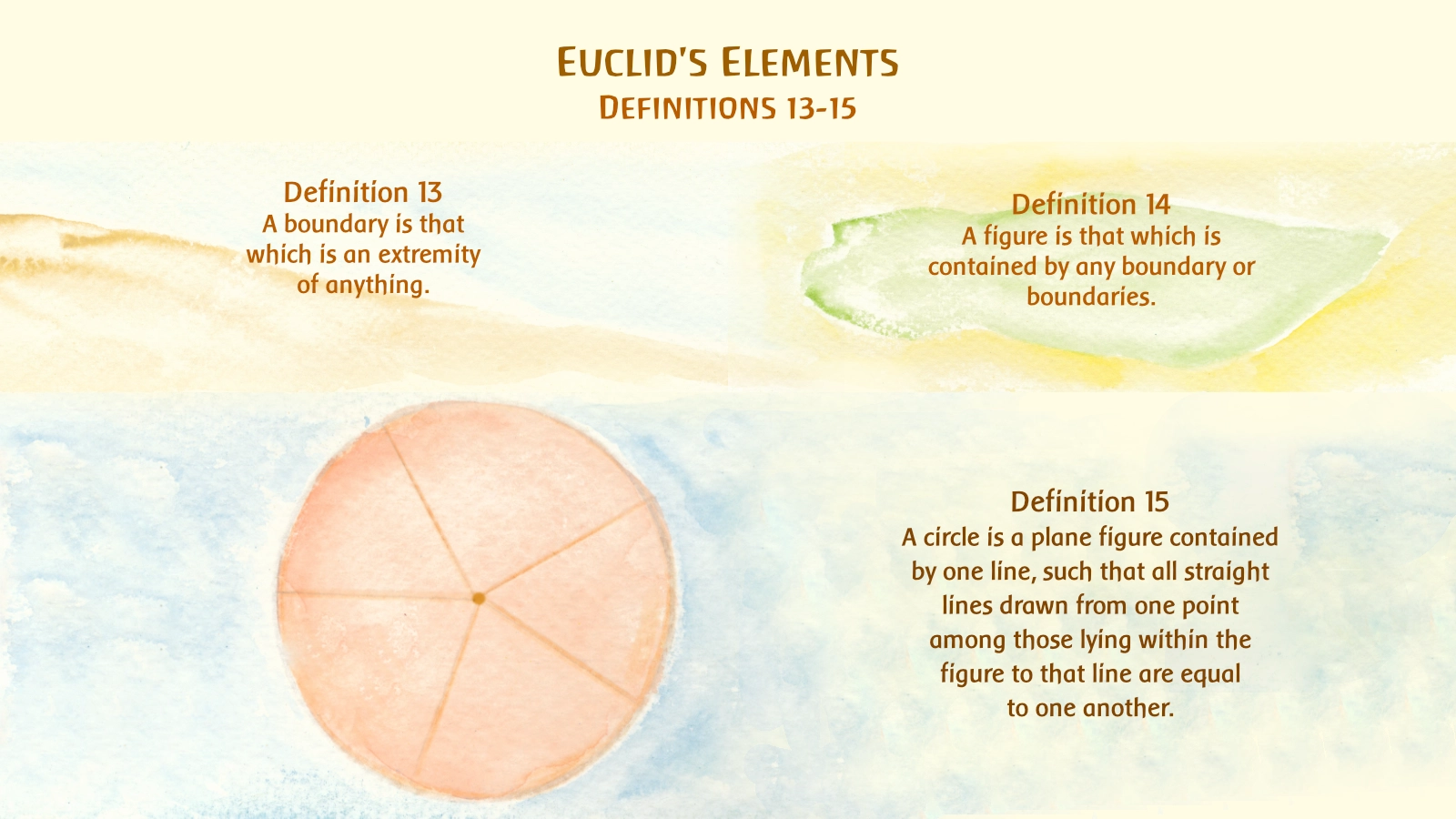
Euclid’s Definition 13: “A boundary is that which is an extremity of anything.” [1]
Lets now look at Euclid’s Definition 13 through a geometrical lens only.
Definition 13 introduces the idea of limit. A boundary is the extremity of something extended: the place where it comes to an end and can therefore be recognized as this figure and not another. A line segment ends in points; a surface ends in lines; a plane figure is held within the boundary or boundaries that contain it. This boundary is not merely an outline added afterwards. It is the condition that allows the figure to become definite.
Once a triangle is enclosed by three straight lines, its angles, sides and possible relationships can be studied. Once a circle is enclosed by one line, the equal distances from its inner point to that line become meaningful. The boundary does not simply surround the figure; it gives the figure the limit through which its geometrical properties can be known.
Definition 13 therefore prepares the way for Definition 14, where Euclid defines a figure as that which is contained by boundary or boundaries. Through boundary, extension becomes form, and form becomes something the mind can distinguish, compare and understand.
Definition 14: Inside and Outside: The Birth of Contained Form
We can now move from boundary to figure. Euclid’s Definition 14 states:
“A figure is that which is contained by any boundary or boundaries.” [1]
At first this sounds almost too easy. A figure is something contained. Yet when you look deeper at this seemingly simple definition you will realize that it is truly the tip of an iceberg. It holds a profound movement of thought. Euclid has already defined a boundary as “that which is an extremity of anything.” Now he moves one step further. A figure comes into being when boundary contains. [1]
This is the moment where geometry becomes philosophically rich. A boundary may show where something ends. A containing boundary does something more. It allows an inside and an outside to become distinguishable. It gives a region enough unity to be recognized as one thing.
A triangle is therefore not merely three line segments. A square is not merely four line segments. A circle is not merely a curved line. Each is a region held within a boundary. The boundary contains something, and the way it contains that space shapes the figure’s structural properties and its relationships within the larger plane.
The Jordan Curve Theorem
In modern topology, this intuition receives a precise mathematical expression in the Jordan curve theorem. A simple closed curve is a curve drawn in the plane that returns to its starting point without crossing itself. It may be as regular as a circle or as irregular as a winding loop, but as long as it closes and does not intersect itself, it does something remarkable: it separates the plane.
The Jordan curve theorem states that every simple closed curve in the plane divides the plane into two distinct regions: a bounded interior region and an unbounded exterior region. The curve itself forms the boundary between them. In other words, once such a curve has been drawn, the plane is no longer experienced as one undivided field. There is now an inside, an outside and the boundary that separates them. [7]
This may seem obvious when we look at a circle or a simple enclosed shape. We immediately see that something has been held within the curve. But mathematically, this is not a trivial fact. To prove rigorously that every possible simple closed curve behaves in this way is far more difficult than it appears. The theorem gives precise mathematical expression to one of our most basic spatial intuitions: a closed boundary creates a region. [7]
This brings us directly back to Euclid’s Definitions 13–15. A boundary is not merely an edge. It is what allows a figure to come into being as a contained form. A circle, a triangle or a square is not simply a collection of lines. Each one encloses a region and separates that region from the rest of the plane. Through the boundary, space becomes distinguished. There is now a figure, an inside and a world outside it.
Euclid did not formulate Definition 14 in the language of modern topology. Yet his definition points toward the same fundamental experience. When a boundary encloses, space is no longer experienced as undivided extension. Something has been held. A figure has appeared.
Boundary, Containment and the Coming-to-Presence of a Thing
The Stanford Encyclopedia of Philosophy opens its entry on boundary by saying that we think of a boundary whenever we think of an entity demarcated from its surroundings. It gives simple examples: the line separating two states, the circle separating the interior of a disc from its exterior and the surface enclosing the bulk of an apple. [10]
The philosophical issue becomes more subtle when we ask whether boundaries are simply found in the world or partly drawn by the mind. Some boundaries are physically obvious. The surface of an apple, the edge of a stone and the outline of a leaf appear as natural discontinuities. Other boundaries are created by convention. A border on a map may not correspond to a visible line in the landscape. A legal boundary can be real in practice even when nothing in the soil or air announces it to the eye. [10]
Euclid’s figure belongs to the world of mathematical abstraction. A drawn triangle may appear on paper, but the triangle as a mathematical figure is not the ink. The figure is the intelligible form held by its boundaries. The boundary makes the figure available to thought.
Martin Heidegger
The same Stanford article quotes Heidegger’s well-known sentence from “Building Dwelling Thinking”:
“A boundary is not that at which something stops but, as the Greeks recognized, the boundary is that from which something begins its presencing.” [10]
This may sound, at first, as if Heidegger is contradicting Euclid. Euclid defines a boundary as the extremity of anything. In other words, he looks at the boundary as the outer limit of a thing, the place where it ends. Heidegger looks at the same reality from the other side. He does not deny that a boundary is a limit. Rather, he asks what that limit makes possible.
A boundary is where something ends, but because it ends there, it can also begin to appear there. Without a boundary, a thing cannot stand apart from what surrounds it. It cannot be recognized as this thing rather than that thing. The boundary is therefore both an ending and a beginning. It marks the place where something ceases, but also the place from which it comes into view as itself.
This is why Heidegger’s statement is so important for the thought we are following. Euclid gives us the precise mathematical formulation: a boundary is an extremity. Heidegger gives us the phenomenological meaning: a boundary allows something to presence, to stand forth, to appear as a distinct reality.
Applied to Euclid, this means that a figure does not begin as an empty outline. It begins as a contained presence. A triangle, square or circle comes into view because a region of space has been bounded. The boundary allows space to be distinguished, held and recognized as a figure. In this sense, Euclid and Heidegger are approaching the same fundamental insight from different angles: a boundary is not merely where something stops. It is also what allows something to appear.
Inside and outside
Inside and outside are not merely spatial directions. They are among the most basic ways in which the mind begins to understand form.
Before containment, there may be extension, movement or surface. With containment, a region is distinguished. There is now an interior. There is an exterior. There is a boundary between them.
This distinction allows further thought to begin. We can compare what is inside with what is outside. We can measure the enclosed region. We can recognise the same form in different sizes and positions. We can speak of area, perimeter, centre, symmetry and relation.
In this sense, a figure is a great act of abstraction. It takes the living experience of boundary, enclosure and wholeness and gives it a clear mathematical form.
This is very important educationally. Children often meet figures first through the eye and hand. They draw a circle. They colour inside it. They step inside a hoop. They make a ring with stones. Long before they can reason abstractly about topology, they experience that a closed boundary gathers a space.
The mind first meets the figure as a lived distinction. Later, mathematics refines that distinction into exact language.
Containment and wholeness
The thought becomes deeper when we move from inside and outside to wholeness.
Many systems require some form of containment before they can function or be understood as units. In science, this does not always mean a sealed wall. Containment may appear as a membrane, surface, vessel, skin, compartment, phase boundary, mathematical limit or conceptual demarcation.
What matters is that something is gathered enough to be treated as one.
In thermodynamics, a system is the part of the universe chosen for study. It is separated from its surroundings by a boundary. That boundary may be real or imagined. Once the boundary is defined, the system can be considered as a whole. We can ask what enters it, what leaves it, what changes within it and how it exchanges energy or matter with its surroundings. [8]
This gives scientific support to the philosophical insight. A system must be distinguished before it can be studied as a system. Without a boundary or demarcation, there is no clear unit under consideration.
In biology, containment becomes even more concrete. The plasma membrane separates the interior of the cell from the external environment. It is selectively permeable, which means it allows some substances to pass while restricting others. Because of this regulated boundary, the cell can maintain an internal composition different from its surroundings. [3]
This is one of the strongest scientific examples of contained form. A living cell has an inside. That inside is not cut off from the world; it is held in regulated relation with the world. The membrane allows the cell to remain itself while exchanging what is necessary for life.
The same principle appears within complex cells. Eukaryotic cells contain membrane-enclosed organelles. These internal compartments allow different functions to take place in organised regions. The nucleus, mitochondria, endoplasmic reticulum and other organelles each hold specialised processes within the larger living whole. [9]
So containment allows more than separation. It allows organisation. It allows differentiated functions to belong to one living unit.
This gives us a beautiful bridge back to Euclid. A figure is not a living cell, and we should not force the analogy. Yet both reveal a lawful idea: something becomes identifiable when it is gathered into coherent form. In geometry this is mathematical figure. In biology this is living organisation. In thermodynamics this is the defined system. In each case, some kind of boundary allows the whole to be recognised.
Plato: Becoming Needs a Place of Reception
Plato’s Timaeus introduces another important strand. In that dialogue, Plato speaks of the receptacle, often connected with the Greek term chōra. The Stanford Encyclopedia of Philosophy describes the receptacle as a “third kind” alongside the eternal forms and the generated images of the forms. It has been interpreted as a kind of material substratum, a kind of space or something combining both roles. [11]
This is difficult philosophical territory and it must be handled carefully. Plato’s receptacle is not the same thing as Euclid’s figure. It is part of a larger cosmological and metaphysical account. Yet it gives us a suggestive idea: becoming requires a “where.” Things that come to be need some field, place or receptivity in which they can appear.
In the context of our article, this helps us think about space before figure. Space is open possibility. It can receive form. It can be divided, gathered, enclosed, measured and contemplated.
A figure arises when this open possibility is held by boundary. Space becomes determinate. The indefinite becomes shaped. The region begins to stand forth.
Plato helps us sense the depth of this movement. Before there is formed appearance, there must be a field in which appearance can take place. Before there is figure, there is space capable of receiving figure.
Aristotle: form makes a thing intelligible
Aristotle brings the next essential idea: matter and form.
In Aristotle’s hylomorphic view, physical objects are compounds of matter and form. The Stanford Encyclopedia of Philosophy explains that Aristotle uses this framework to account for change in the natural world and to explain how substances come into existence. It also notes that form plays a unifying role: form is what unifies matter into a single object. [12]
This is extremely useful for our Euclidean reflection.
A figure is not matter in Aristotle’s physical sense, but Euclid’s definition shows a related intelligible movement. The figure is not simply undifferentiated space. It is space held in form. The boundary gives the region its determinate character.
Aristotle helps us understand why form matters. Without form, there may be material or spatial possibility, but there is not yet a definite thing. Form allows something to be known as what it is.
In a triangle, the three boundaries gather the region into a determinate figure. In a circle, one curved boundary gathers the plane region around a centre. In both cases, the figure becomes intelligible because the contained region has form.
This is why form is not decoration. Form is the condition through which something can be recognised, named and understood.
Cassirer: The Mind Draws Distinctions
There is also an important epistemological dimension. Ernst Cassirer, quoted in the Stanford entry on boundary, argues that the beginning of thought and speech is not simply that we passively seize distinctions already present in feeling or intuition. He says that we draw dividing lines, make separations and connections and through this activity distinct configurations emerge from the flux of consciousness. [10]
The child does not simply receive a ready-made world of mathematical objects. The child learns to notice, distinguish, name and hold forms in thought. Boundary is part of this awakening. Through boundary, attention becomes more precise. Through containment, the mind begins to recognise wholes.
A circle drawn on paper teaches more than the word “circle.” It invites the child to experience a region gathered by a line. It creates an inside that can be coloured, an outside that can be left blank, a circumference that can be traced, a centre that can be found and a form that can be remembered.
Mathematics begins when consciousness learns to distinguish.
Geometry gives that distinction visible form.
Process Philosophy: Figure as Becoming
Process philosophy gives us another important lens. The Stanford Encyclopedia of Philosophy describes process philosophy as a metaphysical approach that understands being as dynamic and treats becoming as central to reality. It emphasizes change, occurrence and temporal unfolding as fundamental features of experience and existence. [11]
This helps us avoid treating Euclid’s definitions as dead statements. A figure may be defined as a completed object, but the mind arrives at it through a process.
First there is the experience of space. Then there is awareness of boundary. Then boundary encloses. Then inside and outside become distinguishable. Then the enclosed region becomes a figure. Then the figure can be named, compared, measured and reasoned about.
So Definition 14 can be read as the result of a process of becoming. A figure is not merely given. It comes into appearance through containment. The boundary gathers space. The gathered space becomes form. The form becomes available to thought.
This is closely connected to the earlier article on abstraction. True abstraction grows from reality. It begins in awareness, deepens through observation, becomes clear through naming and reflection and reaches symbolic representation when something true across many situations can be held in thought.
Euclid’s figure is one such abstraction. It gathers countless experiences of enclosure, surface, outline, region and wholeness into one concise definition.
Bachelard: lived inside and outside
Gaston Bachelard adds a more phenomenological and poetic dimension. The Poetics of Space is a philosophical meditation on lived space, especially intimate spaces such as the house. Harvard Design Magazine notes that the book explores oneiric space and the symbolic meanings of architecture. Bachelard himself writes that an experienced house is not an inert box. [14,15]
Unlike oneiric space, where boundaries may shift, dissolve or follow the logic of dream and image, Euclidean geometry begins by making space definite: a boundary marks an extremity, a figure is contained, and form becomes clear enough to be studied.
The value of Bachelard here is that he helps us remember that inside and outside are experienced before they are abstracted.
The child knows inside and outside through the body. Inside the house. Outside in the garden. Inside the circle. Outside the circle. Inside the blanket fort. Outside the door. Inside the story. Outside the page.
The experience of contained space is emotional, bodily and imaginative long before it becomes mathematical. A room can shelter. A circle can gather children for a game. A nest can hold. A shell can protect. A house can become a world.
This gives geometry its human depth. When Euclid says that a figure is contained by boundary or boundaries, he is giving abstract form to a deeply familiar experience. We know containment through the body before we know it through the mind.
Returning to Euclid
We can now return to Definition 14 with greater depth:
“A figure is that which is contained by any boundary or boundaries.” [1]
This definition is geometrical, but it opens a philosophical doorway.
A boundary gives distinction. A containing boundary gives wholeness. Through containment, space becomes a region. Through region, figure appears. Through figure, thought can compare, measure, name and reason.
This is the movement from openness to form. It is also the movement from undivided space to intelligible whole.
The figure is born when space is held. It stands forth because a boundary gathers it. It becomes itself through containment.
Definition 15: The Circle – Boundary, Containment, Center and Equality
We can now move from figure in general to one particular figure: the circle.
Euclid’s Definition 15 states:
“A circle is a plane figure contained by one line such that all the straight lines falling upon it from one point among those lying within the figure equal one another.” [1]
Euclid’s first defined plane figure is the circle. We cannot say with certainty why he placed it first, but geometrically the choice is powerful. After boundary and figure have been defined, the circle appears as the simplest contained plane figure: it is held by one line, and all straight lines from one inner point to that line are equal.
Euclid is not defining the circle as merely a curved line. He calls it a plane figure. This means that, in Euclid’s sense, the circle is the contained figure itself, not only the boundary that surrounds it. The one line contains a region, and that region is organized by a very precise relationship.
The circle is contained by one line. Unlike a triangle, which is contained by three line segments, or a square, which is contained by four line segments, the circle is contained by one continuous boundary. There are no corners where one boundary meets another. There is no change of direction from side to side. The boundary moves continuously around the figure and returns to itself.
But this is not enough to define a circle. A closed curve may contain a region without being a circle. It may be irregular, stretched, flattened or uneven. What makes the circle distinct is not simply that it is closed, but that every straight line drawn from one inner point to the boundary is equal.
This inner point is what Euclid names, in Definition 16, the center of the circle. [1]
Here the circle introduces a new principle. The boundary is not only enclosing space. It is held in equal relation to a center. Every point on the circumference stands at the same distance from that center. The circle is therefore a contained figure whose boundary is governed by equality.
This is a profound step. In Definition 14, we learned that a figure is contained by boundary or boundaries. In Definition 15, we meet a figure whose containment is perfectly ordered around one point. The boundary does not wander freely. It is not arbitrary. It is everywhere held by the same measure.
This is why the circle feels so unified. Its form is not built from separate sides. It arises from one center and one constant distance. The center does not lie on the boundary, yet it governs the whole figure. The boundary appears outwardly, but the order of the circle comes from within.
In ordinary experience, we meet this long before we can define it. A child turns around in place and feels the world sweep around them. A stone dropped into water sends ripples outward from a point. A wheel turns around an axle. Children sit in a circle and are gathered around a shared center. A compass holds one point still while the pencil moves around it at a constant distance. In all these experiences, the idea of circle begins to awaken: one center, one distance, one surrounding form.
This is especially important educationally. A child does not first need the abstract definition. The child needs to experience circularity through the body, through movement, through drawing, through turning, tracing and gathering. Only then does the definition begin to make sense. The words “center,” “radius,” “circumference” and “circle” are not empty labels. They name relationships the child has already begun to experience.
The circle also deepens our understanding of inside and outside. A circle encloses an inside and separates it from the surrounding plane, but it does so without angles or corners. Its boundary is continuous. Wherever we touch the circumference, we are equally related to the center. This gives the circle a special kind of wholeness. It is not merely enclosed. It is balanced around a point.
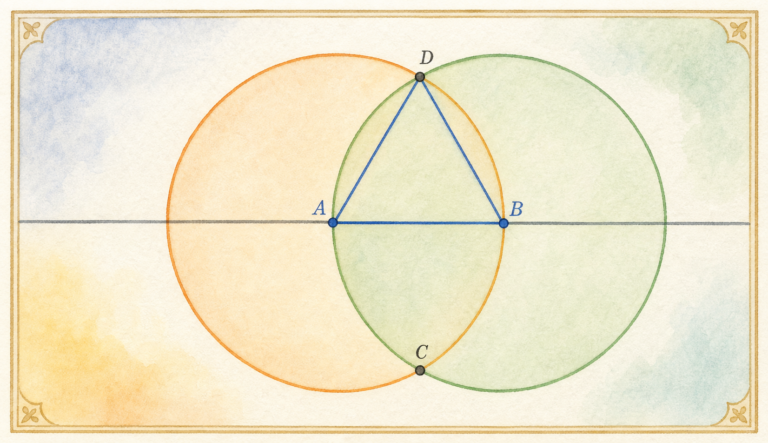
This is why the circle becomes so powerful in geometry. It is one of the first figures Euclid needs for construction. In the very first proposition of the Elements, Euclid constructs an equilateral triangle by drawing two circles. The circle allows a fixed distance to be carried around a center. Because all radii of the same circle are equal, the circle becomes a tool for creating equality in space. [1]
Definition 15 is foundational. The circle gives geometry a way to hold equal distance visibly. It allows equality to become spatial. A length can be preserved, carried, compared and used in construction.
So the circle gathers several ideas at once. It is a figure, because it is contained by a boundary. It is a circle, because that boundary is one continuous line held at an equal distance from a center. It has an inside and an outside, but it also has an inner organizing point. Through the circle, space is not only enclosed. It is ordered around a center.
Returning to the path we have followed, we can see the movement clearly:
A boundary allows distinction. A containing boundary allows figure. A circle is a figure whose boundary is held in equal relation to a center.
The circle is therefore not merely roundness. It is contained space organized by equality.
Closing Thoughts
Euclid’s Definitions 13–15 reveal how much thought is contained within the simplest geometrical language. A boundary marks where something ends and, through that ending, allows a figure to appear. Containment distinguishes what lies within from what lies beyond. In the circle, this contained space is brought into exact relation with a center through equality of distance. We have therefore moved from limit, to form, to order. By returning these abstractions to experiences of boundary, enclosure and centeredness in the world, we gain an inner reference for the definitions themselves. Geometry then becomes more than the study of shapes: it becomes a precise way of understanding how form arises and becomes available to thought.
References
Primary Mathematical Source
[1] Euclid. Euclid’s Elements, Book I, Definitions 13-16 and Proposition 1. Translated and edited by David E. Joyce. Clark University.
Science, Mathematics and Human Boundaries
[2] IUPAC. “Interface.” In Compendium of Chemical Terminology, 5th ed. International Union of Pure and Applied Chemistry, 2025. DOI: 10.1351/goldbook.I03082.
[3] Cooper, Geoffrey M. “The Cell Surface” and “Cell Membranes.” In The Cell: A Molecular Approach. 2nd ed. Sunderland, MA: Sinauer Associates, 2000. Available through NCBI Bookshelf.
[4] American Psychological Association. “Boundary.” APA Dictionary of Psychology.
[5] The Metropolitan Museum of Art. “Greek Gods and Religious Practices.” Heilbrunn Timeline of Art History.
[6] Smithsonian National Museum of Natural History. “Crystal Shapes and Crystal Habits.” Q?rius.
[7] Hales, Thomas C. “The Jordan Curve Theorem, Formally and Informally.” The American Mathematical Monthly 114, no. 10 (2007): 882-894.
[8] Ling, Samuel J., William Moebs and Jeff Sanny. University Physics Volume 2. Houston, TX: OpenStax, Section 3.1, “Thermodynamic Systems.”
[9] Alberts, Bruce, Alexander Johnson, Julian Lewis, Martin Raff, Keith Roberts and Peter Walter. “The Compartmentalization of Cells.” In Molecular Biology of the Cell. 4th ed. New York: Garland Science, 2002. Available through NCBI Bookshelf.
Philosophy and Lived Space
[10] Varzi, Achille. “Boundary.” In The Stanford Encyclopedia of Philosophy, edited by Edward N. Zalta and
Uri Nodelman. Metaphysics Research Lab, Stanford University.
[11] Zeyl, Donald, and Barbara Sattler. “Plato’s Timaeus.” In The Stanford Encyclopedia of Philosophy, edited
by Edward N. Zalta and Uri Nodelman. Metaphysics Research Lab, Stanford University.
[12] Ainsworth, Thomas. “Form vs. Matter.” In The Stanford Encyclopedia of Philosophy, edited by Edward
N. Zalta and Uri Nodelman. Metaphysics Research Lab, Stanford University.
[13] Seibt, Johanna. “Process Philosophy.” In The Stanford Encyclopedia of Philosophy, edited by Edward N.
Zalta and Uri Nodelman. Metaphysics Research Lab, Stanford University.
[14] Bachelard, Gaston. The Poetics of Space. Translated by Maria Jolas. Boston: Beacon Press, 1964.
Originally published as La Poetique de l’espace, 1957.
[15] Harvard Design Magazine. “The Poetics of Space by Gaston Bachelard.” Harvard Design Magazine.
Acknowledgment
I would like to thank ChatGPT for its contribution to research support, fact-checking and language refinement