The conditions under which geometry becomes possible
Introduction
In the previous discussion, we examined the axioms of Euclid as general principles governing equality and comparison. These statements stabilise the field of reasoning. They establish the conditions under which relationships between quantities can be recognised and maintained, allowing a proof to proceed with continuity and coherence.
We now move to the next layer of the structure: the postulates. If the axioms determine how reasoning holds together, the postulates determine what can be done, while the definitions determine what is being worked with. Together, these three layers do not sit as a static list of statements but operate as an interdependent system. The axioms ground the logic, the postulates open the space of possible constructions, and the definitions fix the meaning of every object that appears. None is complete in isolation; each depends on the others to bring the geometric world into being in a precise and controlled way.
The shift at this stage is subtle but decisive. The focus moves from how quantities relate to how geometric objects are introduced, constructed and understood. With the postulates, geometry becomes active. They grant the permissions that allow lines to be drawn, circles to be formed and figures to take shape. From this foundation, the propositions do not simply follow as a sequence of deductions. They emerge. Each proof carries forward what has already been established while extending the reach of the system. In this sense, Euclid’s geometry is generative: a structure that builds itself step by step, where form, logic and construction continually give rise to one another.
Euclid’s Postulates
Euclid’s postulates describe the basic operations that are permitted in geometry. They specify what can be constructed.
Each postulate introduces a simple act. These acts may appear elementary, but they carry significant weight. Every geometric construction and therefore every proof that depends on construction, rests on these initial permissions.
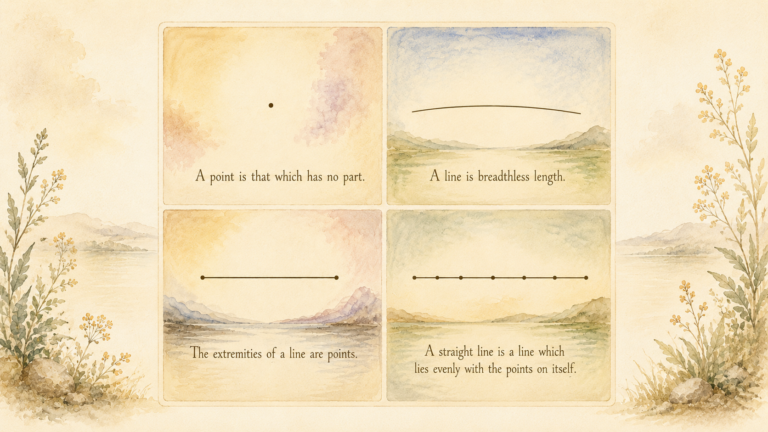
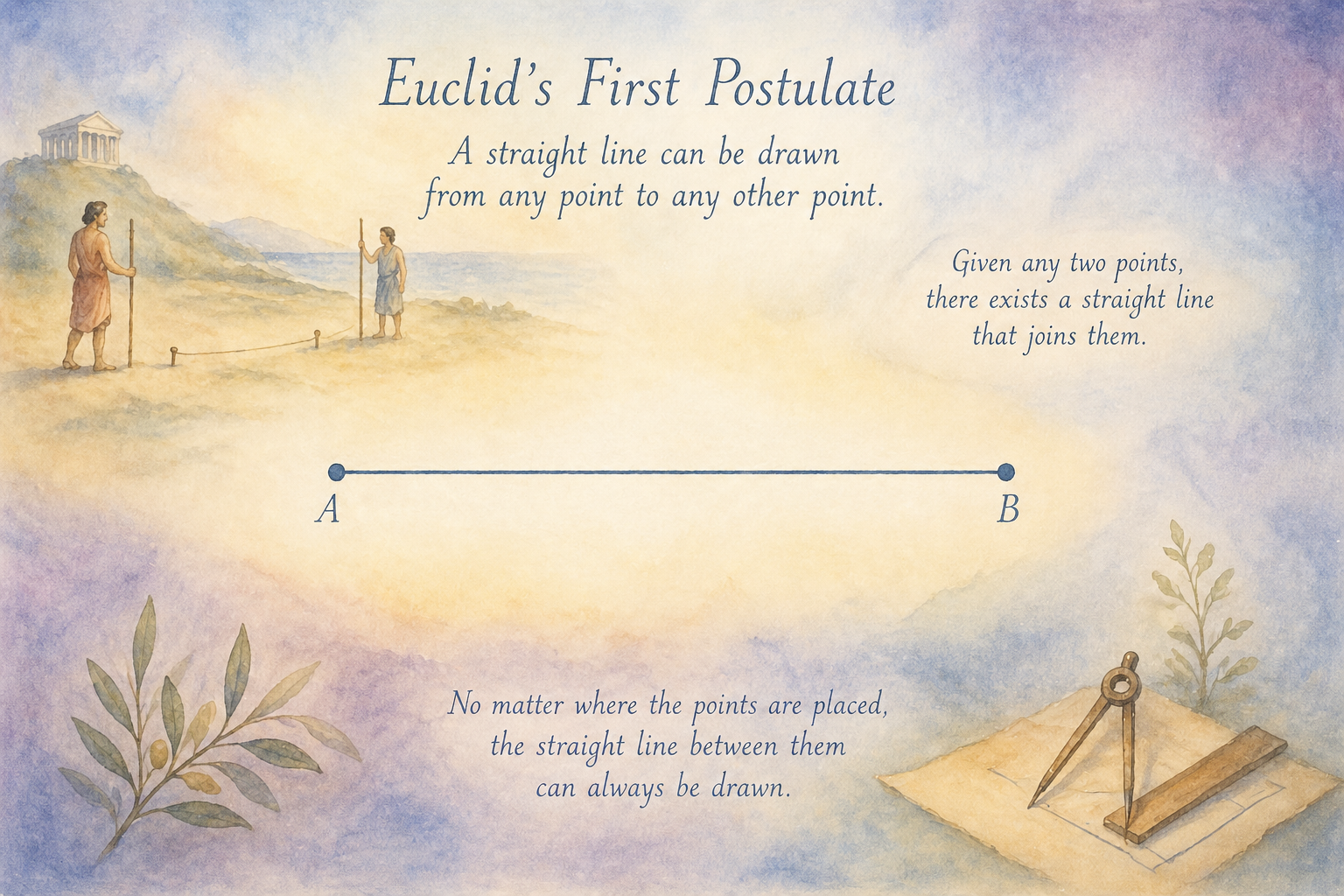
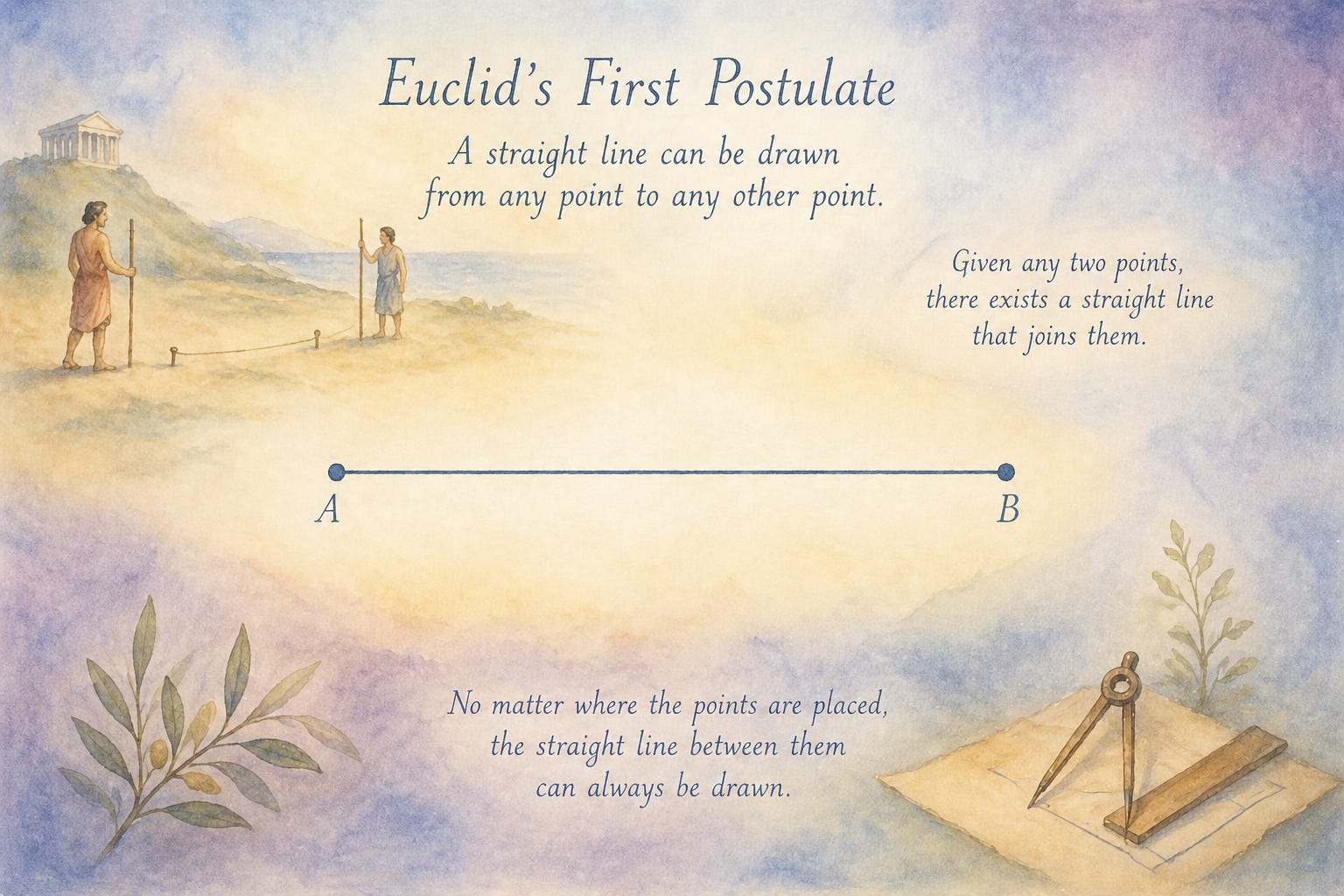
The first postulate states that a straight line can be drawn from any point to any other point.
This establishes a fundamental connection between points. Given two distinct points, there is always a straight line segment that joins them. No further justification is required. The act itself is permitted from the outset.
What is important here is not the existence of lines in a physical sense, but the allowance of their construction within the system. A proof may call upon this directly, knowing that such a line can always be introduced when needed.
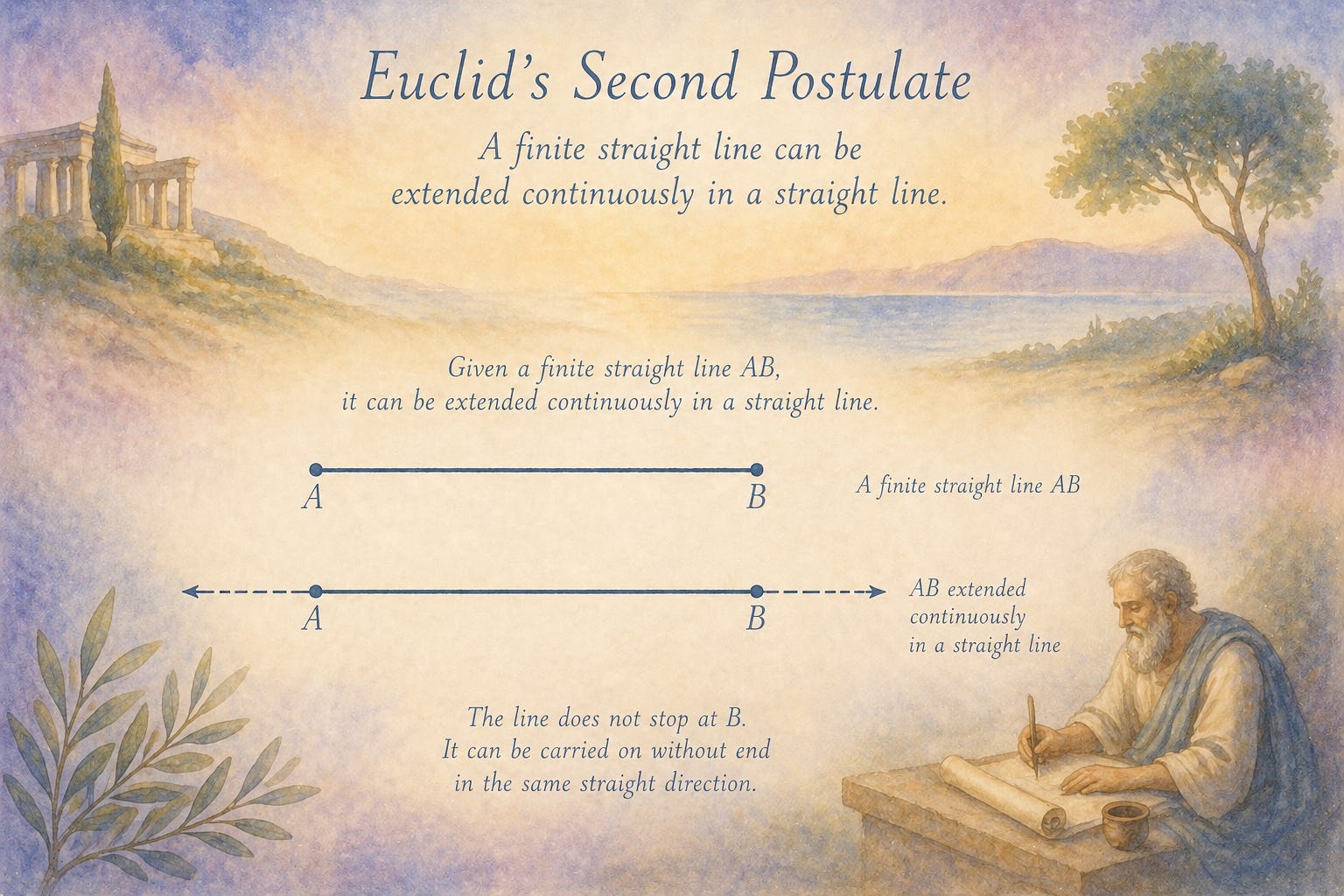
The second postulate states that a finite straight line can be extended continuously in a straight line.
Here, a line is no longer fixed in its initial form. It can be prolonged without restriction. The direction is maintained and the extension does not alter the nature of the line.
This allows geometric figures to grow. A segment need not remain bounded by its original endpoints. It can be extended to meet other constructions, enabling intersections and further relationships to arise.
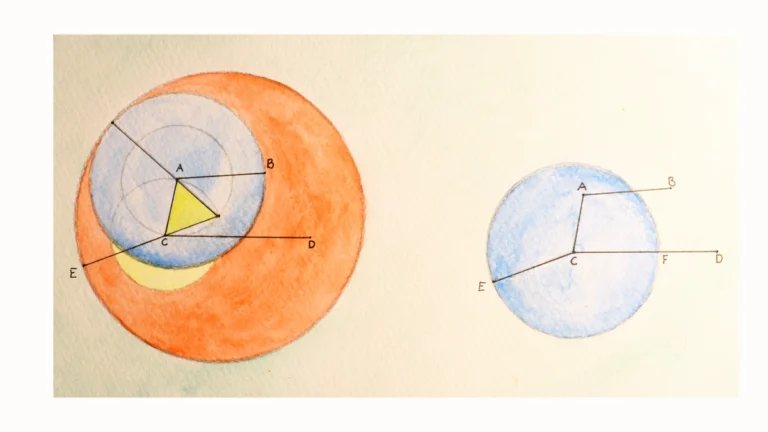
The third postulate states that a circle can be drawn with any centre and any radius.
This introduces a new kind of construction. Given a point and a distance, a circle is defined as the set of all points at that distance from the centre.
The significance lies in control. The radius is not arbitrary once chosen. It fixes the circle precisely. This allows distances to be transferred through construction. A length can be carried from one location to another by using it as the radius of a circle.
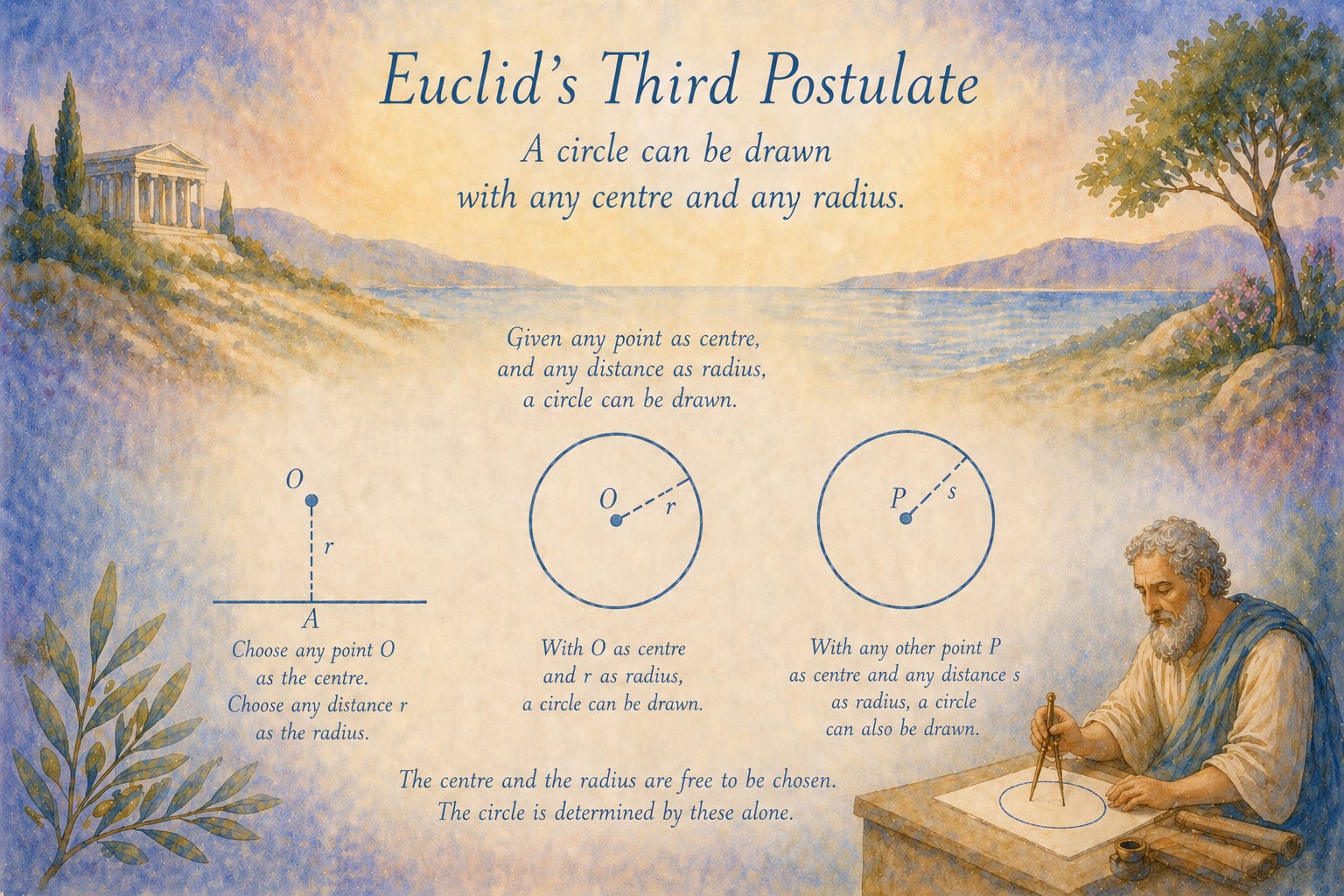
Euclid’s Third Postulate Interactive Diagram
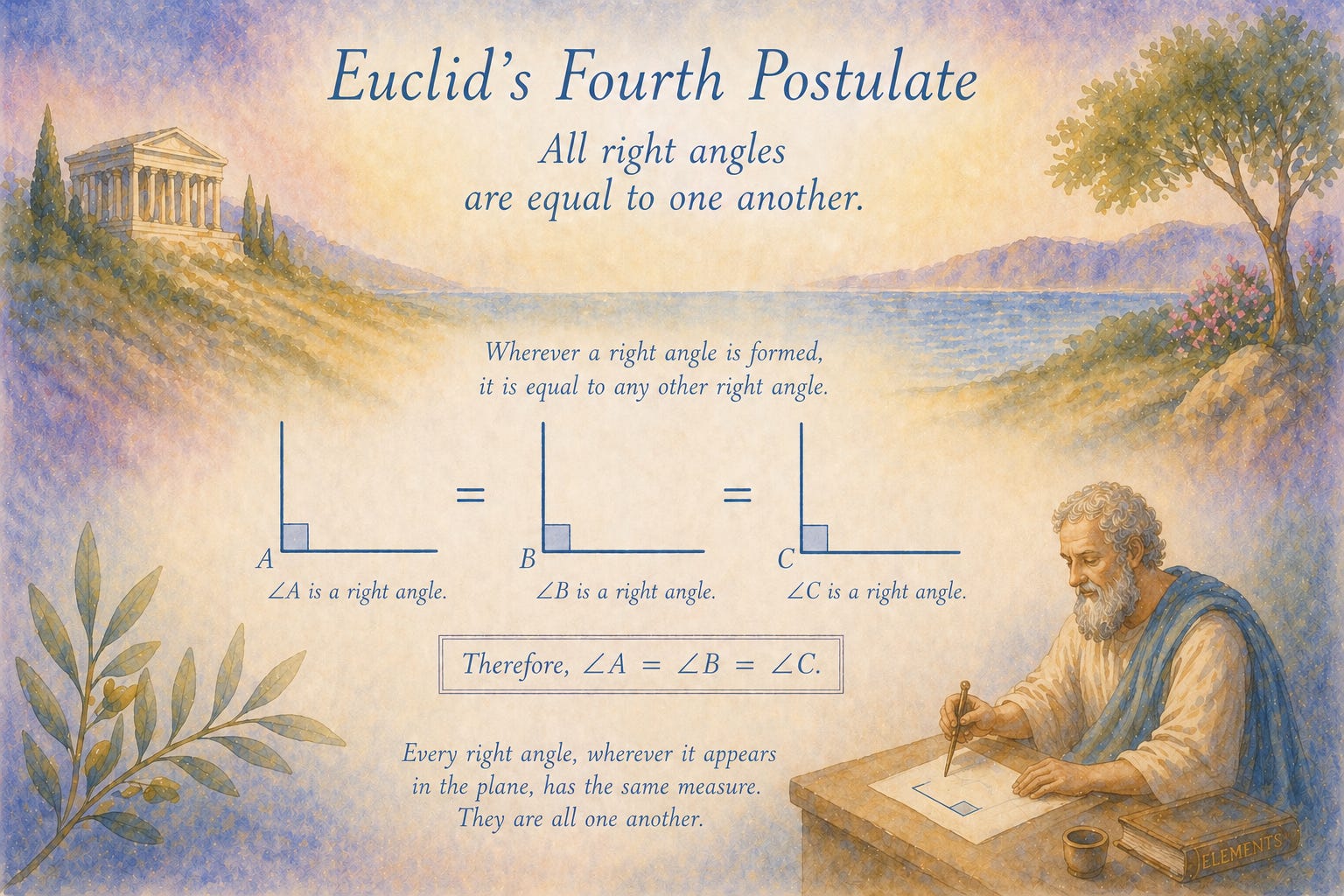
The fourth postulate states that all right angles are equal to one another.
This is the first statement that introduces a uniform standard within geometry. A right angle is not defined by measurement each time it appears. Once identified, it carries the same value everywhere.
This creates stability across constructions. When a right angle is formed, it can be treated as identical to any other right angle, regardless of where or how it appears.
The fifth postulate states that if a straight line falling on two straight lines makes the interior angles on the same side less than two right angles, then the two lines, if extended indefinitely, meet on that side.
This statement is more complex than the others and has been the subject of careful study throughout the history of mathematics.
It introduces a condition under which lines will intersect. If the angles formed are sufficiently small, the lines cannot remain separate. Their extension forces a meeting point.
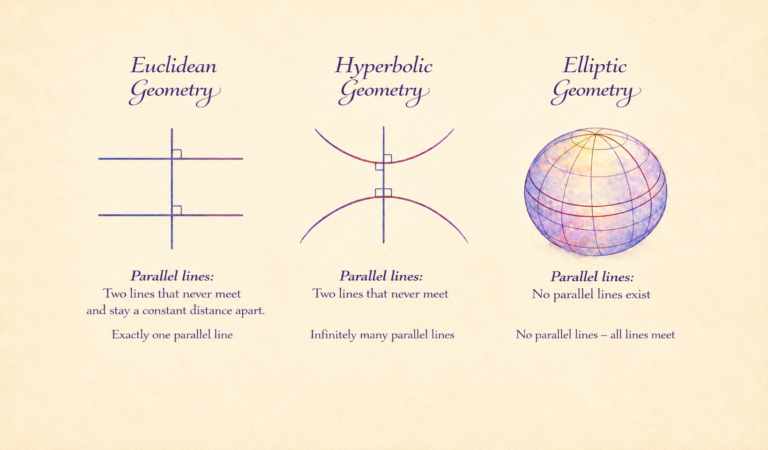
Unlike the earlier postulates, which describe direct constructions, this one describes a relationship that governs how lines behave relative to one another. Its role becomes clearer in the study of parallel lines and the structure of the plane.
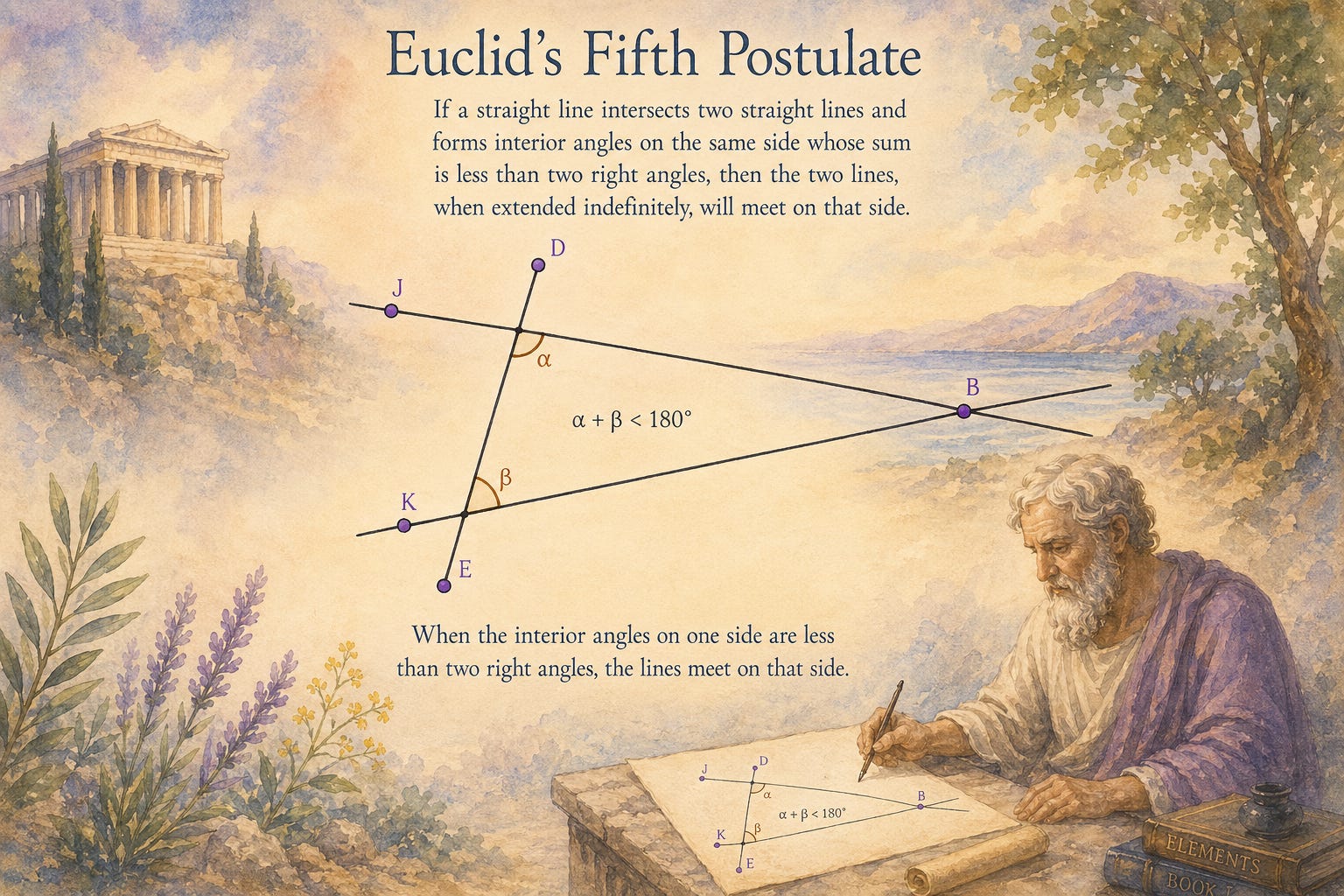
Euclid’s Fifth Postulate Interactive Diagram
Closing Thoughts
With the postulates, Euclid sets the system into motion. Simply put, they grant permission. A line may be drawn, a line may be extended, a circle may be formed. From these simple allowances, an entire world unfolds. Even the fifth postulate, more intricate in its form, does not stand apart but signals how deeply the structure depends on what is permitted at the outset. Nothing in the later propositions exceeds what is authorised here. The postulates therefore act as the generative core of the geometry, a small set of openings through which all construction becomes possible and through which the visible order of the figures begins to emerge