Euclid’s Common Notions or Axioms
Having seen how axioms function at a broader level, both within mathematics and by analogy within human reasoning, we now return to them with a more focused lens.
In the introduction to Euclid’s work in the previous post, the structure of geometry was set out as a whole, showing how axioms form the foundation from which definitions, constructions and theorems arise. We now take that first layer of the structure and examine it more closely.
Instead of viewing axioms from a distance, we begin to work with them in their precise mathematical form, seeing how each statement functions and how it supports the development of a proof.
What follows is a closer study of how they operate, step by step, within the logical structure of Euclidean geometry.
Some History for Context
In Ancient Babylonia and Ancient Egypt, geometry as we understand it today did not yet exist. What did exist was a strong and consistent practice of measurement. Land was measured, fields were set out and structures were aligned using ropes, marked lengths and simple tools.
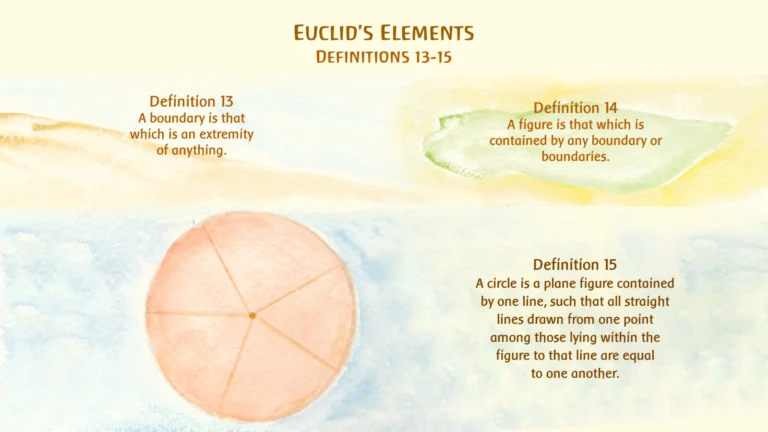
Through the process of physical measuring, certain forms began to appear. When a rope is stretched between two points, a straight line is formed. When boundaries are fixed, triangles arise. When space is organised around a central point, the circle comes into being. These shapes were not studied in themselves. They emerged naturally through repeated practical activity.
Over time, and across generations, these methods were refined. The same procedures produced the same results, and because of this consistency they became trusted. The forms carried reliability, though their meaning remained within the act of measurement itself. At this stage, it is important to recognise that these shapes existed only in relation to physical construction and use.
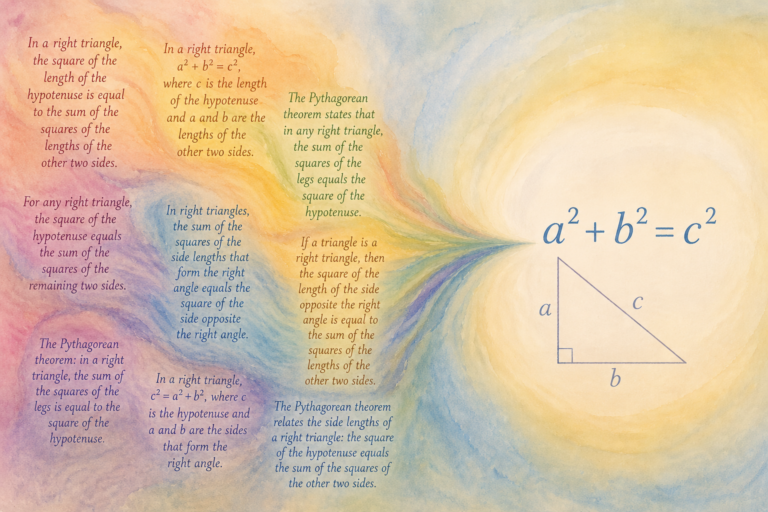
With the Pythagoreans, a shift begins to take place. Attention moves from the act of forming shapes to the relationships within them. Lengths are compared, ratios are examined and patterns begin to stabilise across different instances. Results such as the Pythagorean theorem emerge, showing that a right-angled triangle carries a consistent numerical relationship between its sides.
Geometry here is no longer only a matter of doing. There is an increasing awareness of structure. However, this understanding remains closely connected to specific cases and numerical relationships that are observed rather than systematically derived.
Around 300 BCE, Euclid brings together this growing body of knowledge in his work known as the Elements. The shift that takes place here is fundamental and needs to be seen clearly.
Euclid does not begin with shapes as they appear through measurement, nor with known numerical results. He begins by establishing the conditions under which geometric objects can be defined and constructed.
He first sets out general principles of reasoning, now called axioms, which determine how equality and comparison function. These are not specific to geometry but apply more broadly to quantities. He then introduces postulates, which specify what constructions are allowed in geometry, such as drawing a straight line between two points or constructing a circle from a given centre and distance. After this, definitions are given, which fix the meaning of objects such as points, lines and circles within the system.
Only once these conditions are in place does Euclid proceed to propositions. Some of these involve constructions, while others establish relationships that must hold. Each proposition is supported by a proof, where every step follows from what has already been stated or established.
In this way, geometry is no longer grounded in physical measurement or observed pattern alone. It develops from clearly stated starting conditions, and each result follows necessarily from these foundations.
So the logical structure of Euclidean geometry is:
Axioms → rules of reasoning that determine how equality and comparison behave
Postulates → rules that govern what can be constructed in a two-dimensional space
Definitions → rules that determine what objects are
Constructions → acts that bring geometric objects into existence within the rules of the system
Propositions/Theorems → results that follow logically from axioms, postulates, definitions, and constructions
Proofs → logical reasoning that shows why a statement must be true, based on axioms, postulates, definitions and constructions
Euclid’s Axioms
Axioms are general statements about how quantities behave. They do not belong only to geometry. They apply in any situation where equality, addition, subtraction or comparison is involved.
They are not derived from earlier results. They are taken as starting points. This is important to recognise clearly. When a proof is constructed, each step must rest on something that has already been established. The axioms provide that base. Without them, there would be no stable way to justify how one step follows from another, and the argument would not hold together.
In Euclid’s work, these axioms are often called common notions. They describe how equality can be transferred, how quantities combine and how comparisons are made. Every geometric proof depends on them, even when they are not stated explicitly in each step.
- The first axiom states that things equal to the same thing are equal to each other.
At this stage, it is important to slow this down and see exactly what is being claimed. Equality is not being established through direct comparison each time. Instead, a condition is given under which equality can be transferred.
Suppose we have three quantities. If the first is equal to the second, and the second is equal to the third, then the first and the third must also be equal. This can be written symbolically as:
If A = B and B = C, then A = C.
What is being introduced here is a way for equality to move through a chain of relationships. The first and third quantities do not need to be placed alongside one another for comparison. Their equality follows from their shared relation to the second. In a geometric context, this becomes especially significant. If one line segment is shown to be equal in length to another, and that second segment is shown to be equal to a third, then the first and third are already determined to be equal. The proof does not need to return and measure or construct a direct comparison between them. This allows the argument to proceed step by step. Each established equality can be carried forward and connected to the next. Without this, every relationship would need to be verified independently, and the structure of the proof would not extend beyond isolated observations. So this axiom does more than state a simple fact about equality. It sets the condition under which equality can be sustained across a sequence of steps, making it possible for a proof to develop in a continuous and connected way. - The second axiom states that if equals are added to equals, the wholes are equal.
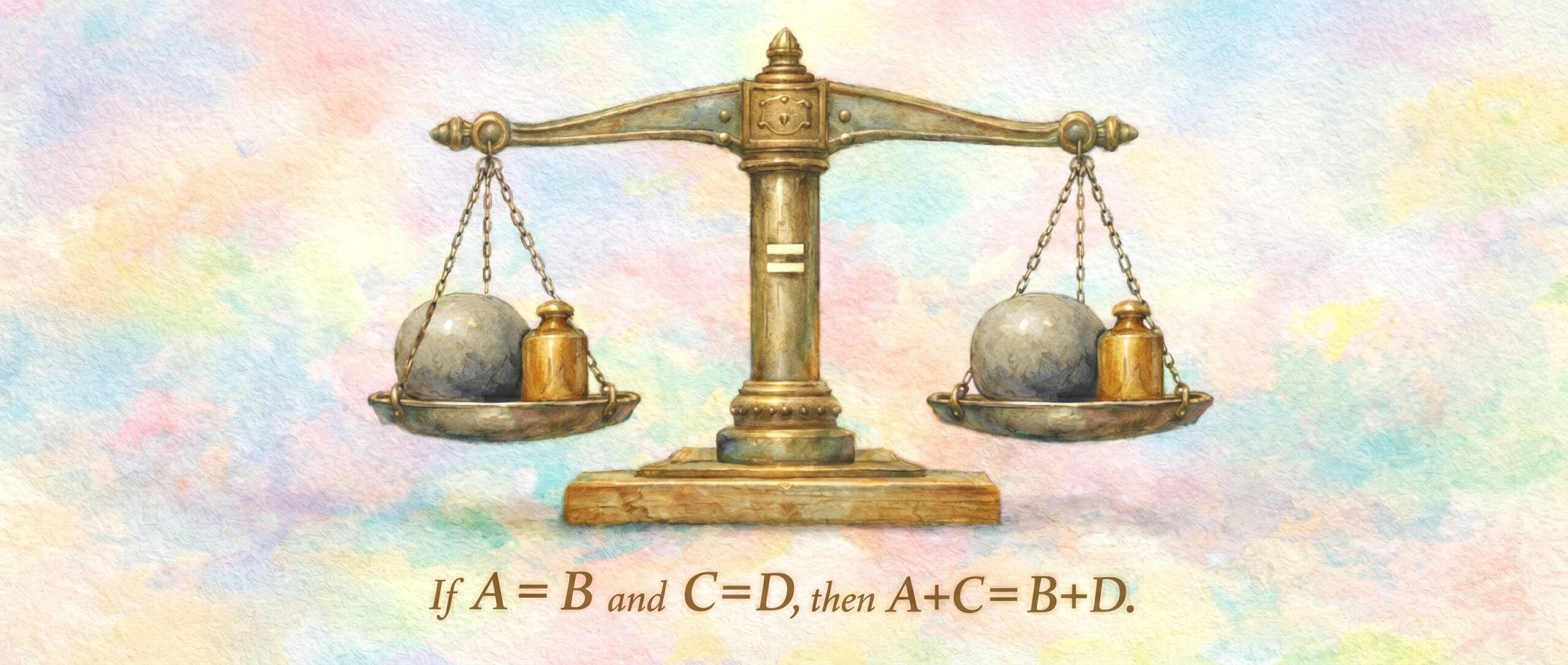
Here again, it helps to slow the statement down and see what is being allowed. We begin with two quantities that are already equal. Then we add equal amounts to each of them. The claim is that the equality is preserved through this process. Symbolically, this can be written as:
If A = B and C = D, then A + C = B + D
This expresses a very precise idea. Equality is not disturbed by the act of adding equal parts. The balance is maintained as the quantities grow. In a geometric setting, this becomes clear when working with lengths or figures. If one line segment is equal to another and equal lengths are added to each, the new, longer segments must still be equal. The extension does not introduce any difference between them. What matters here is that the addition is controlled. The same quantity is added to each side. Because of this, the original equality continues to hold within the larger whole. This axiom allows a construction or argument to move forward. A figure can be extended, a length can be increased and the relationships already established do not need to be reconsidered from the beginning. The equality carries through the change. In this way, the axiom ensures continuity within the proof. As quantities are built up step by step, the structure remains stable and each new stage remains connected to what has already been established. - The third axiom states that if equals are subtracted from equals, the remainders are equal.
As before, it is worth taking a moment to see exactly what is contained in this statement. We begin with two quantities that are equal. From each of these, equal parts are removed. The claim is that what remains after this removal must still be equal. Symbolically, this can be written as:
If A = B and C = D, then A − C = B − D.
The structure is closely related to the second axiom, but the direction of movement is different. Instead of building quantities up, we are now reducing them. What is important is that the reduction happens in the same way on both sides. In a geometric context, this often appears when a larger figure contains equal parts that are taken away. If two line segments are equal and equal portions are removed from each, the remaining segments must still correspond. The equality is preserved through the act of subtraction. This allows a proof to move inward, so to speak. A figure can be simplified, a part can be isolated, and the relationships that were established at the larger scale continue to hold within what remains. Without this principle, every reduction would break the connection to what came before. Each time something was removed, the argument would need to be rebuilt from the beginning. This axiom ensures that the structure of the proof remains intact even as quantities are decreased. In this way, equality is maintained not only as figures are extended, but also as they are reduced. The argument can move in both directions, outward and inward, while remaining consistent at each step. - The fourth axiom states that things which coincide with one another are equal to one another.
To understand this clearly, we need to look carefully at what is meant by coincidence in this context. Here, equality is not established through a chain of reasoning or through operations like addition or subtraction. Instead, it is established through exact correspondence. If two objects can be placed in such a way that every part of one aligns perfectly with the other, then there is no difference between them in form or magnitude. This idea can be expressed symbolically by indicating that one object can be mapped directly onto another:
If A ≡ B, then A = B.
The symbol here is used to represent coincidence or exact superposition. It indicates that one figure can be placed onto the other without any mismatch. In a geometric setting, this often appears when two figures are shown to match exactly in shape and size. If one triangle can be placed onto another so that all corresponding sides and angles align, then the two triangles are equal. The equality does not need to be derived through separate comparisons of each part. It follows from the complete correspondence of the figures. What this axiom introduces is a direct way of recognising equality. Instead of building equality step by step, it allows it to be seen in a single act of alignment. This becomes important in proofs where figures are compared as wholes. Once coincidence is established, equality is secured and the argument can proceed from that point without further breakdown. In this way, the axiom connects equality to exact agreement. Where there is perfect correspondence, there is no distinction to be made, and the figures are taken to be equal. - The fifth axiom states that the whole is greater than the part.
As with the previous axioms, it is worth pausing to see what is being fixed here. Up to this point, the axioms have described how equality behaves. Here, a relation of order is introduced. Quantities are no longer only equal or not equal. They can now be compared in terms of greater and lesser. The statement assumes that one quantity contains another as a part of itself. When this is the case, the containing quantity must exceed the part. Symbolically, this can be expressed as:
If B is a part of A, then A > B.
This introduces a clear direction. A quantity cannot be equal to one of its own parts, nor can it be smaller. The whole necessarily extends beyond any portion taken from it. In a geometric context, this appears whenever a figure is considered alongside one of its components. A complete line segment is greater than any segment contained within it. A whole figure is greater than any region that forms part of it. The comparison does not depend on measurement in each instance. It follows directly from the relation between whole and part. This axiom allows distinctions to be made within a figure. It becomes possible to say that one length exceeds another, or that one region is larger than another, based on their relation rather than on direct measurement. Without this, there would be no fixed way to speak about size or extent within the system. Every comparison would remain uncertain. This axiom establishes a basic ordering that supports further reasoning about magnitude. In this way, it completes the initial framework. Equality can be transferred, preserved and recognised, and now quantities can also be placed in order according to their extent.
Closing Thoughts
In the next article, we will turn to Euclid’s geometric postulates and see how they establish the conditions of the geometric world, together with the definitions that give form to the objects within it. Up to this point, we have been laying the groundwork carefully. With these elements in place, we will be in a position to move into the study of theorems and proofs, where the structure we have been building begins to unfold more fully.
This article forms part of a series of nine articles tracing how language becomes mathematics. All nine articles are now available together in a 57-page PDF for your convenience – for the price of a coffee, US$4.