This blog started with a deep longing to understand the why behind mathematics. I wanted to go beyond procedures and proofs. I wanted to understand the very fabric – the make-up – of the reasoning behind it. How did humanity come to define the premises on which reasoning rests? Who decided that if we argue in a particular way, the conclusion will be true?
These are big questions, and sometimes in my quest I have stood in front of the abyss and wondered: who am I to question it? I am just this tiny human, and before me stretch thousands of years and countless brilliant minds who dedicated their lives to the pursuit of truth and to mapping our space and our minds. Isaac Newton famously wrote, “If I have seen further, it is by standing on the shoulders of giants.” I started to comprehend this more and more and couldn’t help but feel awe and gratitude towards the great minds who helped shape mathematical thought and reasoning.
As I went deeper it felt more and more that I was not just exploring mathematics – I was entering into the very fabric of existence. I felt like one of the ancient explorers I imagine, standing before the endless seas, about to embark on a quest without knowing what awaited them beyond the blue horizon – with faith, courage, and the stars as their only beacons of direction.
Was mathematics discovered or invented? Does it shape our future, or are we simply moving deeper into awareness as our shared destiny unfolds? Is mathematics the ultimate quest for truth, or is it a dynamic system that shapes and organises our daily existence into more intelligible, structured pathways? Can the intellectual pursuit of abstracting processes and form become a prison for the unlimited creative freedom of life itself, or is it actually a tool for freedom?
My quest to understand has led me to explore the Logos, our psychological health and make-up, philosophy, the history of abstraction and logic, and finally Euclid. I have only touched on these subjects. As I have gone along, however, the direction of this exploratory blog has become a lot clearer.
In my teaching years I have found that context is the key to understanding anything more fully. And it is the same here. Whenever during my teaching years, I gave children the history and the bigger picture first they were able to understand the lesson so much better. So I have drawn up a map of the development of mathematics, logic and reasoning from early practical mathematics through to present-day mathematics. I intend to publish a series of articles covering this history in as much depth as is needed to form a clear picture of how mathematical thought developed through the ages and how it came to shape and influence our daily existence in all fields.
To understand how these articles will develop, we first need to look at the following:
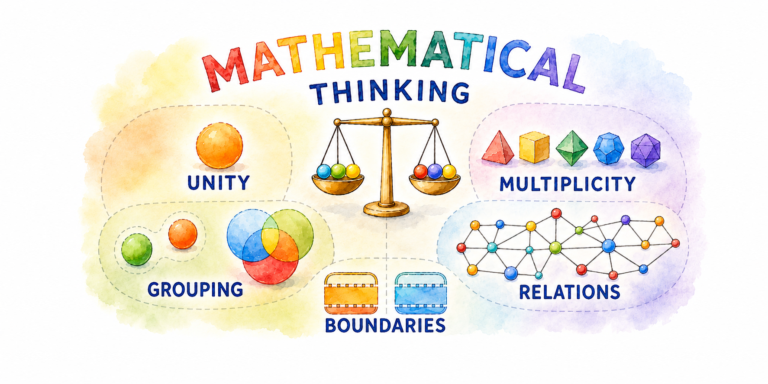
Conceptual understanding gives us a grasp of mathematical ideas, their meaning and their relationships. Procedural skill enables us to carry out mathematical operations and use methods appropriately. Mathematical reasoning allows us to investigate questions, recognise patterns and structures, form conjectures, develop arguments and justify conclusions. These abilities continually support one another, and throughout the history of mathematics they have developed together.
The focus here will be on how mathematical reasoning developed: how practical methods led to the recognition of patterns and recurring structures, how these structures were increasingly abstracted and expressed, and how systematic forms of mathematics developed in which conclusions could be established through deductive argument. We will look at the development of proof, axiomatic systems, symbolic mathematics and the birth of abstract structures that eventually made modern mathematics possible.
Along the way we will ask what assumptions mathematical arguments begin with, what is accepted as true, what logical structures allow one statement to follow from another, and why certain forms of reasoning preserve truth from premises to conclusions. We will also explore how these ways of reasoning developed historically and how mathematical concepts, procedures and reasoning came to work together in the mathematical systems that shape so much of modern life.
Take a simple example. We can use addition to calculate that five plus seven equals twelve. Understanding odd and even numbers involves recognising how quantities can be arranged in pairs, with or without one left over. We can then ask: must the sum of any two odd whole numbers always be even? Each odd number consists of pairs with one left over. When we bring two odd numbers together, those two remaining ones form another pair. We have now explained why the result holds for any two odd whole numbers. The reasoning carries us from a particular calculation to a general conclusion.
Developing this capacity involves practising how to recognise patterns, form conjectures, examine assumptions and test our ideas. We learn to ask why a particular step is justified, whether a conclusion follows from its premises, and whether an argument holds when the circumstances change. Understanding an explanation someone else has given and constructing an argument ourselves place different demands on our thinking. We will explore both avenues.
This series will not only deepen our understanding of mathematics. It should also have a profound effect on the way we view life, encouraging us to examine it more closely and approach it with greater insight and comprehension.
Along the way, it will become clearer why studying Euclid is such a wonderful way to develop mathematical thinking and reasoning. Our exploration of Euclid will therefore continue alongside the articles on the history of mathematical thought. Each article will be clearly marked so that you know which series it belongs to.
I am very grateful for your presence on this journey and would love for you to participate and share your views and insights in the comments as the series progresses.
My articles will remain free for the foreseeable future. However, I would be very grateful if you would support the continuation of my work by occasionally buying me a cup of coffee through PayPal using the link here.
I am also in the process of creating extended compilations of related articles, bringing the different strands together into larger, more coherent explorations. I hope to have the first of these available soon.
Our relationship with mathematics will ultimately shape how it manifests in our lives.
References
- Newton, I. (1675). Letter to Robert Hooke, 5 February 1675/76. Source of the well-known “standing on the shoulders of giants” quotation.
- OpenAI. (2026). ChatGPT (GPT-5.6 Sol). Editorial assistance, language refinement and discussion of mathematical and philosophical concepts.
- SummerGlow. Image used in this article. Pixabay.