Skip to content
Sacred Mathematics

Sacred Mathematics

  • Home
  • About
  • Stories
  • ArticlesExpand
    • How Mathematical Systems WorkExpand
      • Mathematics and Language
      • Euclid and Geometry
    • Teaching Mathematics With Meaning
    • Healing Our Relationship with Mathematics
    • Philosophical Reflections
  • ShopExpand
    • Store PoliciesExpand
      • Refund and Returns Policy
      • Privacy Policy
  • Contact
  • Shopping Cart 0
    • No products in the cart.

Sacred Mathematics
Sacred Mathematics
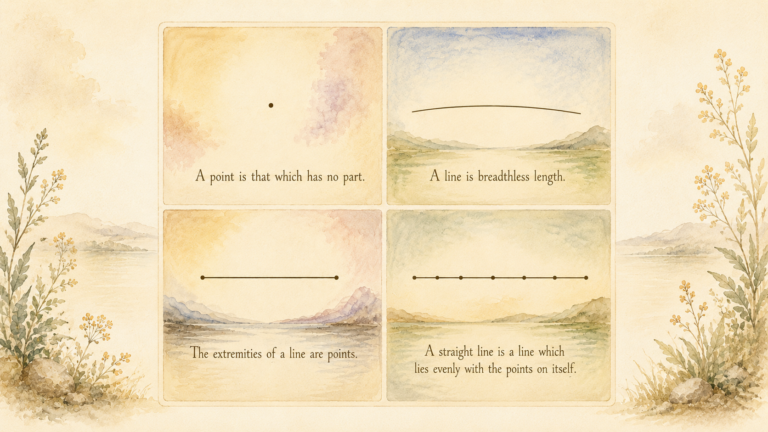
  • Geometry: Euclid’s Definitions 1 – 7: A Deeper Exploration
    Euclid and Geometry

    Geometry: Euclid’s Definitions 1 – 7: A Deeper Exploration

    BySacred Mathematics June 2, 2026June 2, 2026

    Euclid’s Definitions Before we can understand the first definitions in Euclid’s Elements, we need to establish a frame of orientation. Geometry begins when the mind is able to distinguish position, relation, extent, boundary and form against a larger spatial field. Geometry does not begin only with circles and triangles drawn on paper. It begins with…

    Read More Geometry: Euclid’s Definitions 1 – 7: A Deeper ExplorationContinue

  • Equilateral Triangle
    Euclid and Geometry

    The First Geometric Construction: Where Definitions Begin to Take Form 

    BySacred Mathematics May 13, 2026May 26, 2026

    In the previous articles, we explored how Euclid sets a geometric world in motion through his axioms – or common notions as they are referred to in ‘The Elements’ – and his postulates. Once these foundations are in place, something remarkable becomes possible: form can be explored in a two-dimensional realm on a flat surface…

    Read More The First Geometric Construction: Where Definitions Begin to Take Form Continue

  • Euclid’s Postulates: The Foundations of Geometry
    Euclid and Geometry

    Euclid’s Postulates: The Foundations of Geometry

    BySacred Mathematics May 13, 2026May 26, 2026

    The conditions under which geometry becomes possible Introduction In the previous discussion, we examined the axioms of Euclid as general principles governing equality and comparison. These statements stabilise the field of reasoning. They establish the conditions under which relationships between quantities can be recognised and maintained, allowing a proof to proceed with continuity and coherence….

    Read More Euclid’s Postulates: The Foundations of GeometryContinue

  • From Words to Symbols: How Abstraction Clarifies Rather Than Escapes Reality
    Mathematics and Language

    From Words to Symbols: How Abstraction Clarifies Rather Than Escapes Reality

    BySacred Mathematics May 13, 2026June 1, 2026

    Symbols are often misunderstood as a departure from reality – as if abstraction were a form of distancing or simplification that strips experience of its richness. In mathematics especially, symbols are sometimes treated as cold replacements for meaning, a shorthand that sacrifices depth for efficiency. Yet this view mistakes what symbols actually do. A symbol…

    Read More From Words to Symbols: How Abstraction Clarifies Rather Than Escapes RealityContinue

  • The Ground of Geometry: Understanding Euclid’s Axioms
    Euclid and Geometry

    The Ground of Geometry: Understanding Euclid’s Axioms

    BySacred Mathematics May 13, 2026May 26, 2026

    Introduction Having seen how axioms function at a broader level, both within mathematics and by analogy within human reasoning, we now return to them with a more focused lens. In the introduction to Euclid’s work in the previous post, the structure of geometry was set out as a whole, showing how axioms form the foundation…

    Read More The Ground of Geometry: Understanding Euclid’s AxiomsContinue

  • Logical Operators in Mathematics
    Mathematics and Language

    Logical Operators in Mathematics

    BySacred Mathematics May 13, 2026June 1, 2026

    Truth Relationships Between Mathematical Statements Introduction In the previous blog, Language and Formal Mathematical Reasoning, we examined how language introduces logical operators and relational structures that allow ideas to be related to one another. Words such as and, or, if, then and not organise how statements connect, depend on one another or exclude one another, while words such as because and…

    Read More Logical Operators in MathematicsContinue

  • Language and Formal Mathematical Reasoning
    Mathematics and Language

    Language and Formal Mathematical Reasoning

    BySacred Mathematics May 13, 2026June 1, 2026

    How Relational Words Prepare the Mind for Logic. Mathematical reasoning rests on relationships between ideas. Long before symbols appear, language already introduces the structures that make this reasoning possible. Everyday speech contains relational words that organise how statements connect, depend on one another, or exclude one another. Through repeated use, these structures stabilise in thought….

    Read More Language and Formal Mathematical ReasoningContinue

  • How the Body, Language and Experience Create the Foundations of Mathematical Thinking
    Mathematics and Language

    How the Body, Language and Experience Create the Foundations of Mathematical Thinking

    BySacred Mathematics May 12, 2026June 1, 2026

    How the language of relationships, boundaries and distinctions prepares the mind for number The Body as the First Mathematician Mathematical thinking begins long before numbers appear. Its first roots grow in the body. Long before a child can speak or recognise symbols, their movements, sensations, balance, rhythm and gestures are already organising experience in a…

    Read More How the Body, Language and Experience Create the Foundations of Mathematical ThinkingContinue

  • How Meaning Is Formed with Words
    Mathematics and Language

    How Meaning Is Formed with Words

    BySacred Mathematics May 12, 2026June 1, 2026

    Language as the First Architecture of Thought. Clear thinking begins long before a conclusion ever appears on the horizon. It begins in the earliest stirring of awareness, at the moment when something felt, seen or sensed starts to move toward language. This is the alchemy of thought: experience becoming form, fluid impressions taking on shape…

    Read More How Meaning Is Formed with WordsContinue

  • close up of a unique snowflake on gradient background
    Philosophical Reflections

    Pathways That Formed Our Way of Knowing

    BySacred Mathematics May 12, 2026June 1, 2026

    The History of Mathematical Thinking Children in school are not taught to think mathematically. This creates a gap in understanding that often stays with them throughout life. Mathematical thinking is not lifeless, mechanical or purely intellectual – far from it. It begins in the body’s encounter with the living world. Rudolf Steiner noted that the…

    Read More Pathways That Formed Our Way of KnowingContinue

Page navigation

1 2 Next PageNext

Mentor: Lydia J van Vuuren
Western Cape
South Africa
info@sacredmathematics.com

  • Store Policies
  • Privacy Policy
  • Refund and Returns Policy
  • Contact

Follow Me

Facebook Instagram

© 2026 Sacred Mathematics

  • Home
  • About
  • Stories
  • Articles
    • How Mathematical Systems Work
      • Mathematics and Language
      • Euclid and Geometry
    • Teaching Mathematics With Meaning
    • Healing Our Relationship with Mathematics
    • Philosophical Reflections
  • Shop
    • Store Policies
      • Refund and Returns Policy
      • Privacy Policy
  • Contact