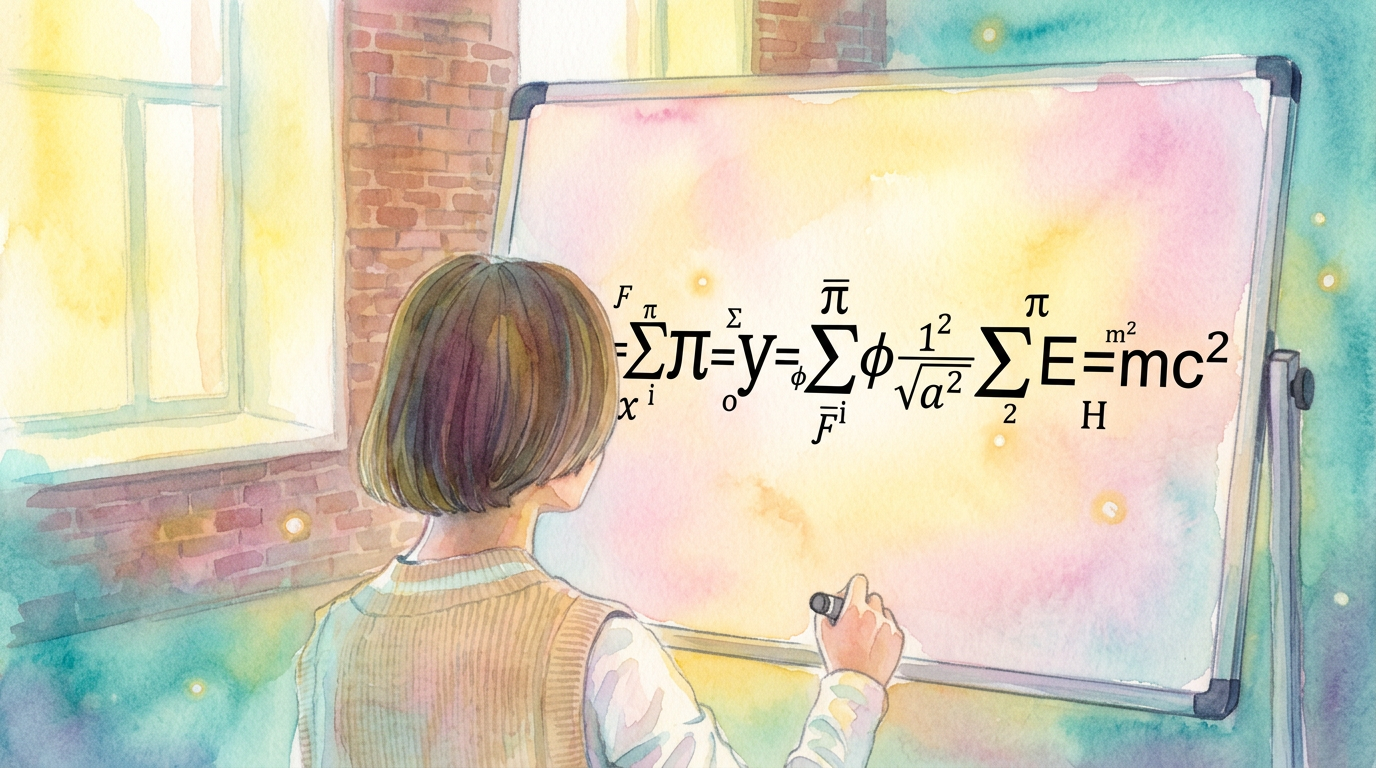
How mathematics moves from the visible world into invisible relationships
Why Does Abstraction Frighten Us?
In my experience, one of the primary reasons why some of us react with fear when faced with an abstract mathematical formula is that somewhere in us we register that we are looking at something meaningful, something powerful, something fundamentally connected to the way the world works, and yet we do not know what it is.
A formula can feel like a sealed door. We sense that somehow behind this door lies something that makes the world go round, and we have no idea how to enter it. This can make us feel very vulnerable.
Complexity scares us. Not knowing scares us. Being excluded from meaning scares us.
It is a human thing.
So what can we do to make peace with the fear that can arise in the process?
We can begin by understanding the process of abstraction itself.
Many people do not understand where abstraction comes from or how it develops. Yet understanding how something comes about can already pacify many fears.
At its core, abstraction does the following:
It looks at many instances where something is inherently similar. Then it lets go of everything that is not essential and retains the sameness, so that the essential relationship can become visible.
And this is its path:
Experience → noticing → naming → comparing → generalizing → symbolizing → abstract reasoning.
For some of us, looking at this path can stir anxiety. Our intuitive selves may rebel against it. Alarm bells can go off. The soul may ask: “What about me? Am I to be reduced to a formula?” The imagination may protest: “I cannot be contained in rigid symbols. I am alive. I move. I reach beyond form.”
These are powerful human reactions.
At this point, the process of abstraction touches something much deeper than school mathematics. It brings us face to face with the tension between freedom and form. The embodied, intuitive, imaginative part of us does not want to be trapped. It does not want to be flattened into dead symbols. It does not want the mystery of existence reduced to a mechanism.
And yet it is right here, at this point of contention, that the beauty reveals itself.
Abstraction does not have to be the enemy of intuition. It does not have to imprison imagination. At its best, abstraction gives form to what intuition has already begun to perceive.
The problem comes when abstraction is introduced too quickly, before the mind has had enough embodied experience to support it. Then the formula feels empty, cold and threatening. It feels like a wall. But when abstraction grows out of experience, image, comparison, language and relationship, it becomes a bridge.
This is where clear intention becomes important.
Before engaging with mathematics, we can reassure the intuitive and imaginative parts of ourselves that they are not being negated. They are not being discarded. They are not being asked to leave the room.
They are essential to the process.
Intuition helps us sense pattern before we can explain it. Imagination helps us form inner pictures. Feeling helps us recognize when something is meaningful. Abstraction then helps us clarify, refine and carry these insights into more exact thought.
Peace comes when abstraction, intuition and imagination are no longer enemies.
Abstraction supports intuition by giving it structure. Intuition supports abstraction by keeping it connected to meaning. When these two forces work together, mathematics becomes less frightening. It becomes a disciplined way of seeing more deeply into relationship, pattern and form.
An example of the process of abstraction.
The best way sometimes to understand something is to look closely at the unfolding path it follows in the embodied world.
1. The Number 3: From Experience to Quality to Abstraction
Let us begin with the number 3.
The child first encounters the number 3 in the world in three ways – as a quantity, as a quality inherent to the nature of the world and also as a placeholder for sequence.
Quality of Numbers
Let’s first look at how the child meets three in the world as a quality.
Three is an inherent quality of wholeness, balance and completion. It is present in the beginning, middle and end of an event, project or task. It is present where two opposing forces meet a middle, forming either a balanced or unbalanced structure. It is part of how we structure our days – morning, afternoon and evening. It is also an inherent quality in our experience of time: past, present and future.
We find it in bottom, middle and top and also in the family image of mother, father and baby. In geometry, the triangle embodies this three-ness, where three straight sides form an enclosed figure.
This is where the Waldorf approach has something valuable to offer. In Waldorf education, young children first meet the world through movement, rhythm, image, story and experience. This is also true with regard to numbers. The quality of numbers is traditionally the first lesson children receive in mathematics. The numbers 1 – 12 are related to their inherent presence in embodied existence, nature and in human thought. Through drawing, storytelling, poems, songs and the arts, the qualities of numbers are brought to children with warmth and imagination. Children learn from the beginning that each number contains worlds of meaning and that the symbol is only a way to hold the meaning.
Numbers as a Quantity
Three apples on a table.
Three stones in a hand.
Three birds on a branch.
Three fingers held up in the air.
At first, these experiences are concrete and particular. The apples are red. The stones are rough. The birds move. Each experience of three is part of its situation.
Then the mind starts to notice – it sees that there is something similar in all the situations.
The apples are not the stones. The stones are not the birds. The birds are not the fingers. Yet each group carries the same quantity. Something remains constant while everything else changes.
Numbers in Sequence
A child can also encounter three-ness in sequence. Three is not only a group of three things seen all at once. It can also unfold one after the other. The child takes three steps across the room: one, two, three. The child hears three knocks on the door, three claps in a rhythm or three notes in a little song. In this way, three is experienced through time. It has a beginning, a middle and an end. The child feels that the first comes before the second and the second before the third. The child comes to know that number 3 is not only pointing to a quality or quantity but it also is present in order. It has a place in time, movement and rhythm before it is ever written as the symbol 3.
This is exactly here where abstraction begins.
If everything falls away then the only thing that remains constant is the number three. So human beings assigned a symbol to represent the number three – 3. This symbol holds the meaning discussed above. It can hold quantity, sequence, rhythm, form and quality. Yet when it appears in mathematics, its exact function depends on the context. Sometimes 3 tells us how many. Sometimes it tells us where something stands in order. Sometimes it is used as a factor, an exponent or part of a larger relationship.
The symbol stays the same, but the role it plays changes according to where and how it is used.
The written sign “3” is not just a number in itself. It is a sign that points to a reality the child has already begun to know. If the child has met three richly, then the symbol is not empty. It carries apples, stones, birds, claps, steps, fingers, triangles and stories within it.
This is healthy abstraction.
The mind lets go of the redness of the apples, the roughness of the stones, the movement of the birds and the sound of the claps. It does not reject these experiences. It gathers them and keeps what is essential.
The three-ness remains constant though out. So it is retained.
Abstraction is the gathering of experience into essence.
Closing Thoughts
When we understand this process, abstraction becomes less frightening. We begin to see that the symbol doesn’t take away meaning from the world but that it holds meaning. The problem arrives when abstraction is done before experience has been observed and integrated into personal experience adequately. If the child or the adult has contemplated and integrated the embodied reality behind a symbol, equations won’t feel like a locked door. It becomes a doorway. It gathers the world into a smaller form so that the mind can work with it more freely. This is how we begin to make peace with abstraction. We do not have to choose between embodied experience and exact thought. The one can lead into the other. Mathematics then becomes what it was always meant to be: not a cold removal from reality, but a deeper way of entering it.
This article forms part of a series of nine articles tracing how language becomes mathematics. All nine articles are now available together in a 57-page PDF for your convenience – for the price of a coffee, US$4.