Euclid’s Definitions
Before we can understand the first definitions in Euclid’s Elements, we need to establish a frame of orientation. Geometry begins when the mind is able to distinguish position, relation, extent, boundary and form against a larger spatial field.
Geometry does not begin only with circles and triangles drawn on paper. It begins with the mapping of space. Long before geometry was arranged into a formal system, people measured land, drew lines, made circles, compared lengths, observed angles, built structures and traced the order of the heavens. Geometry grew from this contact with space: with position, direction, boundary, surface, figure and relation.
In modern life, attention is often divided. Screens, media, advertising, social platforms, and constant streams of information compete for our attention. Yet attention is a limited human capacity. When the field of awareness is overcrowded, it becomes harder to notice simple spatial relationships: where something is, how it is placed, what lies near it, what lies beyond it and how one form relates to another.
Yet mathematics, and geometry in particular, requires this kind of attentiveness. Geometry begins with the ability to isolate one aspect of experience from the surrounding complexity. Before there can be measurement, proof, construction or abstraction, there must first be orientation.
At the most basic level, anything that can be observed or described must be located in some way. A star has a position in the sky. A stone has a position on the ground. A mark on a page has a position in relation to the edges of the page. A point in a diagram has a position in relation to other points, lines and figures. Position is therefore one of the most fundamental ideas in mathematical thought.
This becomes clearer when viewed against the larger background of existence. Earth itself is not fixed in an absolute sense. It rotates on its axis, orbits the Sun, and moves with the solar system through the Milky Way. The Milky Way itself moves within a larger cosmic structure. Every object, from a grain of sand to a planet, can be understood as occupying a position within a system of relations.
In this sense, “somewhere” is not a material object. It does not have weight, colour, texture, or size. It is a location within a field. It is a reference point. To say that something is “here” or ‘there’ is already to begin thinking geometrically, because the words imply relation: relation to the observer, relation to other objects and relation to the surrounding space.
Ancient geometry emerged from this need to understand position, extension, boundary, and form. Ancient scholars observed the world through the movements of the stars, the shape and direction of shadows, the division of land, the construction of buildings and the regularities found in natural and human-made forms. Straight lines, triangles, and circles were not first encountered as abstract ideas alone; they were used, drawn, measured and constructed.
Around 300 BCE, Euclid gathered and organised this inherited body of geometrical knowledge in The Elements. He did not invent geometry out of nothing. He arranged earlier spatial practice and mathematical thought into a disciplined logical form. In Book I, this begins with the Definitions. These definitions take familiar geometric forms and relations and give them exact abstract mathematical meaning. They transform visible and practical forms into ideal mathematical objects that can be used for precise reasoning. The Elements is generally understood as an organised synthesis of earlier Greek mathematical knowledge, and Book I is formally arranged through definitions, postulates, common notions and propositions.
After the definitions, Euclid gives the postulates. These are the basic permissions and assumptions that allow the defined objects to be used in construction and proof. The first three postulates are especially constructive: they allow a straight line to be drawn from any point to any point, a finite straight line to be extended continuously in a straight line and a circle to be described with any centre and distance.
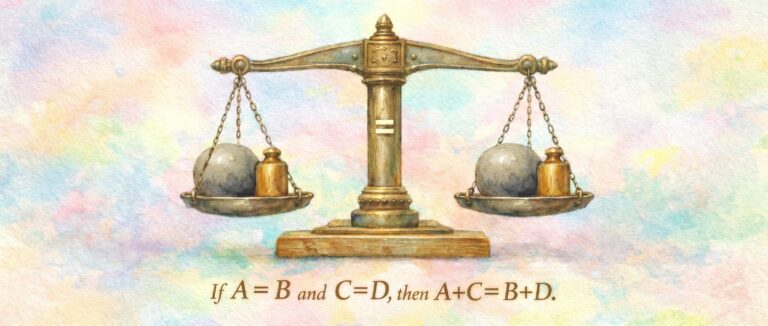
Finally, Euclid sets out the Common Notions: general principles of equality and comparison, such as the idea that things equal to the same thing are equal to one another, and that the whole is greater than the part. These are not specific to one figure. They are wider principles that allow reasoning itself to proceed.
This does not mean that mathematical understanding always develops in this exact order. We may first encounter lines, circles, triangles and angles through drawing, measuring and construction. Practice, construction, definition and reasoning continually inform one another. Euclid’s written order gives the material a logical form, but the life of geometry also grows through repeated movement between what is seen, what is drawn, what is measured and what is understood.
In this article, and in the ones to follow, we will take a closer look at Euclid’s definitions. We begin with Definitions 1–7, where geometry moves from point, to line, to surface and then to plane.
Euclid’s Definitions 1 – 4
Euclid begins with the simplest possible object of geometric thought: the point.
A point gives geometry its first act of orientation.
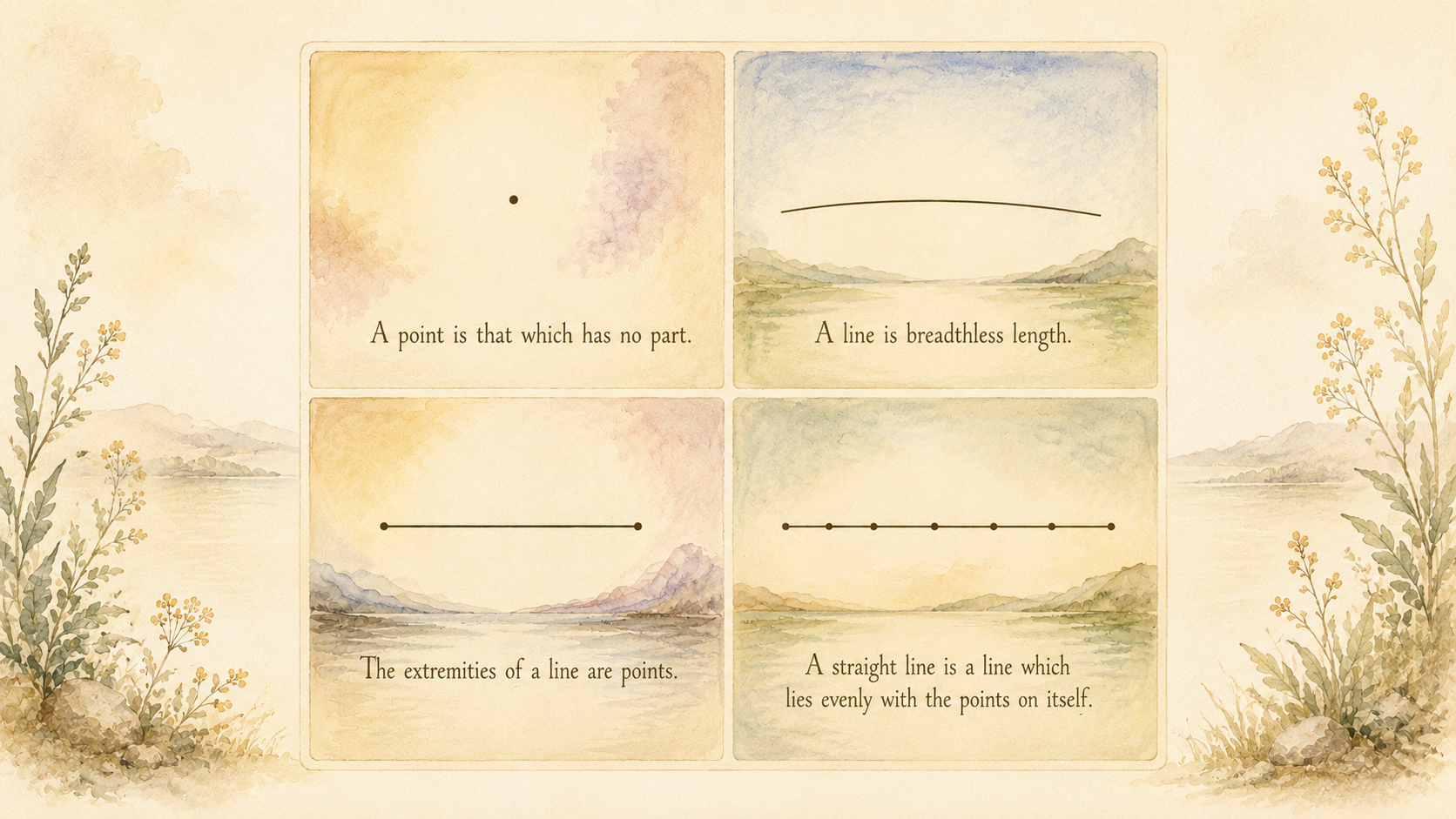
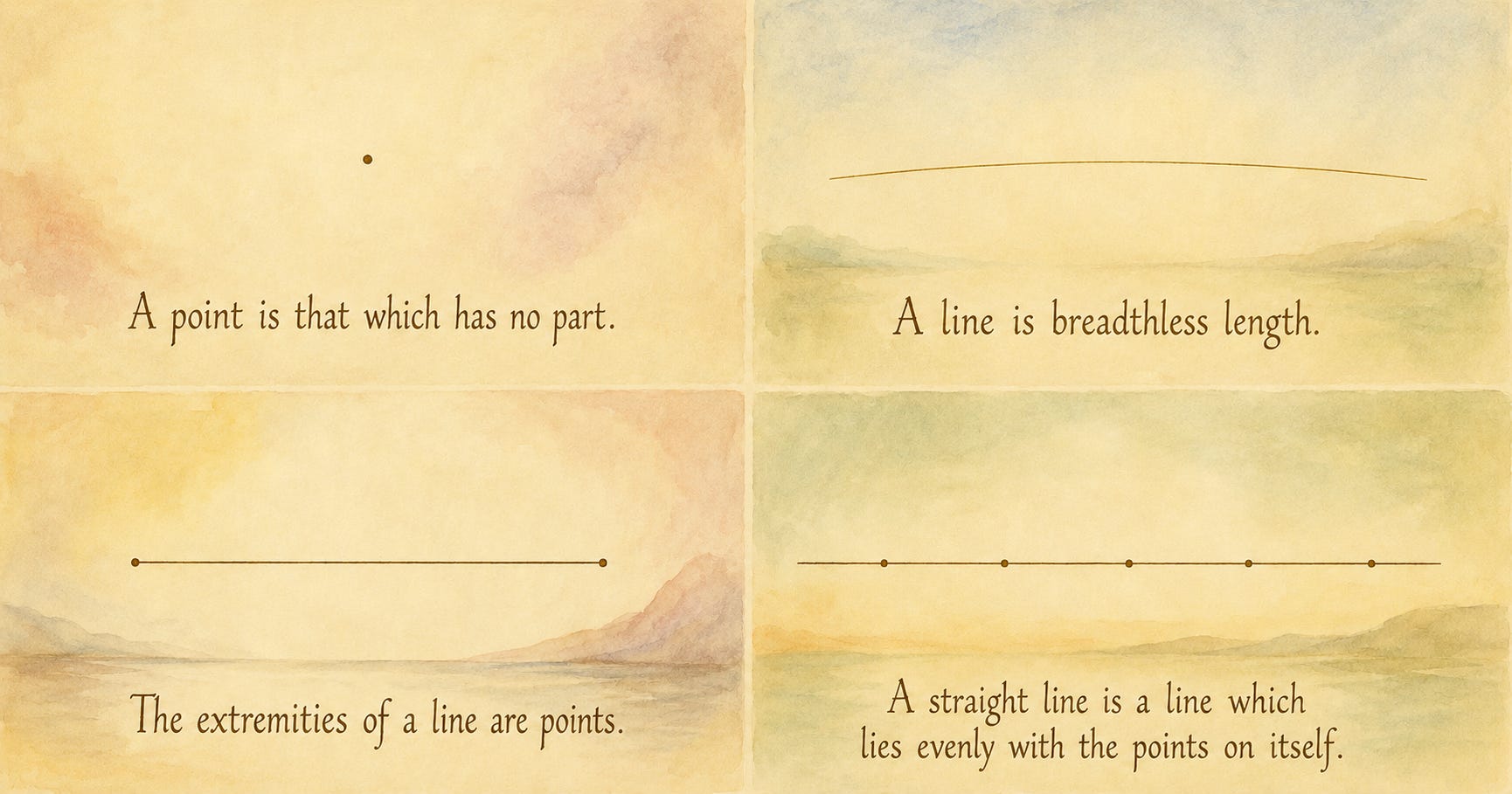
Euclid’s first four definitions state:
1. A point is that which has no part.
2. A line is breadthless length.
3. The extremities of a line are points.
4. A straight line is a line which lies evenly with the points on itself.
There is a precise logic in this sequence. Euclid begins with position, then moves to extension, then to limitation and then to straightness. Each definition depends on the one before it. The point makes location thinkable. The line makes extension thinkable. The extremities of a line show how extension can be bounded. The straight line introduces regularity and order within that extension.
Seen in this way, the first four definitions are the beginning of a complete mathematical language. Euclid is showing how geometry can arise from the most minimal act of spatial thought: the recognition of a position within a field.
From this beginning, the whole architecture of geometry becomes possible. Shapes, angles, circles, triangles, constructions, and proofs will come later. But first there must be orientation. First there must be a way to mark position against the vast background of space.
Let us now take a closer look at each of the definitions stated above and explore their qualities in greater depth.
Definition 1: A point is that which has no part
A point is that which has no part.
A point denotes position. It is a starting place. A “somewhere”.
Euclid begins with something that cannot be divided, extended, measured or broken into pieces. This is a profound beginning. A point has no part. It has no length, no width, no depth, no inside, no outside. It is not a tiny dot in the physical sense. It is not a small object. It is the idea of position stripped of all size.
A point drawn on paper does occupy space, because the pencil mark has width, substance and physical presence. But in Euclid’s world, what appears on the paper is only a visible aid to the mind. The true point is not the dot of ink or graphite. It is the idea of position without size.
Here we need to make an important shift. We are no longer relating only to the physical world with our senses. We are beginning to relate to form with the mind. A point corresponds to something real in our experience: the idea of a place, a position, a beginning. Yet we cannot reproduce this perfectly on paper. The physical mark is imperfect, but it helps us grasp the idea.
A point is therefore both incredibly simple and incredibly powerful. It gives the mind somewhere to begin. Without the point, there is no line. Without position, there can be no relation. Without a “somewhere”, no geometric world can unfold.
The point is the first act of orientation.
Definition 2: A line is breadthless length
Then Euclid defines a line.
A line is breadthless length.
This is already a remarkable abstraction. A physical line on paper always has some thickness. It takes up space. But the line of geometry has length without breadth. It extends, but it has no width.
Here the geometric world has moved one step further. The point gives us position, but the line gives us extension. Something now stretches from one place towards another. Direction begins to appear. Movement becomes possible in thought. The mind is no longer resting only on a single position. It can now follow an extension.
And this extension will later also become a boundary. A line can mark an edge. It can separate one region from another. It can become the limit of a surface. So the line is not only something that stretches; it is also something that can define, enclose and give shape. But before Euclid uses the line in this way, he first clarifies its nature. In itself, a line is length without breadth.
And yet this line is still not a physical thing. It is not a piece of string, a mark of ink, the edge of a ruler or the side of a table. All of those have thickness. All of them occupy space. Euclid’s line does not have breadth. It is length alone.
This is one of the great powers of mathematics. It can take something we experience physically and refine it until the idea becomes clearer than anything we can draw. The drawn line helps us, but it is not the full reality of the mathematical line. It is a visible doorway into an invisible exactness.
The line is therefore the first unfolding of position into extension. It is also the beginning of boundary – because once extension can be followed – it can also begin to limit, separate and shape the space in which geometry will unfold.
Definition 3: The extremities of a line are points
The third definition gives the line its limits.
The extremities of a line are points.
A finite straight line, such as the one used in Euclid’s first proposition, has ends and those ends are points.
This matters because the geometric world is now beginning to take on structure. We no longer have only position. We have extension and that extension can be limited. It can begin somewhere and end somewhere. The point, which first appeared as position without size, now returns in a new role. It becomes the boundary, or extremity, of a line.
This is an important development. In the previous definition, the line appeared as length without breadth. It opened the possibility of direction, movement and boundary. But now Euclid shows us that the line itself can also be bounded. A line may later become the boundary of a surface, but when it is finite, its own boundaries are points.
So boundary begins to work on more than one level. A point can bound a line. A line can later bound a surface. And once surfaces are bounded by lines, figures can begin to arise. The whole geometric world is beginning to reveal its layered order: each form can become the limit of something larger.
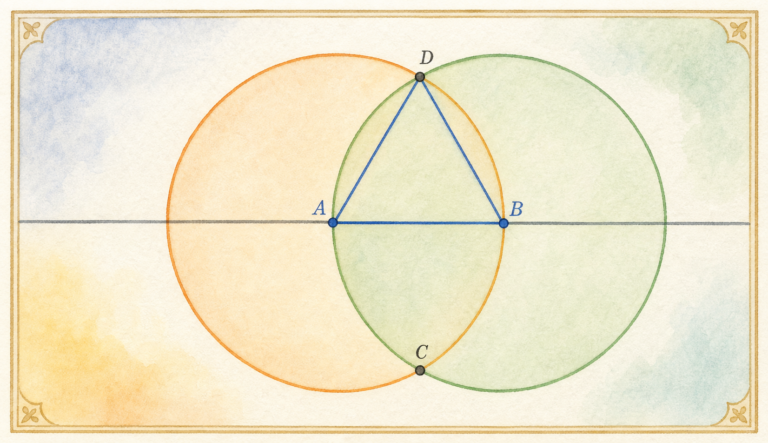
This is important for understanding Euclid’s first proposition, where he constructs an equilateral triangle on a given finite straight line. That “given finite straight line” already depends on these first definitions. It is not just any vague mark on the page. It is a line with extremities. It has two endpoints. Those endpoints matter, because the circles constructed in the proof are drawn from those points.
So Definition 3 quietly prepares us for construction. It shows us that geometry will not only be about abstract extension, but also about limited extension: about lines that begin, lines that end and points that mark those limits.
The line has length. The point has no part. But together they allow the mind to think about bounded form. Boundary is no longer merely something we see in the physical world as an edge or outline. It has entered the world of thought. It has become exact. Through this, geometry begins to build a world in which form is no longer vague, but held, limited and made intelligible.
Definition 4: A straight line is a line which lies evenly with the points on itself
After this, Euclid defines a straight line.
A straight line is a line which lies evenly with the points on itself.
Again, when we draw a straight line on paper, we draw something physical. But the drawn line is not the perfect mathematical line itself. It is a sign, a symbol – an aid to thought.
This fourth definition gives the line a particular nature. Not every line is straight. A line may be curved, wandering, bending, or irregular. But a straight line has a special kind of order. It lies evenly with the points on itself.
This wording can feel strange to the modern ear, but it points towards something essential. A straight line does not turn away from itself. It does not bend. It keeps its direction. Its points are arranged in an even relation along the length of the line. There is a kind of inner consistency to it.
The straight line is one of the most important objects in Euclidean geometry. It becomes the basis of construction, comparison, extension, joining, cutting and proof. When Euclid’s postulates later allow a straight line to be drawn from any point to any point, and a finite straight line to be produced continuously in a straight line, these definitions are already working underneath the surface.
And yet this idea does not come from nowhere. Boundaries, edges, paths, directions and extensions are all around us. The mind abstracts from the world and creates a clearer, more exact version of what it perceives. In nature, we seldom encounter perfect straight lines, yet as human beings we use straight lines constantly in the construction of our world – in roads, buildings, tools, diagrams, writing, measurement and design.
The straight line gives direction a disciplined form. It is extension held in order.
Step by step, the geometric world comes into being. Not as a collection of dry facts, but as a world of thought becoming visible.
The marks on the page are physical. They are imperfect. They have thickness, texture, and limitation. But through them the mind begins to see something else – something more exact, more ordered, and more enduring.
This is where Euclid’s definitions become alive. They are not merely words to memorise. They are the first acts of orientation in a world of form. They teach us how to look, how to distinguish, how to name and how to begin thinking mathematically.
From line to surface: the birth of the plane
Euclid’s Definitions 5 – 7
After Euclid has given us the point, the line, the extremities of a line and the straight line, something begins to open. Until now we have been dealing with position and extension. A point gives us somewhere. A line allows that somewhere to stretch into length. The extremities of a line remind us that extension can begin and end. A straight line then gives that extension a particular order.
But even with all of this, we do not yet have the full field in which geometry can take place. A line can stretch from one point to another, but it does not yet give us an area. It gives direction. It gives connection. It gives the possibility of moving in thought from one position to another. But it does not yet give us the space in which a figure can fully appear.
For this, the line must open into surface.
Definition 5: A surface is that which has length and breadth only
Euclid’s fifth definition says that a surface is that which has length and breadth only. This is another remarkable act of abstraction. A point has no part. A line has length without breadth. Now a surface has length and breadth, but no thickness.
This is not the same as a sheet of paper, a wall, a table top, or the page on which a diagram is drawn. All of these physical things have thickness. They belong to the material world, and the material world never gives us Euclid’s forms perfectly. Even the thinnest piece of paper has depth. Even the smoothest surface has texture. But the mathematical surface is different. It is the idea of spread-outness without thickness. It is the mind, grasping breadth and length while leaving depth behind.
This matters because something important has now happened. The geometric world has widened. The point gave us position. The line gave us extension. The surface now gives us a field. Something can spread out. Something can enclose. Something can begin to have area. A figure can now appear, not merely as a path or a direction, but as a form that occupies a region in thought.
Definition 6: The extremities of a surface are lines
Then Euclid gives the surface its limits. The extremities of a surface are lines. This follows with such a beautiful inner order from what came before. The extremities of a line are points. The extremities of a surface are lines. The point returns as the limit of the line, and the line now returns as the limit of the surface.
So the definitions are not isolated statements. They are beginning to speak to one another. They are creating a layered world. A point can mark the end of a line. A line can mark the boundary of a surface. Extension can be limited. A surface can be enclosed. Form begins to arise through boundary.
This is why these definitions matter for everything that follows. A triangle will later be bounded by three straight lines. A quadrilateral will be bounded by four straight lines. A circle will be bounded by its circumference. Already, quietly, Euclid is preparing the possibility of figures. He is showing us that geometry is not only about things spreading out, but about things being given form through limits.
Definition 7: A plane surface is a surface which lies evenly with the straight lines on itself
Then comes the seventh definition. A plane surface is a surface which lies evenly with the straight lines on itself.
This definition can sound strange to modern ears, just as the definition of a straight line can sound strange. But again, Euclid is trying to bring a very exact idea into language. Not every surface is a plane surface. The surface of a ball is a surface. The surface of the earth is a surface. The surface of a wave, a hill, or a fruit is a surface. These surfaces may have length and breadth, but they curve. They do not lie evenly in the way a plane does.
A plane surface is a surface that does not bend away from itself. It gives straight lines a consistent field in which to lie. It is flat in the mathematical sense. It offers the ordered space in which Euclid’s geometry can unfold.
And this is crucial, because Book I of The Elements takes place in the plane. Points, straight lines, angles, circles, triangles and rectilinear figures all need this plane if they are to be constructed and understood in the way Euclid intends. The plane is therefore not merely a blank background. It is the ordered field in which relation, construction, comparison and proof become possible.
This is the birth of the plane.
Once the plane is present, geometry has a place to happen. Lines can meet. Angles can arise. Circles can be drawn. Triangles can be constructed. Figures can be compared and proofs can be discovered.
Closing Thoughts
This is what I find so beautiful about these early definitions. At first they may appear dry, as if they are merely names to be memorised. But once we begin to see what grows from them, they become full of meaning. Euclid is preparing a world. He begins with position, lets it extend into line, gives that line limits, orders it through straightness, opens it into surface, gives the surface boundaries and then clarifies the plane as the space in which the rest of the geometry can unfold.
Only after this can the angle properly appear as the inclination of two lines that meet in a plane. Only after this can the circle take its place. Only after this can triangles and other figures be formed with precision.
So Definitions 5 – 7 bring us to a crucial threshold. The line opens into surface, and the surface becomes plane. The geometric world now has the space it needs for construction, relation and proof.