The Equilateral Triangle
In the previous articles, we explored how Euclid sets a geometric world in motion through his axioms – or common notions as they are referred to in ‘The Elements’ – and his postulates. Once these foundations are in place, something remarkable becomes possible: form can be explored in a two-dimensional realm on a flat surface and truths about space can be discovered through construction and reason.
By setting rules and conditions that correspond to spatial relationships, Euclid allows the mystery of the world around us to be glimpsed on a sheet of paper. Lines, circles, points and figures are no longer merely marks. They become part of a structured world in which relationships can be tested, followed and proved.
From these premises Euclid derived his 23 definitions, giving names to the basic objects that arise within this system. Rather than listing them in isolation, we will allow them to emerge naturally through the unfolding activity of construction, where their meaning can be experienced rather than merely stated.
In this article, we begin to set these possibilities in action. We will draw the first lines and construct an equilateral triangle, using only what Euclid has allowed through his postulates and common notions. In doing so, we will see how Euclid proves that all three sides of the triangle are equal. This is the first proposition of Book I of The Elements: “To construct an equilateral triangle on a given finite straight line.”
How exciting this must have been when it was constructed for the first time! A simple line is placed before us and from that line a complete and balanced figure begins to emerge. The triangle is not guessed. It is not merely drawn by eye. It is constructed according to agreed principles and its equality is shown through reason.
Before we begin the construction, let us briefly recap the axioms and postulates as set out by Euclid.
Axioms
- Things which are equal to the same thing are also equal to one another.
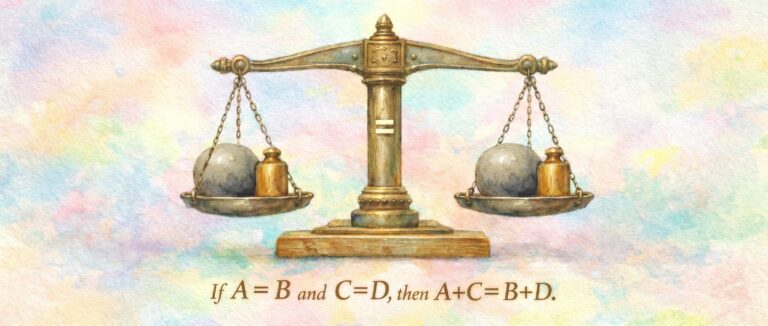
- If equals are added to equals, the wholes are equal.
- If equals are subtracted from equals, the remainders are equal.
- Things which coincide with one another are equal to one another.
- The whole is greater than the part.
Postulates
- A straight line may be drawn joining any two points.
- A finite straight line may be extended continuously in a straight line.
- A circle may be drawn with any given centre and radius.
- All right angles are equal to one another.
- If a straight line intersects two straight lines so that the interior angles on the same side sum to less than two right angles, then the two lines, if extended indefinitely, meet on that side.
So without further delay, we move into the first construction, where the system shifts from pure possibility into visible form and where the fundamental objects of geometry begin to reveal themselves through action within the given parameters.
The First Construction: Where Definitions Begin to Take Form
The opening proposition of Euclid’s Elements asks for a simple task: to construct an equilateral triangle on a given finite straight line. Nothing beyond what has already been established is required. No new assumptions are introduced. The construction proceeds entirely within the permissions already granted.
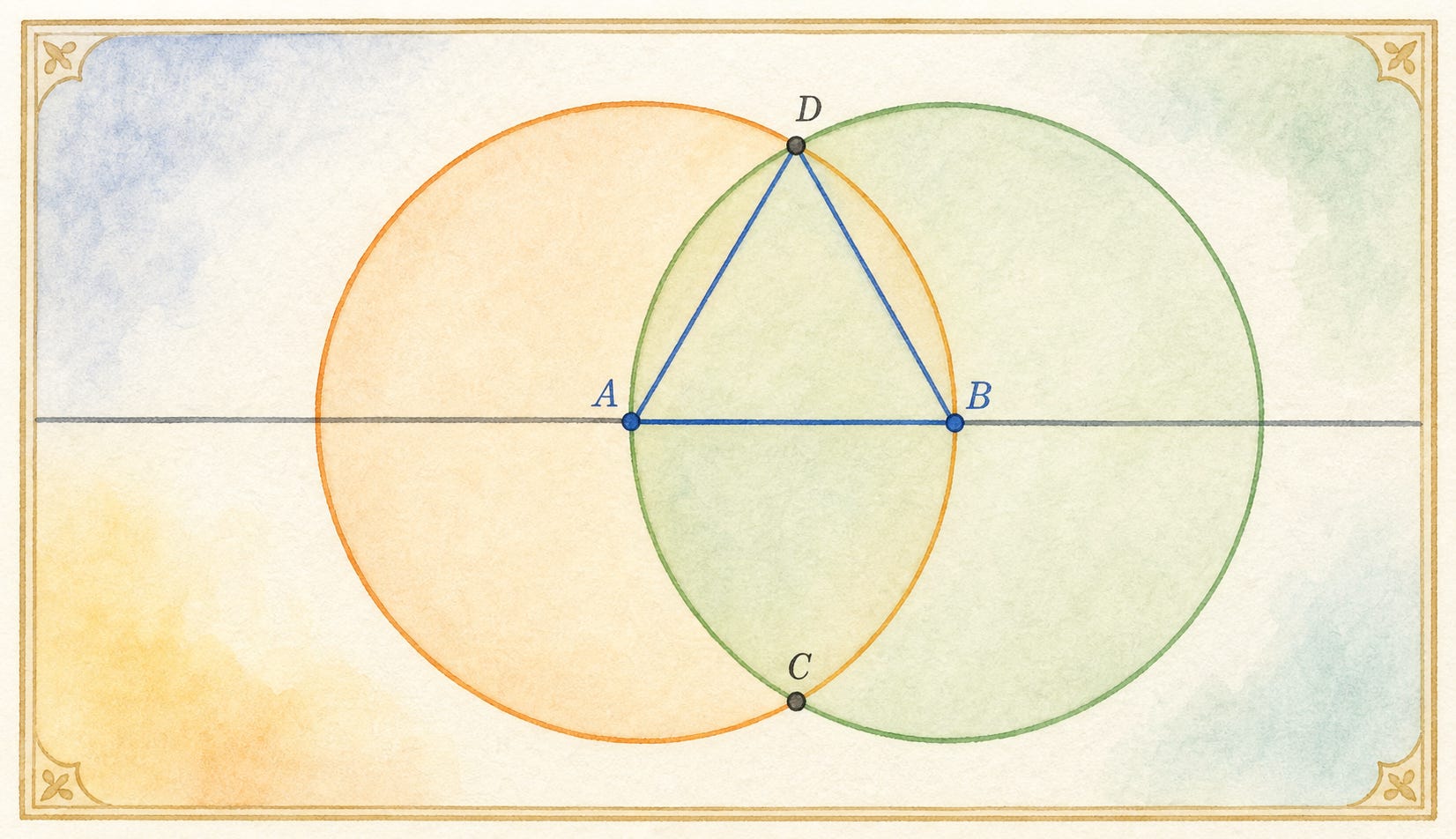
Interactive Figure: Euclid’s First Construction: Equilateral Triangle
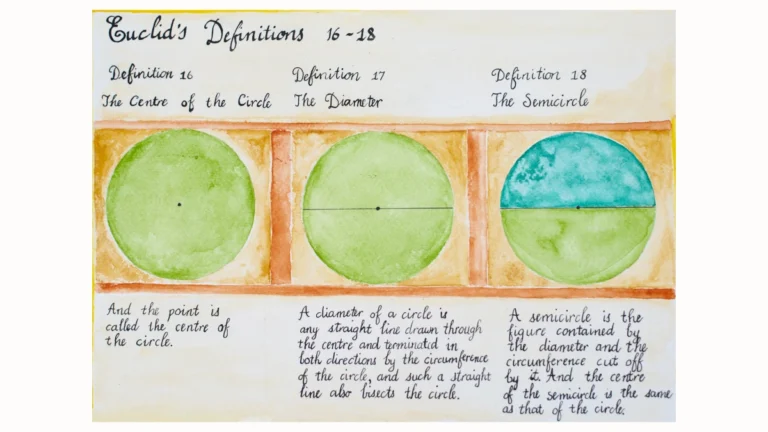
We begin with a finite straight line. It is given. Before anything is constructed, this line is already present as the first object of thought. Euclid defines a line as “breadthless length”, and a straight line as “a line which lies evenly with the points on itself.” It has length, but no breadth. Its two ends are points, and a point, for Euclid, is “that which has no part.” These points do not occupy space; they mark the limits of the finite line. In this way, the finite straight line stands before us as something definite: an object from which construction can begin.
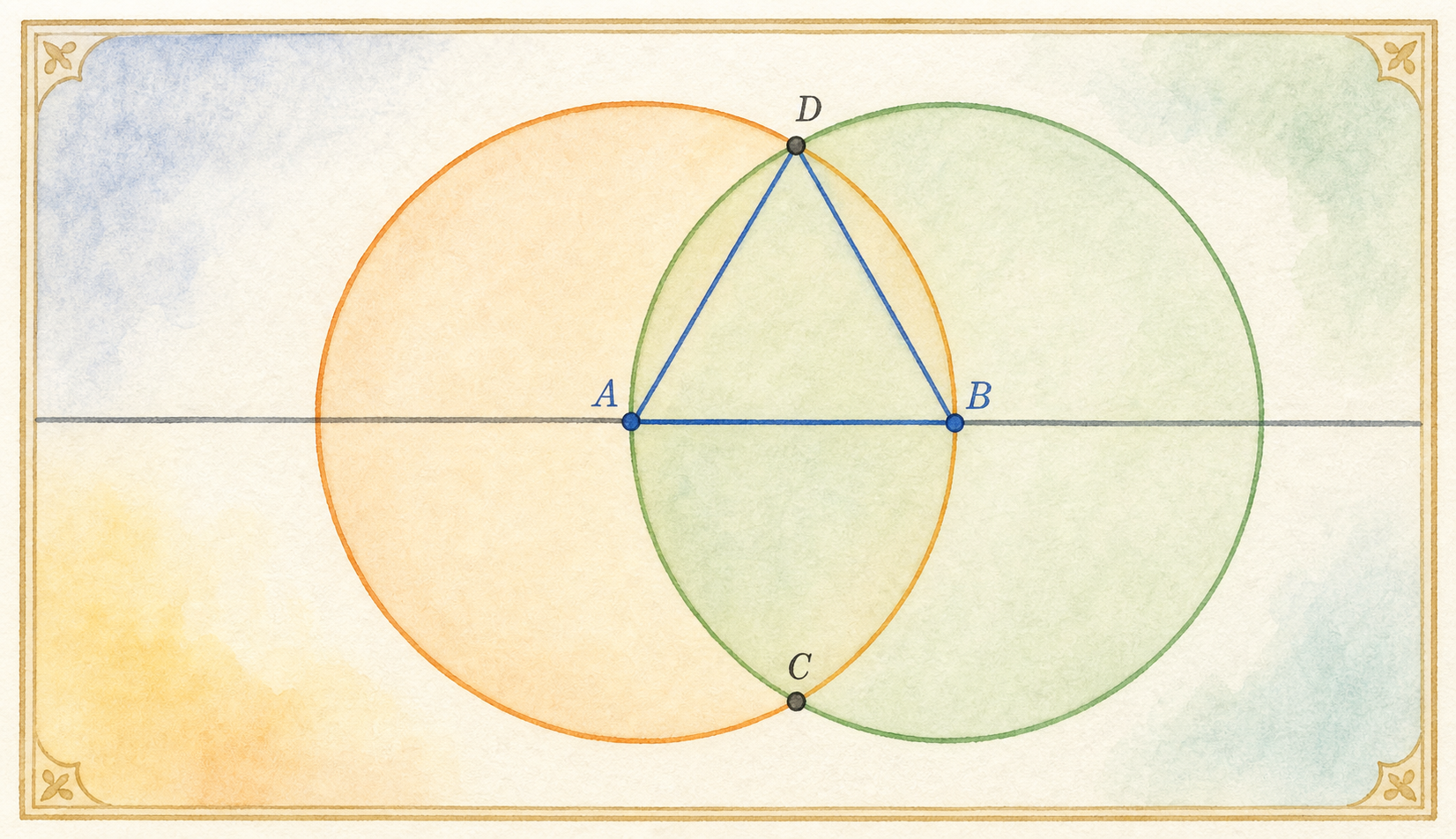
From one endpoint, a circle is drawn using the length of the line as its radius. This act depends directly on the third postulate, which allows a circle to be constructed with any centre and any radius. At the moment the circle is drawn, something further becomes clear. The idea of a circle is no longer an abstract description. It appears as the set of all points at a fixed distance from a centre. The definition begins to take form through the act itself.
From the other endpoint, a second circle is drawn with the same radius. Again, the same permission is used, and again the meaning of the construction is carried through in practice. The two circles intersect. This point of intersection is not assumed in advance. It arises from the construction.
Now, straight lines are drawn from this intersection point to each endpoint of the original line. The first postulate permits this directly. What emerges is a triangle. More precisely, it is a figure bounded by three straight lines. The definition of a triangle is not introduced as a statement. It is recognised in what has been formed.
What remains is to establish that the triangle is equilateral. Each side of the triangle corresponds to a radius of one of the circles. Since all radii of a circle are equal, and since both circles were constructed using the same radius, the three sides must be equal. Here, the axioms governing equality quietly enter. They ensure that what has been constructed can be understood as having consistent and transferable relationships.
Definition: An equilateral triangle is a three-sided figure in which all three sides are equal in length.
This is the significance of the first construction. It shows that geometry does not begin with fully formed concepts laid out in advance. It begins with simple permissions and proceeds through action. The objects of the system take on clarity as they are used. Meaning is not imposed from outside but arises within the structure itself.
From this point onward, each proposition carries this movement forward. Constructions are introduced, relationships are established and the system extends its reach.
What began as a small set of allowances now develops into a coherent and expanding body of knowledge, where form, reasoning and construction remain inseparably linked.
Note
In modern geometry, an equilateral triangle has three equal angles, each measuring 60 degrees. However, in Euclid’s system, the equality of the angles is not included in the original definition. It is proved only later, after the triangle has been constructed and the necessary propositions have been established.