
Introduction
In my previous work, we have traced the development of mathematical thought conceptually from experience to language, and eventually to logic, symbols and abstraction. You can read the articles here. There is also a compilation that you can purchase for US4$
In the next series of articles, we are going to look at the development of the kinds of human reasoning that eventually made mathematical thought possible. How did humans move from a prehistoric way of experiencing the world to the abstraction of numbers? Our ability to reason symbolically and build knowledge across generations gave the human race unprecedented power. We became able to understand processes, predict outcomes and find ways of protecting ourselves and improving our lives. Over time, these abilities helped us move far beyond mere survival and gave us an extraordinary capacity to shape the world around us.
Today we are faced with the enormous challenge of dealing with the extraordinary power we have created for ourselves. The question is increasingly whether we can restrain our predatory behaviour and bring it into balance with growth, replenishment and moral responsibility so that the wider balance of life on Earth can be sustained. If not, we risk self-destruction, driven by greed and fear, in the delusion that more, instead of balance, will somehow make us safe in the face of the abyss.
My true belief is that if human beings understood themselves better, they would be able to make better decisions and govern their lives with more insight and wisdom. Through these articles, I am hoping to contribute in some small way towards humankind’s progress towards more sustainable and peaceful living. I have found in my teaching that when children had a sense of the bigger picture, they understood concepts much more easily.
So in my articles I am going back into human history and asking how all of this came about. How did it happen that human beings came to exercise such extraordinary power over the world around them? If you look at the animal kingdom, many animals possess physical and sensory abilities that far exceed our own. Some are stronger, faster, more agile, or able to hear, smell and see things that we cannot. They can accomplish feats that in a human being would seem like superhero stuff. But none of this has matched the extraordinary reach of humankind’s own superpower – our capacity to reason abstractly, create symbolic systems and build knowledge across generations.
Our capacity for abstraction has made extraordinary things possible. In the service of fear and destruction, it has contributed to the development of guns and eventually nuclear weapons. In the service of compassion and moral responsibility, it has contributed to heart transplants, medicine, safe housing, abundant food supplies, transport and electricity. None of these developments comes without cost, but together they have made many aspects of our lives safer and easier.
So without further ado, let’s get into it. First we’re going to have a look at the prehistoric mind before exact number, written numerals and formal mathematical abstraction.
The Prehistoric Mind
What do we inherit? A Thought Experiment
Before we begin, I want to explain why I am using the rather interesting thought experiment of placing a baby born today into a prehistoric community. We are born into an intellectual world that has been accumulating for thousands of generations, and it is almost impossible for us to imagine what it would be like without it. Numbers, writing, maps, clocks, calendars, scientific explanations, systems of measurement and mathematical ideas are already waiting for us when we arrive. We do not have to invent them for ourselves. By imagining a modern baby growing up without access to this immense inheritance, we can begin to separate what the human mind may be capable of from what culture has already placed into its hands. It also helps us resist the temptation to look at prehistoric people simply as less developed versions of ourselves. Their minds were being educated by a very different world, demanding extraordinary knowledge of landscapes, animals, materials, seasons, movement and survival. The baby therefore gives us a way of asking a more interesting question: what kinds of thinking arise from human experience itself, and how might those capacities, accumulated and transformed across generations, eventually have opened the way towards number, abstraction and mathematics?
A Modern-Day Baby in Prehistoric Times
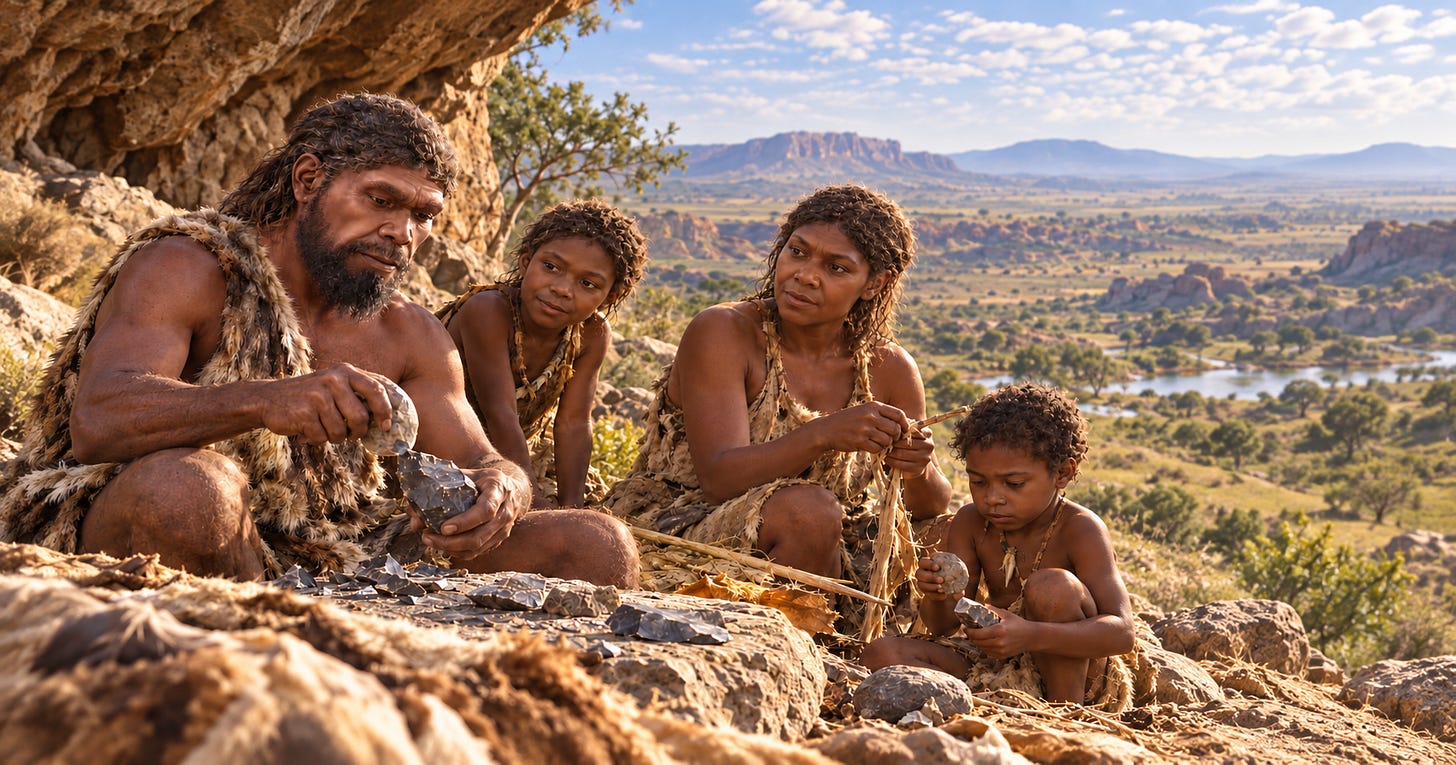
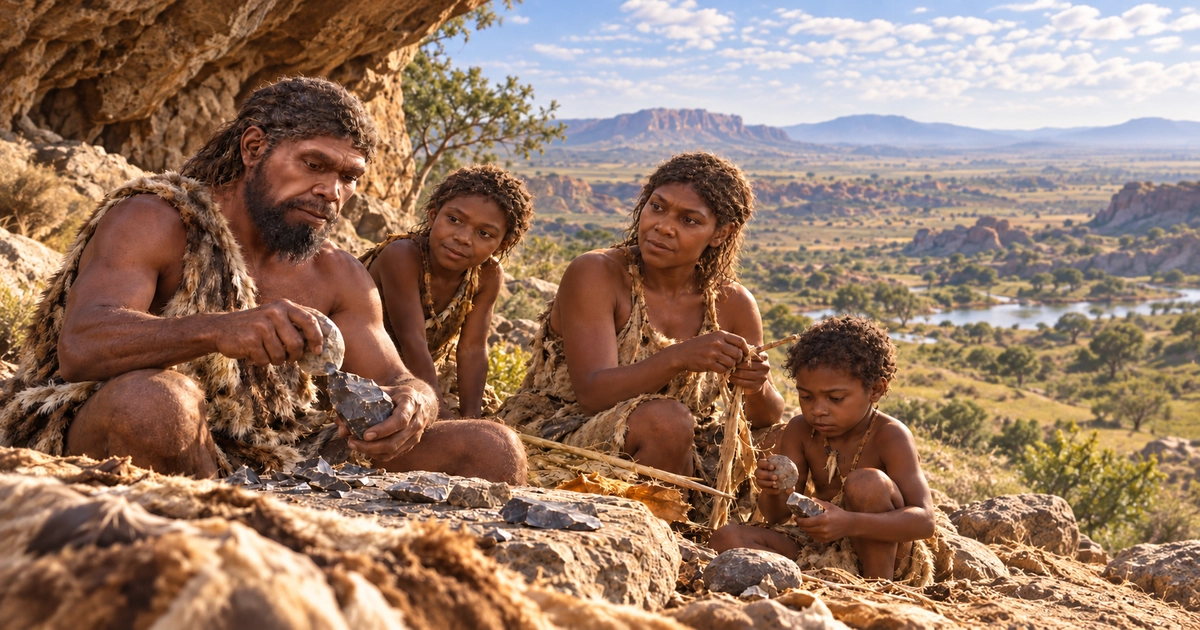
Let us imagine for a moment that a baby born today could somehow be transported 300,000 years back in time, to the early history of Homo sapiens. A group of our ancient ancestors finds her, takes her in and raises her as one of their own. They give her a name – Aya.
Around 300,000 years ago is a reasonable place for our thought experiment to begin. Fossils from Jebel Irhoud in Morocco, dated to approximately 315,000 years ago, are among the earliest remains assigned to Homo sapiens. They show that our species emerged through a long evolutionary process across Africa, with different features developing over time.
So what would happen to Aya?
She would arrive with the biological inheritance of a human being born today. She would be able to see, hear, learn, remember, recognise people, respond socially and gradually make sense of the world around her. Research with infants suggests that some sensitivity to quantity appears very early. Babies can distinguish between different quantities under certain experimental conditions long before they learn to count, although researchers still debate exactly how these early representations work and how numerical they really are.
Aya would therefore come into this ancient world with a mind ready to learn.
But what would she know?
She would know nothing of the world she had left behind. She would have no concept of written numbers, multiplication, geometry, algebra, clocks or scientific measurement. The symbol 7 would mean nothing to her. Neither would a map, a calendar or an equation. She would grow up learning whatever language, gestures, customs, skills and ways of understanding the world were available within the community that raised her.
This is where the thought experiment becomes really interesting.
A child born today enters a world containing an almost unimaginable inheritance of accumulated knowledge. Before she understands a single word, that world is already there waiting for her. Numbers have been named. Languages have been developed. The movements of the planets have been studied. Diseases have been identified. Maps have been drawn. Mathematical relationships discovered thousands of years ago can be taught to her in a classroom within a few minutes.
She did none of the work that produced this knowledge. Neither did her parents. Thousands of generations contributed to the world of ideas into which she was born.
Research into cumulative culture shows how important this process is. Human knowledge can develop across repeated episodes of social transmission until a body of knowledge or a technology exists that no single individual could realistically have invented alone. Other animals also show forms of cultural transmission and even cumulative change. What is extraordinary in humans is the open-ended scale to which this process has developed.
Aya would have the benefit of accumulated knowledge too, but it would be the accumulated knowledge of the people among whom she lived.
Growing Up in a Prehistoric World
So let’s see what happens next to Aya.
She knows nothing about 2026. She has no memory of cars, houses, books or numbers. The people around her are her family. The landscape they move through is home. The animals, plants, changing weather, sources of water, dangerous places, useful stones and pathways through the land are the world she has to learn.
And there would be an enormous amount to learn.
The archaeological evidence from around the period in which we have placed her already shows communities with substantial technical knowledge. At Jebel Irhoud in Morocco, the human remains dating to around 315,000 years ago were found together with Middle Stone Age tools. At Olorgesailie in Kenya, evidence dating from around 320,000 years ago includes smaller and more specialised stone tools, pigments and obsidian brought in from sources many kilometres away.
Obsidian is a natural volcanic glass. It forms when lava cools very quickly, so crystals do not have time to grow. It is especially useful for stone tools because when it breaks, it can produce extremely sharp edges. Prehistoric people used it for cutting tools, blades and points.
Let’s return to the stone tools and think for a moment about what is involved in making them.
With prepared-core techniques, the person making the tool first works the stone so that a later strike will produce a flake with particular qualities. The shape of the core, the angle of the striking surface and the sequence in which material is removed all affect what happens next. Archaeologists are understandably cautious about trying to read thoughts from stones, but experimental and technological studies of prepared-core methods point towards structured, goal-directed action involving planning and an understanding of spatial relationships.
Aya would have to learn which stones behave in which ways. Where to strike. How hard. At what angle. What happens to the possibilities remaining in the core after each piece has been removed. A mistake made early in the process may affect what can be done later.
There is already something here that interests me mathematically. The maker is working with relationships – between surfaces, angles, force, sequence and possible outcomes.
Learning the Landscape
The obsidian found at Olorgesailie did not originate immediately around the archaeological sites. Some sources lay tens of kilometres away across difficult terrain. We do not know in every case whether the people who used the obsidian travelled to those sources themselves or whether some of the material passed between groups. Either possibility tells us that their world extended far beyond what they could see from where they were standing.
Imagine what the important questions are that Aya would have to think about.
Where is the water when this source dries up? Where do particular animals move at different times? Which plants are useful and when can they be found? Which route takes you across difficult ground? Which places are dangerous? Where can the right kind of stone be found? How do you get there and find your way back?
We cannot recover the detailed landscape knowledge of a community that lived 300,000 years ago. Archaeology gives us fragments. Research among present-day hunter-gatherers can help us understand the extraordinary level of environmental knowledge human beings are capable of developing when their lives depend upon it. It cannot simply be projected backwards as a description of prehistoric life.
Studies of Hadza foragers in Tanzania, for example, using thousands of person-days of GPS data, show people moving through extensive landscapes as part of their ordinary subsistence activities. Their movements reflect where resources occur and the different tasks people undertake. Other ethnographic research has documented detailed knowledge of animals, plants, routes, seasons and places among foraging peoples in very different environments.
Aya would begin learning it long before she was capable of explaining any of it. Research across a range of hunter-gatherer societies shows children accompanying adults on foraging activities from infancy. As they grow older, observation, imitation, play and participation become important ways of acquiring practical skills. Children also learn from one another. By later childhood many are already competent at collecting food, while demanding skills such as hunting and complex tool manufacture can take much longer to master. There is considerable variation between cultures, so there is no single hunter-gatherer pattern of childhood.
At first Aya would know almost nothing. She would have to watch. Follow. Try. Fail. Try again. Gradually places would acquire meaning. A track in the ground would become more than an indentation in the dust. A particular plant would become food, medicine, poison or something of no interest at all. The shape of a cloud, the behaviour of an animal or the condition of a path might carry information that an inexperienced person simply would not see.
Tracking gives us a beautiful example of how far this kind of knowledge can develop.
In a recent study in Namibia, Indigenous tracking experts were asked to examine prehistoric engravings of animal tracks and human footprints. From the details represented in the engravings, they could identify such things as species, sex, age group and even which leg had made the track in more than 90 percent of the engravings examined. The engravings themselves are vastly younger than the world of our imagined baby, so they cannot tell us what people knew 300,000 years ago. What the study shows is the remarkable amount of information a trained human mind can learn to see in something that an untrained observer may barely notice.
Now imagine these kinds of judgements running through an ordinary day.
Which animals are close enough to pursue? Which route is shorter or safer? Is there enough water? Which piece of stone is large enough for what you need to make? In which direction did the animal move? How recently did it pass? When is it worth continuing and when is it wiser to turn back?
These judgements involve quantity, comparison, direction, distance, sequence, shape, time and relationships between actions and their consequences. These activities already form part of the experiential ground from which mathematical thinking could eventually develop. The archaeological evidence does not tell us that people 300,000 years ago possessed exact number systems or formal mathematical concepts, but they did engage in complex reasoning activities on a day-to-day basis. Relationships are already there in experience.
This brings us back to the interesting question with which we began our thought experiment.
Would Aya Be More Intelligent?
Would Aya have some advantage because she was born in 2026?
We simply do not know.
The early Homo sapiens fossils from Jebel Irhoud already had brain sizes within the range in people living today. Their braincases, however, had a more elongated shape. Research tracing the evolution of Homo sapiens suggests that the globular brain shape characteristic of people today developed gradually over a much longer period, reaching the present-day range somewhere between about 100,000 and 35,000 years ago. Fossilised braincases give us information about size and outer shape. They cannot tell us how intelligent an individual was or allow us to assign anything resembling an IQ to a person who lived hundreds of thousands of years ago.
Aya has the genome and developmental biology of a human being alive today. There may therefore be differences between her development and that of the children around her. We do not have enough evidence to tell us what those differences would mean in practice.
She would grow up alongside the other children, learning the same landscape, animals, plants, tools and practical skills through the same shared culture. There is no reason to assume that she would naturally be better at these things simply because she was born in 2026.
This begins to change the way we think about intelligence.
A child born in our world is surrounded by books, numbers, maps, machines, clocks, diagrams and explanations. A child born into a prehistoric community would be surrounded by a different field of knowledge. Her attention would be trained by the demands of that world.
Aya would grow into the knowledge available to her.
She might become an excellent tracker. She might know an enormous landscape intimately. She might become highly skilled at making tools and understanding the behaviour of animals. There is no reason to expect her spontaneously to invent arithmetic, geometry, writing or a calendar simply because those things exist in the civilisation into which she happened to be born 300,000 years later.
This is perhaps where the thought experiment becomes most revealing.
The extraordinary intellectual world we live in today has accumulated over thousands of generations. Human culture has an extraordinary capacity to preserve discoveries, modify them and build upon them, allowing later generations to begin with knowledge they did not have to discover for themselves. Recent work on cumulative culture suggests that forms of cumulative change also occur in other animals, while human culture appears exceptional in the enormous and open-ended range of what can be accumulated.
Aya has lost access to almost all of that inheritance.
What she has instead is another inheritance – the accumulated knowledge of the prehistoric community that takes her in.
And this brings us closer to the question we really want to ask.
What was already present in these practical ways of thinking that could eventually allow quantity to become number and experienced relationships to become mathematical concepts?
Before Exact Number
As Aya grows up within her prehistoric community, she is already surrounded by relationships that will matter for survival. One group of animals is larger than another. One water source is farther away. A stone is too small for the tool someone is trying to make. A path leads in one direction and another path somewhere else. Certain events happen again and again.
She does not need a written number system to experience any of this.
Quantity
Long before children learn to count, they show some ability to distinguish between quantities. In a well-known experiment, six-month-old babies could distinguish between groups of eight and sixteen objects when other visual differences were carefully controlled. They were less successful when the quantities were closer together, such as eight and twelve. This kind of result has been found repeatedly and is usually taken as evidence that infants possess some form of approximate sensitivity to quantity.
This sensitivity is also found far beyond our own species. Monkeys, birds and many other animals can distinguish between quantities, usually with greater accuracy when the difference between them is relatively large. Research comparing primates and corvids has even found striking similarities in the way approximate quantity is represented in their brains.
So the ability to perceive that there is more here than there reaches much deeper into our evolutionary history than the ability to say exactly how many things there are.
Imagine that Aya sees two groups of animals. One group is obviously larger. She may recognise the difference immediately. Knowing that one group contains seven animals and the other contains twelve requires something more. Exact number allows a quantity to be identified independently of how large it looks in comparison with something else.
There is another curious ability that sits close to this boundary.
If I place two or three stones on a table, most of us do not need to count them one by one. We simply see how many there are. This rapid recognition of a small number of objects is usually called subitizing. Experiments with young children have found accurate rapid recognition of small collections before fluent verbal counting is established, although the range develops with age. Research on infants also suggests that very small collections can sometimes be represented precisely, but scientists continue to debate whether this involves number itself or a more general ability to keep track of a few individual objects.
For our inquiry, we do not have to settle that debate.
What matters is that the human mind can respond to quantity before it possesses the symbolic number system through which we eventually learn to express quantity exactly.
And quantity is only one part of the story.
Space
She moves through a landscape. Some places are close and others far away. Things can be above or below her, behind her or ahead. Paths turn. Objects have shapes. A place she cannot currently see may still have to be remembered because there is water there, useful stone, food or shelter.
Spatial abilities also have deep evolutionary roots. Research with animals, infants and young children suggests that navigation draws upon representations of distance and direction, while the recognition of objects involves sensitivity to properties such as shape and length. These abilities fall far short of Euclidean geometry, yet they reveal that some of the relationships later formalised by geometry are already encountered and processed through ordinary perception and movement.
This interests me because mathematics can seem so far removed from physical experience when we meet it on a page.
A line has no thickness. A mathematical point has no size. A number can be considered without referring to any particular thing at all.
Yet the relationships from which these ideas eventually grew are everywhere.
Distance is walked. Direction is followed. Shape is seen and touched. Quantity is encountered in things.
Pattern
Day follows night and night follows day. Seasons return. Animals move through landscapes in ways that may recur. The stages involved in making a tool can be repeated. A successful action can be remembered and attempted again.
Repeated experience gives the mind something immensely important: the possibility of recognising regularity across different moments.
Aya does not have to formulate a rule to recognise that something has happened before. She can remember a sequence. She can begin to anticipate what may happen next. She can recognise that an action which worked yesterday may work again today.
Somewhere inside experiences of this kind lies a profound change in what thought can do.
Now imagine that Aya has seen one group containing more animals than another. Later she sees two piles of stones and again one contains more. The animals and stones have almost nothing in common as physical objects. Yet there is a relationship that can be recognised in both situations.
The same happens with distance. One journey is longer than another. Later two completely different journeys can also be compared. A particular sequence used while making a tool can be remembered and repeated with another piece of stone.
The mind is beginning to hold something that can travel from one experience to another.
Abstraction
Abstraction does not have to begin with algebra or philosophical reasoning. At its most basic, it involves recognising something that remains meaningful across different situations even though the particular things involved have changed.
Think again about three animals, three stones and three people.
The animals can move away. The stones can be scattered. The people can leave. At some stage in the development of exact number, the shared quantity can itself become something that can be held in thought.
We have to be careful here. We do not know when prehistoric people first made this particular conceptual move, and abstraction itself is unlikely to have appeared suddenly. Early humans were already capable of behaviours requiring categorisation, planning and the transfer of learned relationships between situations. The development we are trying to understand probably unfolded through many overlapping capacities over enormous stretches of time.
Language
Once an experience can be named, it becomes easier to hold it in a shared form. Words such as more, less, near or far can carry distinctions from one situation into another. Exact number words eventually take this much further because they allow a particular quantity to be identified and communicated.
This is where language begins to play an enormous role in the development of mathematical thought.
If a relationship can be named, it can also become part of the shared knowledge of a community. One person can draw another person’s attention to it. Children can learn the word and the distinction it carries. Over generations, the concept can be refined. Eventually, naming can lead towards definition – towards increasingly precise agreement about what we mean when we speak of quantity, equality, distance, shape or number.
Research among people whose languages traditionally contain very limited systems for expressing exact number gives us an unusual glimpse into the difference.
The Mundurukú of the Amazon were found to be very capable of comparing and approximately adding quantities much larger than the range of their number words. Their performance changed when exact arithmetic was required for larger quantities. This supports a distinction between our ability to estimate quantity and the culturally developed systems that allow us to work with exact numbers.
Research with the Pirahã brings another piece into the picture. Later work found that their language did not contain words for exact numerical quantities. Participants could nevertheless reproduce large quantities exactly when the objects remained directly available for matching. Their accuracy declined when the task required them to remember the exact quantity after the original arrangement was no longer available. The researchers described number words as a kind of “cognitive technology” – a cultural tool that helps human beings keep track of exact quantities across time, space and changes in the way those quantities are presented.
I find this particularly important for Aya.
Her eyes can see quantity. Her body can experience distance. Her mind can recognise patterns and remember relationships. Her community can give names to distinctions and pass knowledge from one person to another.
Memory and language extend what can be carried beyond the immediate moment.
And once a relationship has a shared name, it can become part of accumulated knowledge. It can be remembered when the original objects are gone. It can be discussed. Compared. Taught. Refined. Eventually it can be defined with increasing precision.
A larger group can be recognised as larger. A small collection may be recognised immediately. Distances can be compared. Shapes can be remembered. Sequences can be repeated. Relationships can be recognised again when the objects themselves have changed. Language can help hold and communicate some of these distinctions.
How did humanity move from experiencing more and less to knowing an exact quantity – five, for instance – that remains five whether we are speaking about animals, stones, people or anything else?
At what point does more become five?
Closing Thoughts
Aya has taken us a long way already. Through her we have been able to separate the capacities of the human mind from the enormous inheritance of knowledge that culture places into our hands. We have seen that long before exact number, human beings were already living within worlds shaped by quantity, space, pattern, sequence, comparison and relationship. These were experienced through the body, the landscape, tools, movement and survival. Somewhere within this rich field of experience, something began to change. Relationships could be recognised across different situations, held in memory, communicated and gradually abstracted from the particular things in which they first appeared.
If you have found this valuable, please consider buying me a coffee through PayPal to support my work. All contributions are deeply appreciated.
References
Brooks, A. S., Yellen, J. E., Potts, R., Behrensmeyer, A. K., Deino, A. L., Leslie, D. E., Ambrose, S. H., Ferguson, J. R., d’Errico, F., Zipkin, A. M., Whittaker, S., Post, J., Veatch, E. G., Foecke, K., & Clark, J. B. (2018). Long-distance stone transport and pigment use in the earliest Middle Stone Age. Science, 360(6384), 90–94. doi:10.1126/science.aao2646
Frank, M. C., Everett, D. L., Fedorenko, E., & Gibson, E. (2008). Number as a cognitive technology: Evidence from Pirahã language and cognition. Cognition, 108(3), 819–824. doi:10.1016/j.cognition.2008.04.007
Hublin, J.-J., Ben-Ncer, A., Bailey, S. E., Freidline, S. E., Neubauer, S., Skinner, M. M., Bergmann, I., Le Cabec, A., Benazzi, S., Harvati, K., & Gunz, P. (2017). New fossils from Jebel Irhoud, Morocco and the pan-African origin of Homo sapiens. Nature, 546, 289–292. doi:10.1038/nature22336
Lenssen-Erz, T., & Pastoors, A. (2023). Animal tracks and human footprints in prehistoric hunter-gatherer rock art of the Doro! nawas mountains (Namibia), analysed by present-day indigenous tracking experts. PLOS ONE, 18(9), e0289560. doi:10.1371/journal.pone.0289560
Lew-Levy, S., Reckin, R., Lavi, N., Cristóbal-Azkarate, J., & Ellis-Davies, K. (2017). How do hunter-gatherer children learn subsistence skills? A meta-ethnographic review. Human Nature, 28(4), 367–394. doi:10.1007/s12110-017-9302-2
Morgan, T. J. H., & Feldman, M. W. (2025). Human culture is uniquely open-ended rather than uniquely cumulative. Nature Human Behaviour, 9, 28–42. doi:10.1038/s41562-024-02035-y
Neubauer, S., Hublin, J.-J., & Gunz, P. (2018). The evolution of modern human brain shape. Science Advances, 4(1), eaao5961. doi:10.1126/sciadv.aao5961
Nieder, A. (2018). Evolution of cognitive and neural solutions enabling numerosity judgements: Lessons from primates and corvids. Philosophical Transactions of the Royal Society B: Biological Sciences, 373(1740), 20160514. doi:10.1098/rstb.2016.0514
Pica, P., Lemer, C., Izard, V., & Dehaene, S. (2004). Exact and approximate arithmetic in an Amazonian indigene group. Science, 306(5695), 499–503. doi:10.1126/science.1102085
Richter, D., Grün, R., Joannes-Boyau, R., Steele, T. E., Amani, F., Rué, M., Fernandes, P., Raynal, J.-P., Geraads, D., Ben-Ncer, A., Hublin, J.-J., & McPherron, S. P. (2017). The age of the hominin fossils from Jebel Irhoud, Morocco, and the origins of the Middle Stone Age. Nature, 546, 293–296. doi:10.1038/nature22335
Schlanger, N. (1996). Understanding Levallois: Lithic technology and cognitive archaeology. Cambridge Archaeological Journal, 6(2), 231–254. doi:10.1017/S0959774300001724
Spelke, E. S., Lee, S. A., & Izard, V. (2010). Beyond core knowledge: Natural geometry. Cognitive Science, 34(5), 863–884. doi:10.1111/j.1551-6709.2010.01110.x
Starkey, P., & Cooper, R. G., Jr. (1995). The development of subitizing in young children. British Journal of Developmental Psychology, 13(4), 399–420. doi:10.1111/j.2044-835X.1995.tb00688.x
Wood, B. M., Harris, J. A., Raichlen, D. A., Pontzer, H., Sayre, K., Sancilio, A., Berbesque, C., Crittenden, A. N., Mabulla, A., McElreath, R., Cashdan, E., & Jones, J. H. (2021). Gendered movement ecology and landscape use in Hadza hunter-gatherers. Nature Human Behaviour, 5, 436–446. doi:10.1038/s41562-020-01002-7
Xu, F. (2003). Numerosity discrimination in infants: Evidence for two systems of representations. Cognition, 89(1), B15–B25. doi:10.1016/S0010-0277(03)00050-7
Xu, F., & Spelke, E. S. (2000). Large number discrimination in 6-month-old infants. Cognition, 74(1), B1–B11. doi:10.1016/S0010-0277(99)00066-9
Moraes, C., Varotto, E., Habicht, M. E., Galassi, F. M., Moura, L., & Abdullah, J. Y. (2026). Digital facial approximation of Jebel Irhoud composite skull (~315,000 BP). Heritage, 9(9), 369. doi:10.3390/heritage9090369
Research and Editorial Assistance
ChatGPT (OpenAI, GPT-5.6 Sol) was used to assist with research, source identification, fact-checking, structural development and editorial refinement. All information was independently reviewed during the development of the article, and I take responsibility for the final text.