
Mathematics and Language
From experience and meaning to logic, symbols and abstraction
Mathematical thought does not begin with symbols. It grows from experience, perception and the relationships we learn to recognise and name. Language gives form to these relationships, makes distinctions clearer and prepares the mind for logic, definition and proof. These articles trace that development step by step, so the pathway is best followed in sequence.
Experience
Perception, relationship, distinction and meaning
Language
Naming, definition, logic and reasoning
Abstraction
Symbols, axioms and mathematical structure
Mathematics and Language
The improved 57-page PDF compilation of all nine articles, brought together in one document.
US$4.
Follow the movement from experience and language into logic, symbolism and abstraction.
-
Pathways That Formed Our Way of Knowing
This article explores the long pathways that formed mathematical thinking, from the ancient recognition of order in the world to the later development of symbol, abstraction, logic and proof. Mathematical thought grew from the body’s encounter with rhythm, pattern, movement, language and form. Across cultures and ages, human beings slowly learned to recognise structure, refine meaning, discipline thought and question the limits of certainty. Seen in this light, mathematics becomes part of a much older story: the story of how the human mind learned to perceive the world with greater clarity.
-
How Meaning Is Formed with Words
Clear thinking begins long before a conclusion ever appears on the horizon. It begins in the earliest stirring of awareness, at the moment when something felt, seen or sensed starts to move toward language. This is the alchemy of thought: experience becoming form, fluid impressions taking on shape through words. Long before we reason, we are already naming, and through naming, we are already creating a world we can navigate.
-
How the Body, Language and Experience Create the Foundations of Mathematical Thinking
Mathematical thinking begins long before numbers appear. Its first roots grow in the body. Long before a child can speak or recognise symbols, their movements, sensations, balance, rhythm and gestures are already organising experience in a mathematical way. Every reach, fall, climb and imitation traces the first patterns of order. The body measures long before the mind knows it is measuring and through these small actions the organism prepares the ground on which later understanding will stand.
-
Language and Formal Mathematical Reasoning
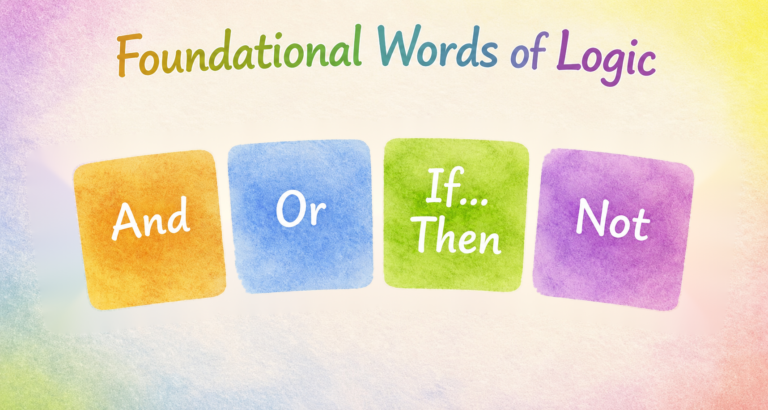
This article explores the relationship between language and formal mathematical reasoning. Before the mind can follow a proof, interpret a definition or understand a symbolic statement, it must first learn how ideas relate through language. Words such as if, then, because, therefore, and, or and not prepare the ground for logical structure. They help us recognise conditions, consequences, distinctions and relationships. In this way, language becomes one of the first bridges into formal mathematical thought.
-
Logical Operators in Mathematics
This article explores logical operators and the role they play in mathematical thinking. Words such as and, or, not, if and then may seem ordinary, but they carry powerful relationships between ideas. They help us combine statements, separate possibilities, create conditions and recognise when something follows from something else. In mathematics, these small words become essential tools for reasoning clearly.
-
How Axioms Determine the Foundation of Mathematical Reasoning
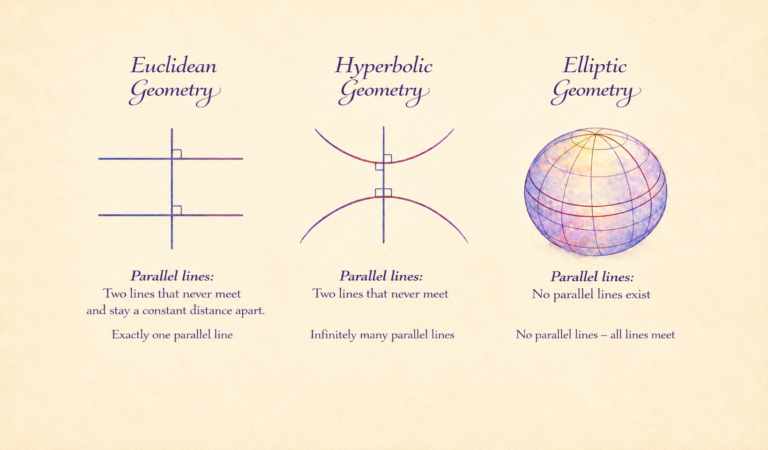
This article explores Euclid’s axioms, or Common Notions, and the role they play in forming the foundation of mathematical reasoning. Before geometry can move with certainty, it must rest on truths that are accepted as self-evident. But this raises a question beyond mathematics: what are the axioms beneath our own thinking? What hidden assumptions determine the way we reason, choose and meet the world?
-
Euclid’s Common Notions or Axioms: The Ground of Geometric Reasoning
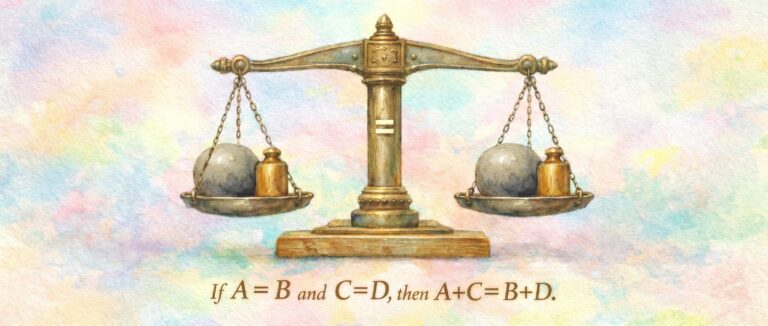
This article explores Euclid’s axioms, also known as the Common Notions. These simple statements form the foundation beneath geometric reasoning. They speak about equality, comparison and the way thought can move from one truth to another with certainty. Before Euclid constructs complex figures or proves difficult propositions, he first asks us to accept these basic relationships. The axioms show that geometry is not built from diagrams alone. It is built from clear thinking.
-
From Words to Symbols: How Abstraction Clarifies Rather Than Escapes Reality
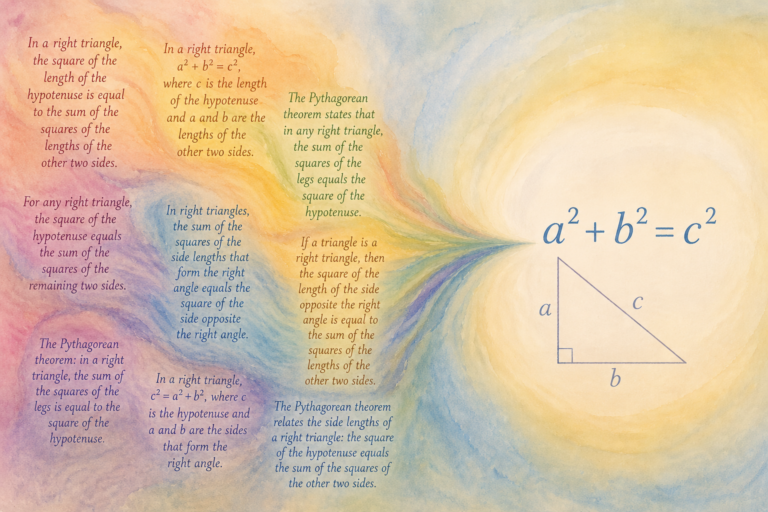
Explore how mathematical thinking moves from experience and language into symbols, and why symbols become meaningful only when they hold ideas already understood.
-
Making Peace with Abstraction
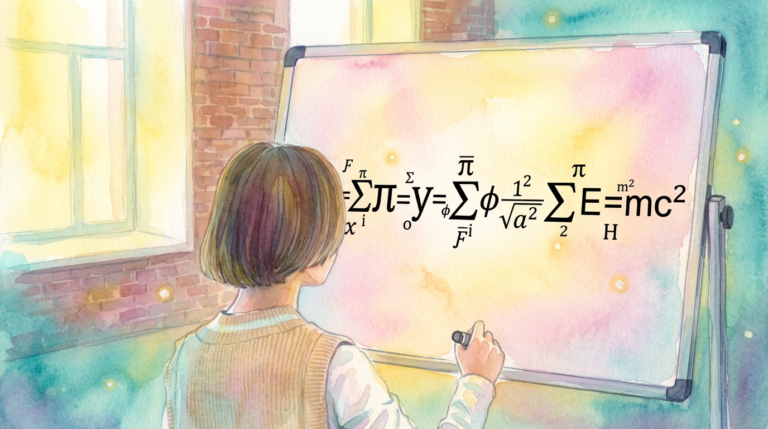
Have you ever stood before a mathematical formula and looked at it with some apprehension, wondering what it is actually about?
With this article, I hope to clear some of the mystery around the process of abstraction and show how it actually works.


When you are ready to explore another area of Sacred Mathematics, return to the Study Pathways page.