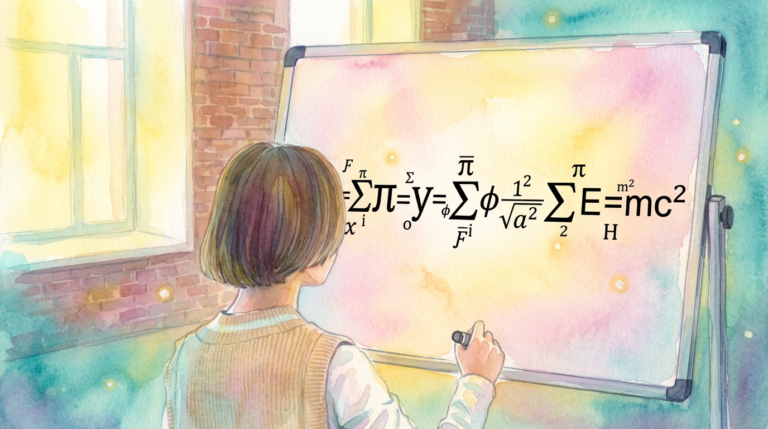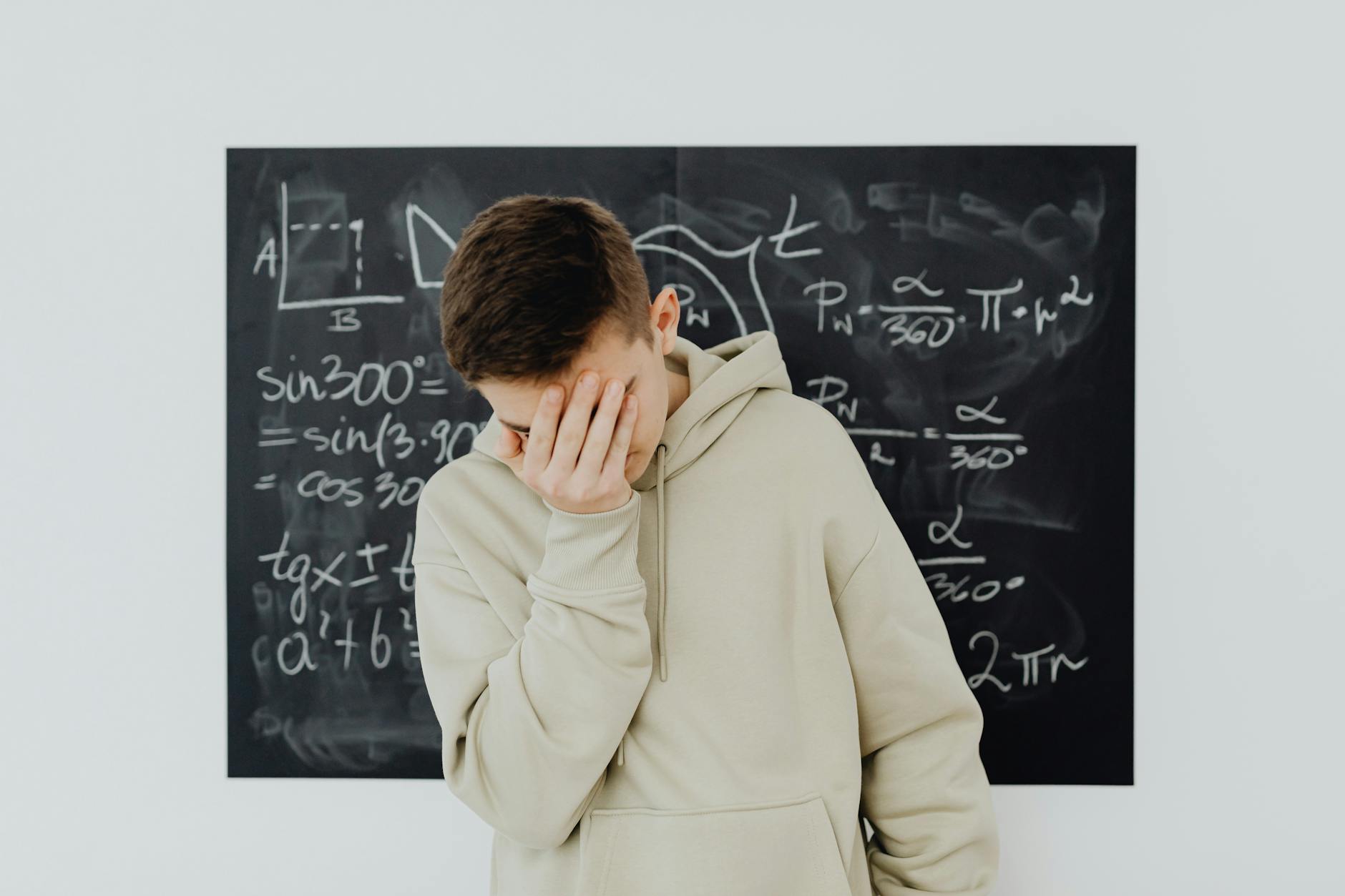
A return to the quiet beauty, mystery, and innate intelligence we were born with.
Why do people turn away from mathematics?
Most people do not turn away from mathematics because they cannot understand it. They leave because somewhere in childhood, mathematics stopped feeling safe.
It begins slowly. A classroom moves too quickly, a teacher assumes understanding, a symbol is written on the board before the idea beneath it has taken shape in the child’s mind. A moment of confusion – entirely natural – is met not with patience, but with pressure. A hand goes up and is ignored. A question is asked and dismissed. A wrong answer draws a laugh from the class. Before the mind has a chance to unfold, the heart contracts.
Mathematics, at its core, is slow. It is contemplative, intimate and patient. It requires the kind of time that allows a thought to breathe. But the school environment rarely gives such time. Instead, it pushes children into performance. Speed becomes a proxy for intelligence, and those who think more slowly – often more deeply – begin to believe they are “behind.” A child does not question the system; a child questions themselves.
So the disconnection begins with a feeling: I am not good at this.
And once that feeling takes root, mathematics becomes something far heavier than numbers or equations. It becomes a mirror that reflects inadequacy. To protect themselves, many children learn to turn away. They avoid, deflect, or put on a mask of disinterest. By adulthood, the avoidance has become so deeply entrenched that it forms part of identity.
Yet the problem is not that children are incapable of understanding mathematics.
They simply understand it in layers, through forms of meaning that match their stage of development. Small children are not meant to grasp the deeper logical structures or abstractions – not yet. Their world is sensory, practical, relational. When mathematics is introduced to them through movement, rhythm, pattern, counting, symmetry, and real-life situations, they absorb its essence without needing the higher explanations.
Too often the “why,” behind math was not given gently over years, gaining depth as the child grows. The smallest “why” – Why do we count these? Why does this shape fit here? Why does this pattern repeat? – is enough at the beginning. Later, the “why” becomes: Why does this method work? Why is this relationship true? Why does this pattern hold?
Understanding is not a single revelation. It is a staircase. But in many classrooms, children are pushed to climb steps before their legs are ready, or asked to leap straight into abstraction without being grounded in the mystery, curiosity, and meaning that should come first. When mathematics is taught without these early anchors – without wonder, without connection to real life, without the gentle layering of meaning over time – it feels arbitrary. And humans do not bond with what feels arbitrary.
Shame deepens this separation. Mathematics exposes misunderstanding quickly. A wrong answer is visible. A moment of confusion shows. For sensitive or thoughtful children, this exposure can feel like vulnerability. Instead of interpreting confusion as a step toward understanding, they interpret it as a flaw in themselves. And so the mind that might have become curious becomes guarded. The heart withdraws its willingness to try.
By adulthood, the belief “I’m just not a math person” feels like a fact. But it is not a fact – it is a scar.
Yet beneath that scar, something stays alive. Humans are naturally attuned to pattern, rhythm, symmetry, relation. These instincts develop before language itself, long before any equations appear. Even adults who claim to hate math often respond with quiet recognition when they are shown mathematical ideas through geometry, nature, music, movement, or story. They rediscover a doorway that was always theirs.
People do not disconnect from mathematics because they are incapable of understanding it. They disconnect because mathematics was not offered to them in a human way – through stages, through meaning, through curiosity, through safety, through the slow unfolding of deeper explanations as their minds became ready.
To reconnect with mathematics as an adult requires more than new information. It requires healing. It asks you to gently unlearn the old associations: the pressure, the comparison, the fear of exposure. It invites you to return to that early place where discovery was natural, where questions were allowed, where learning felt like wonder rather than judgment.
When mathematics is reintroduced as something living – something that grows with you, something that reveals itself step by step – the mind remembers. And the subject that once felt like a closed door becomes a way back into clarity, into curiosity, and into the quiet intelligence you have always carried within you.
The Road to Healing
Correction does not begin with better techniques or faster explanations. It begins with a turning inward – with listening to what has been formed in us through our past encounters with mathematics. Long before the intellect is engaged, the heart has already learned whether mathematics is a place of safety or threat. Sacred Math begins by tending to this inner ground.
The first healing is relational. Mathematics must be approached again as a space that can be entered without fear. For many, resistance to mathematics is not a lack of ability, but a wound. Anxiety, shame, and withdrawal are signs that the soul learned to protect itself when understanding was rushed or when worth became entangled with correctness. These responses are not obstacles to be removed; they are messages asking to be met with compassion. Before understanding can take root, safety must be restored.
The second healing is a remembering of what mathematics truly is. When mathematics is treated as a set of rules delivered from above, learners lose trust in their own inner knowing. Sacred Math returns mathematics to its origin in human sense-making – in wonder, in noticing, in the quiet recognition of pattern and relationship. Questions are not disruptions to truth; they are invitations into it. Not knowing is not failure. It is a sacred threshold, the place where insight is born.
A third healing restores honor to intuition. Intuitive number sense – the felt awareness of quantity, rhythm, proportion, and balance – is a form of wisdom that lives in the body and the imagination before it ever appears as symbol. Learners need permission to feel their way into understanding, to estimate, to compare, to sense when something is coherent. When intuition is welcomed, an inner compass awakens. Truth is no longer something imposed from outside, but something recognized from within.
Finally, healing requires reverence for time. Understanding unfolds at its own pace. When learning is hurried, meaning is forced to lag behind form. Slowing down allows understanding to ripen. It creates space for insight to arrive in its own moment, often quietly, often unexpectedly. This patience restores confidence not through affirmation, but through lived alignment between inner knowing and outer structure.
Correcting our relationship with mathematics is therefore a spiritual act. It is not about striving, but about release. Not about control, but about trust. As pressure falls away, dignity returns to the act of thinking. Mathematics re-emerges not as a task to survive, but as a living language through which the human mind can once again listen to order, relationship, and meaning woven into the fabric of creation.
The Way Forward
Sacred Math is shaped as a deliberate and prayerful return to mathematical meaning. It is not a collection of topics to be consumed, but a sequence of contemplative thresholds through which understanding is gradually restored.
The early blogs serve as orientation. They invite a gentle clearing of inherited beliefs and unexamined wounds around mathematics. Here, learners are guided to notice where trust was broken and where their relationship with the subject was interrupted.
The blogs that follow return to foundations. Intuition, number sense, pattern, rhythm and spatial awareness are approached as lived experiences – ways of perceiving and relating – rather than technical competencies to be acquired. Mathematics is reintroduced as something that grows out of attention and presence. Students are invited to feel their way back into coherence, allowing understanding to arise from within rather than being imposed from without.
Only once this ground has been carefully re-established do the later blogs turn toward abstraction and structure. Symbols, formal reasoning, and rigor are revealed as sacred compressions of meaning – vessels that carry insight rather than demands that enforce obedience. Structure appears in its rightful role: as supportive architecture shaped from lived understanding, not as a framework imposed from above.
Taken together, these blogs form a path rather than a syllabus. They ask for slowness, sequence, and sincerity. Mathematics is not something to be mastered in haste, but something to be re-entered with reverence.
This is Sacred Math’s commitment: to return mathematics to life by restoring meaning before method, intuition before structure, and relationship before performance. From this place, mathematics may once again be encountered not as an empty shell, but as a living language – one through which understanding unfolds patiently, coherently, and from the inside out, in quiet alignment with the deeper order of being.