The Quality of Numbers Album & Songbook
Waldorf Education Grade One
Based on the work of longstanding mentors and teachers in Waldorf education, this resource was created for teachers, homeschoolers and parents and is used in classrooms and homes around the world.
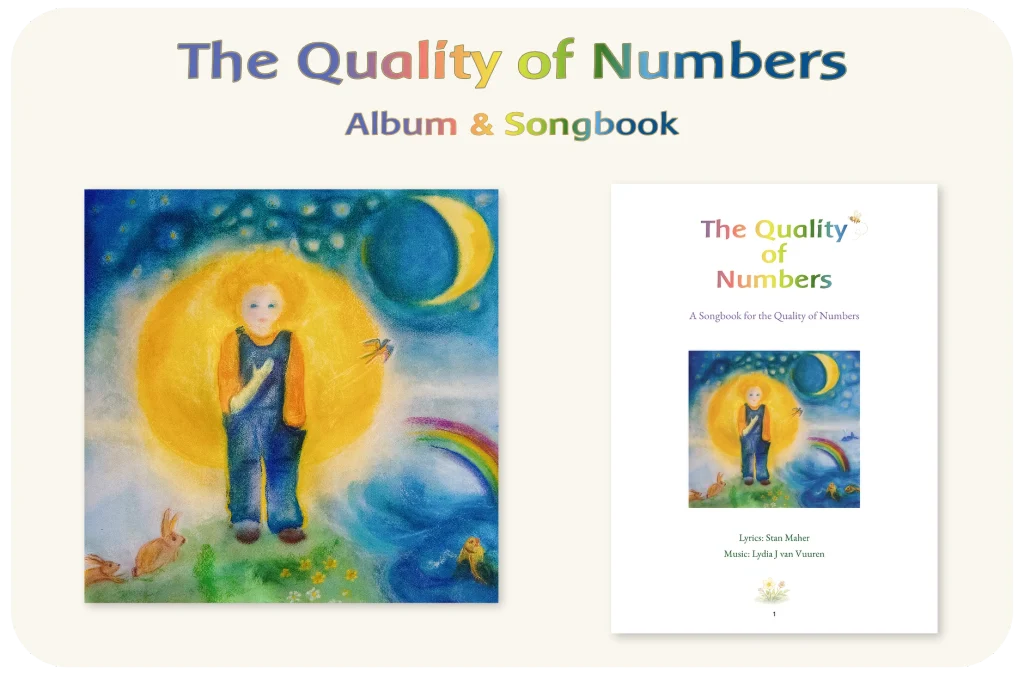
Expanded Songbook
Now with additional background on the Quality of Numbers, classroom activity suggestions, improved layout and graphics, and revised musical notation.
+
Introductory bonus
Mat and the Peach Pit: A Story About Up and Down – Digital PDF + Educator Guide included at no additional cost.
US$19.99
Children love to meet numbers through songs, stories, rhythm and imagination
The Quality of Numbers Album and Songbook brings the numbers one to twelve to life through timeless verses, beautiful imagery, music, rhythm and story. It invites children to hold a number imaginatively while discovering its patterns, relationships and deeper significance in the world around – nourishing their feeling life, awakening their imagination and deepening their inner experience.
The songs, verses and stories provide a complete foundation for the Grade One Quality of Numbers block in Waldorf education – giving teachers rich creative material from which to create deeply meaningful lessons tailored to their own needs. The songs and stories can also complement other curricula beautifully.
Verses and stories are drawn from the much-loved and internationally recognized Waldorf resource Putting the Heart Back into Teaching by Stan Maher and Yvonne Bleach – a work that made a lasting contribution to Waldorf education through multiple editions.
Sincere thanks to the Novalis Institute of South Africa for generously granting permission for their use.
The original stories and verses, together with the melodies and musical arrangements for this album, were created without the use of generative AI.
Download for free
The Quality of Numbers: A Teacher’s Companion
A valuable guide that helps teachers gain deeper insight into the symbolism and archetypal imagery expressed in the verse and song for each number, and see how these themes unfold across the album to form a coherent whole. It offers comprehensive background on each number, providing a strong foundation from which teachers can create engaging and educationally rich lessons for the children in their care.
Step inside The Quality of Numbers
Listen to samples of the story and song for Number One, explore a few pages from the Songbook and see how music, story and imagery can work together to create a deeply meaningful learning experience for children.
Number One – Story
Number One – Song
Why music belongs at the heart of the experience
Within Waldorf education, the arts – for instance, music, movement, story, painting and drawing – are part of the way in which a young child first enters into an idea. In the early grades especially, Rudolf Steiner placed great emphasis on rhythm and artistic experience, arguing that teaching should speak not only to the child’s thinking but also to feeling and will. He described music and singing as something that should begin in the first years of school and gradually become part of the child’s inner being.
Music can play a very special role when introducing the quality of numbers to children. It has the potential to bring the numbers to life and to become the vehicle through which number can be experienced inwardly and become part of the child’s being. By singing a song about a number, a child can voice the descriptive poetic verses, step its rhythm, move with its images and become familiar with its mood long before everything contained in the song is consciously understood. This can nurture and develop the child on multiple levels resulting in a satisfying joyful and meaningful lesson while preparing the ground from which mathematical thinking can grow.
Waldorf mathematics guidance itself places this kind of activity close to the heart of Grade One arithmetic. The early aim is described as developing a feeling for numbers, with songs, games and rhythmic movement, helping children experience number through the body before mathematical activity becomes increasingly internalised and abstract.
Morning Circle – song, rhythm and movement
The songs can be introduced and sung during Morning Circle, where the children learn them naturally through imitation and repetition. They sing, step the steady beat, clap rhythmic phrases, move together and practice counting through rhythm and movement.
At this stage there is no need to explain every image in the song. The child can simply experience it. A phrase about a honeycomb or snowflake may live in the imagination for several mornings before its mathematical significance is explored more consciously.
This rhythmic beginning also allows number to enter the body. Counting can be walked, stepped, clapped and spoken so that the experience of number sequence is not initially confined to the head. Waldorf curriculum guidance for the early grades repeatedly uses songs, movement games, clapping and rhythmic counting in this way.
Main Lesson – from story into discovery
The Main Lesson begins with the story.
The stories included with The Quality of Numbers Album & Songbook contain the core images and ideas belonging to the quality of each number, but they need not be treated as finished scripts. They can – and ideally should – become starting points for the teacher’s own storytelling. A teacher can extend them with adventure, humor, suspense, wonder and local detail, allowing the story to speak to the particular children sitting in front of them.
The important thing is that the mathematical idea first arrives imaginatively.
From there the children move out of the story and into direct experience. They look for the number in themselves and in the world around them.
With Six, for example, the children may count six legs on an insect, look closely at the six-sided cells of a honeycomb, explore the structure of a snowflake, arrange six children in different formations or discover that six objects remain six whether they are arranged in a row, in two groups of three or in three pairs.
The images that were first sung and imagined now become things to discover.
The lesson therefore moves naturally from imagination towards observation and growing awareness.
Artistic activity – giving the experience form
The experience can then move into drawing, painting or modelling.
In Waldorf education, artistic activity is intentionally integrated into academic learning. It forms an essential part of how children learn. The artistic activity therefore supports the movement from imagination and direct experience toward conceptual thought.
A child who has experienced Six through snowflakes, honeycombs or flowers might draw a sixfold form, paint an image from the story or model something encountered in the lesson. What was first heard as music and imagined through story is now given visible or tangible form.
At the end of a lesson, the child has met the same idea through sound, movement, imagination, observation and artistic creation. Each of these encounters adds another layer to the experience, helping the child develop a fuller understanding of the number.
Music Lesson – returning to the song as music
The song can return during the music lesson, but here it should not become another mathematics lesson.
It can simply be developed as music.
The children can refine the melody through imitation, listen carefully to musical phrases, step the beat, clap rhythms, explore gesture and movement and, where appropriate, eventually play the melody on a simple instrument.
Through group singing the child must listen while participating, move while remaining aware of others and contribute an individual voice to a larger musical whole. Contemporary Waldorf music education places considerable emphasis on listening, relationships between tones, movement and shared musical experience.
The mathematics and music therefore support one another while each is recognised as a subject in its own right.
From experience towards abstraction
The following day the child recalls the story, song, movement and discoveries. Artistic work may be deepened and the written numeral is introduced.
The number has been heard, sung, moved, imagined, discovered, counted, arranged and created. Through these different experiences, the child has begun to recognise the relationships within the number. The symbol can then begin to stand for what has already been experienced. The written numeral becomes the final condensation of something much richer.
Who this resource is for
The Quality of Numbers is especially suited to:
- Waldorf Grade One teachers
- Homeschooling parents
- Holistic educators
- Parents who value music, story and imagination in learning
- Educators looking for a deeper way to explore the qualities of number
- Older children in educational settings who have not previously encountered the qualitative nature of numbers
You do not need to be a specialist music teacher to use the resource. The songs and supporting material are designed to be explored naturally at home or in the classroom by anyone.
What makes these songs and stories special
- A deeper experience of number. The verses and songs invite children to explore what numbers are. Through music, verse, story and imagination, children encounter the qualities, patterns and relationships that give number its meaning before these experiences are condensed into abstract symbols. This becomes an important step in the child’s gradual journey towards conceptual understanding and mathematical abstraction.
- Rooted in Waldorf education. The original verses and stories are taken, with permission, from Putting the Heart Back into Teaching: A Manual for Junior Primary Teachers by Stanford Maher and Yvonne Bleach. The book grew out of teacher-enrichment work at the Novalis Institute and brings together stories, verses, songs, games and teaching ideas rooted in Waldorf education.
- Pentatonic music for the early years. The melodies composed for The Quality of Numbers are pentatonic, reflecting the important place that pentatonic music holds in the early years of Waldorf education. Its open tonal quality is particularly suited to the musical experience of the young child, supporting listening, imagination and an experience of melody before music becomes more strongly defined through later tonal and harmonic forms.
- An unfolding across all twelve numbers. In my years of teaching and exploring the Quality of Numbers, I have rarely encountered material with this degree of archetypal, symbolic and imaginative depth. The stories and verses offer far more than illustrations of individual numbers: their images and relationships develop across the twelve numbers as a meaningful progression, giving the teacher material from which a deeply considered experience of number can be created for the child.
What teachers and families have said
Fantastic Resource!
★★★★★
This is a MUST BUY resource for Class One teachers teaching the quality of numbers! It includes a story and song for each number. The songs are delightful, fun and catchy! – definitely a worthwhile investment!
Patricia Hall – Teacher
A Great Resource!
★★★★★
We absolutely love the stories and songs. A great resource to help teach the quality of numbers. Overall, one of the best resources out there to bring each number to life.
Chelsie – Teacher
Wonderful CD!
This is a wonderful CD and a great help in the classroom. The songs and poems are really easy to learn and the children love it. I found it very helpful when I taught Class 1 a couple of years ago, and still use some of the verses and songs. I can really recommend this CD for all primary school teachers!”
Elizabeth Swanepoel – Waldorf Teacher and Principal
Love your materials!
Thank you so much!! I want to say that my children LOVE your materials, best investment I have made so far in our home school. Beautiful!! Will you publish / come out with more materials.”
Marie Löfstedt – Homeschooling Parent
Absolutely love this
We absolutely love this. The story of each number is beautiful and the songs are as well. Thanks for putting this together!
Liliana Varela-Tello – Homeschooling Parent
Wonderful CD!
The songs on the CD are catchy and fun. A must for all homeschooling moms and kids! Trust me… maths CAN be fun!!
Ronel Kemp Wright – Homeschooling Parent
About the Creator
The Quality of Numbers Album & Songbook was developed by Lydia J van Vuuren, a Waldorf educator, musician and songwriter with twelve years of experience in Waldorf education. She has specialised in mathematics and mathematics education, drawing inspiration from the Waldorf curriculum.
Her work with Sacred Mathematics grows from a love of mathematics and a continuing exploration of the foundations of mathematical thought. She is particularly interested in how these foundations can be integrated into teaching content to create clearer entry points into mathematical understanding for both adults and children.
She is deeply committed to Waldorf methodology and pedagogy and believes it offers one of the strongest approaches to developing sound mathematical thinking in children. At the same time, she remains open to the insights and contributions of contemporary educational research across different pedagogical approaches and systems.
The musical settings in The Quality of Numbers bring together her background in mathematics education with her work as a songwriter, allowing the qualities of each number to be experienced through melody, rhythm and song.
An Introductory Gift
With your purchase of The Quality of Numbers Album & Songbook, you will also receive:
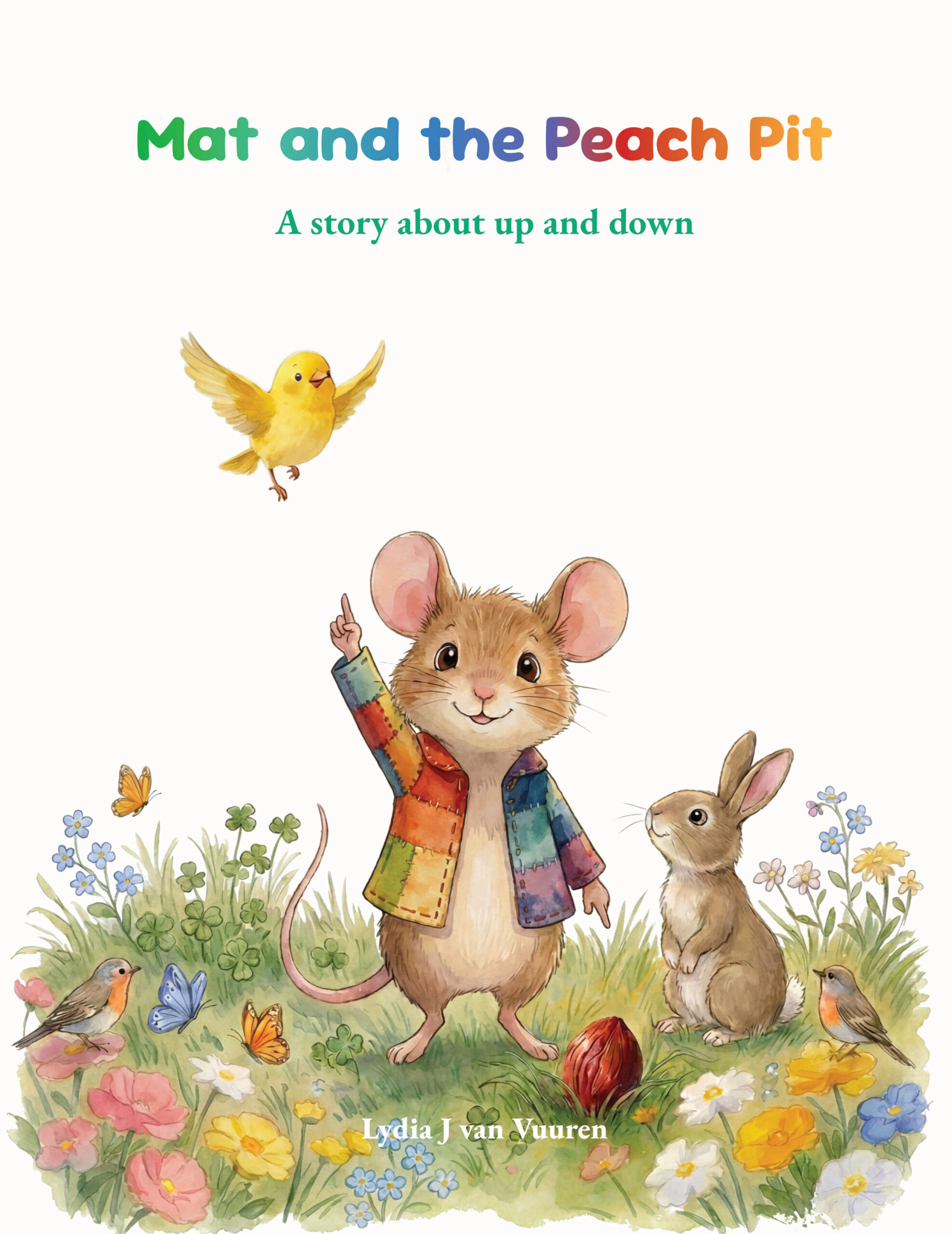
Mat and the Peach Pit — A Story about Up and Down
A mathematical story for children written according to Waldorf educational principles and designed to cultivate spatial and directional awareness in young children. It comes with an accompanying Educator Guide, created to support meaningful encounters with spatial language and movement, especially the directions of up and down, while helping to develop early mathematical thinking.
Digital PDF
Mat and the Peach Pit remains available as a standalone Sacred Mathematics resource; it is included here as a special introductory gift with The Quality of Numbers.
What you receive
The Complete Album
Twenty-four high-quality audio recordings of stories and songs exploring the qualities of numbers one to twelve, supplied in both WAV and MP3 formats.
The Songbook PDF
Printable Songbook PDF with sheet music for easy learning and classroom or home use.
The Verses and Stories PDF
The verses and stories in written form for easy reference and use.
Mat and the Peach Pit – A story about up and down + Educator Guide
A mathematical story based on Waldorf educational principles designed to develop spatial and directional awareness in young children, together with an accompanying Educator Guide.
Digital Access
Your resources are available to download immediately after purchase, so you can begin exploring them straight away.
Begin your journey through the qualities of number
US$19.99
Secure checkout • Immediate access to digital resources
Money Back Guarantee
If you decide within seven calendar days of purchase that The Quality of Numbers Album & Songbook is not right for you, contact us with your order details for a full refund, no questions asked.
Questions you may have
Is this a physical product?
No. The Quality of Numbers Album & Songbook is a digital resource.
How will I receive my purchase?
After checkout, your download links will appear on the order confirmation page and will also be sent to you by email.
What ages is this suitable for?
The resource is especially suited to Grade 1 children in Waldorf education, but its imaginative and musical approach can also be enjoyed by older children who have not previously encountered the qualitative nature of numbers, whether at home or in other educational settings.
Do I need musical training to use it?
No specialist musical training is required. The songs and supporting material are designed to be accessible to teachers, homeschoolers and parents.
Can I use the songs in a classroom or homeschool setting?
Yes. The resource is intended for educational use in homes, classrooms and similar learning environments. Children can also enjoy the stories and songs simply for their own pleasure at any time.
Can I print the songbook?
Yes. The songbook is supplied as a printable digital PDF.
What audio formats are included?
The audio recordings from The Quality of Numbers Album & Songbook are supplied in both WAV and MP3 formats.
Is this only for Waldorf education?
No. The resource grew out of Waldorf teaching experience, but it can be used by any teacher, homeschooler or parent who wants children to meet numbers meaningfully in a qualitative way and develop a deeper understanding of number from the very beginning.
How does the introductory bonus work?
When you purchase The Quality of Numbers Album & Songbook during the introductory offer, Mat and the Peach Pit – Digital PDF + Educator Guide is included at no additional cost.
YES, I would love The Quality of Numbers: Album & Songbook for the children in my care.
US$19.99
Secure checkout • Immediate digital access
If you have any further questions, you are very welcome to contact me at info@sacredmathematics.com