Axioms and Truth Statements.
In the previous blog, I introduced axioms, logical operators, and how mathematics uses them to connect statements, build definitions, and construct proofs. Logical operators such as and, or, if…then and not determine how statements combine and how conclusions follow from premises. We are now going to look at each of these in more detail, beginning with axioms or truth statements. Logical operators tell us how statements connect, but they do not tell us where the first statements come from. Before any logical reasoning can begin, there must already be certain statements that are accepted as starting points. Mathematics, like any logical system, cannot prove everything from nothing; it must begin somewhere. These starting points are called axioms, and they form the foundation on which all mathematical reasoning is built.
How Fundamental Beliefs Create the World in Which We Live
Before we continue the deeper investigation into axioms, it is helpful to pause and consider an analogy that can make this idea more intuitive. The role that axioms play in mathematics is not completely unfamiliar to us, because something very similar happens in human thinking and in the way people live their lives.
In mathematics, axioms are statements that are accepted as true at the beginning of a system. They are not proved inside the system, but everything that follows must be consistent with them. Once the axioms are accepted, definitions are built from them, theorems are proved from them, and entire mathematical structures grow from them. The axioms therefore define the world in which the mathematics takes place. They determine what is possible in that system and what is not possible, and they determine what must logically follow from the starting assumptions.
In a similar way, people often live according to certain fundamental beliefs about themselves, other people, and the world. These beliefs are usually formed through experience, upbringing, education, and repeated patterns of reinforcement. Over time, these beliefs become deeply ingrained and are often no longer questioned. They are simply accepted as true, and from these beliefs thoughts, decisions and actions naturally follow. In this sense, these beliefs function very much like axioms in the system of a person’s life.
If a person believes, for example, that they are not capable or not good enough, then many logical consequences follow from that starting belief. The person may avoid difficult tasks, hesitate to take opportunities, doubt their own decisions, and interpret mistakes as proof of failure rather than as part of learning. When we look at the behaviour from the outside, it may sometimes appear irrational, but within the system defined by the starting belief, the behaviour is actually logically consistent. The actions follow logically from the assumption.
If the starting belief changes, the logical consequences also change. If a person begins to operate from a belief such as being capable of learning, improving, and solving problems over time, then different decisions and actions follow. The person may attempt new challenges, accept mistakes as part of learning, take responsibility for decisions, and gradually build confidence through experience. The external world may not change immediately, but the internal starting point has changed, and therefore the logical direction of actions and decisions begins to change as well.
This analogy helps us understand something very important about axioms in mathematics. Axioms are not just abstract statements written at the beginning of a textbook. They define the entire world in which the mathematics operates. Once the axioms are accepted, everything that follows must be consistent with them. If the axioms change, the entire mathematical world changes and different results become possible.
In both mathematics and in human reasoning, the starting assumptions are extremely important. From a small number of accepted starting truths, entire systems of reasoning, behaviour and outcomes can develop. Understanding the starting point is therefore one of the most important steps in understanding both mathematical reasoning and, in a broader sense, human reasoning as well.
What is an Axiom – A Deeper Investigation
Axioms or statements that are accepted without proof is a very deep idea that lies at the heart of mathematics. Many students do not realise this when they first encounter proofs, geometry or algebra. Over centuries, mathematicians developed and refined axioms, and they now form the foundation on which all mathematical reasoning is built. From these starting points, everything else in mathematics must logically follow.
What makes this even more remarkable is that mathematics built from these simple starting assumptions does not remain only an abstract logical system. Mathematical structures developed from axioms are able to describe and predict the behaviour of the physical world with extraordinary accuracy. Using mathematics, scientists can calculate the motion of planets, predict the behaviour of waves and light, model the flow of electricity, design bridges and buildings and describe the motion of objects through space. Many physical laws are written in mathematical form and once these mathematical relationships are established, they can be used to predict outcomes long before they are observed experimentally.
Throughout the history of science, there have been many instances where mathematical results were developed through pure logical reasoning and were only later confirmed through observation or experiment. This shows that mathematics is not merely a collection of calculations, but a logical structure that often reflects the structure of the natural world itself. From a small set of axioms and logical rules, mathematics grows into a system powerful enough to model nature, support engineering and technology, and help us understand patterns and relationships in the universe
This remarkable connection between mathematics and the physical world was noted by the physicist Eugene Wigner, who described it as the unreasonable effectiveness of mathematics in the natural sciences. He observed that mathematical ideas are often developed purely through logical reasoning without any intention of describing the physical world, yet later these same mathematical structures turn out to describe physical phenomena with extraordinary precision. There is no obvious reason why abstract systems built from axioms should match the behaviour of the universe so well, yet again and again mathematics proves to be the exact language needed to describe nature. This observation highlights the deep and somewhat mysterious relationship between logical reasoning, mathematical structure and the physical world.
For this reason, axioms are far more than simple starting statements. They form the foundation of a logical system from which entire branches of mathematics grow and through mathematics, they ultimately contribute to our ability to describe, predict, and interact with the physical world with remarkable precision.
Building Different Mathematical Worlds – The Development of Axioms Through History
The idea of axioms did not appear all at once in mathematics. It developed slowly over many centuries as mathematicians began to realise that mathematical reasoning must start from clearly stated assumptions. The history of axioms is therefore also the history of mathematics becoming more precise, more logical and more aware of its own foundations.
The Ancient Greeks were among the first to recognise that mathematics should be built on clearly stated starting points. The philosopher and mathematician Aristotle studied logic and reasoning and developed some of the earliest formal principles of logical thought. He investigated how conclusions follow from premises and how logical arguments are structured. Although Aristotle did not create axiom systems in the modern mathematical sense, his work on logic laid the foundation for later mathematical reasoning by showing that knowledge can be built through structured logical arguments starting from accepted principles.
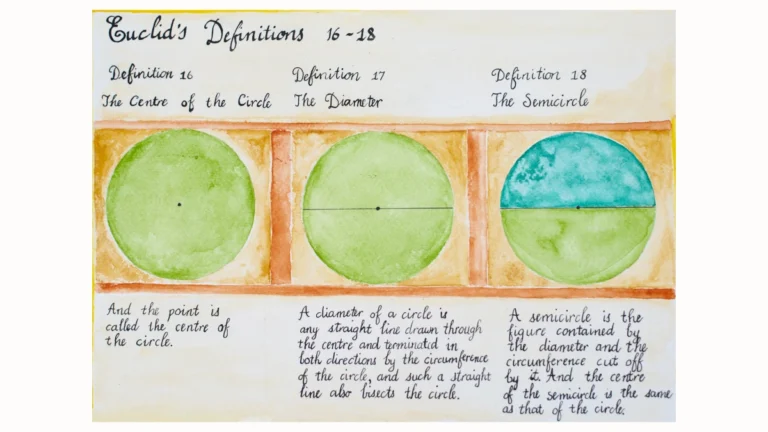
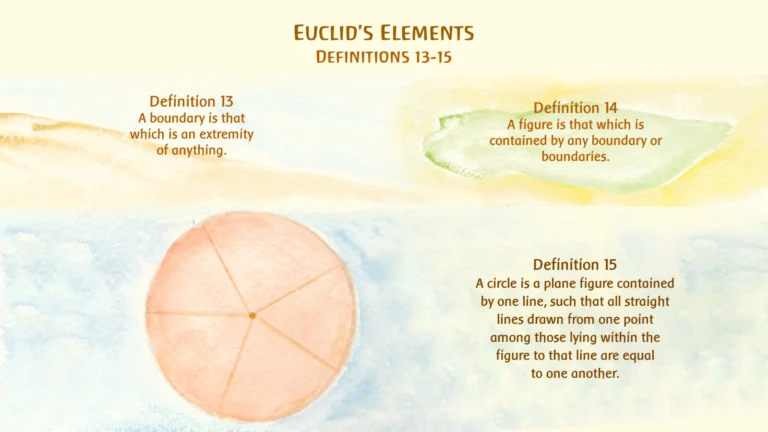
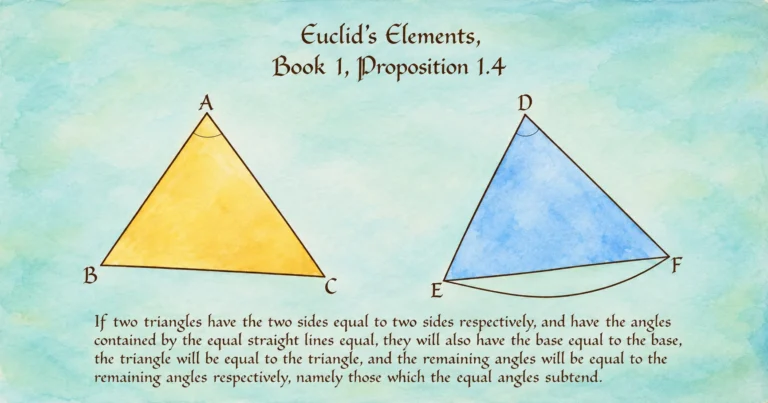
A major step forward came with the Greek mathematician Euclid around 300 BCE. In his work Elements, Euclid organised geometry into a logical system built from definitions, common notions and postulates, which we now call axioms. Instead of simply collecting geometric facts, Euclid began with a small number of basic assumptions and then proved hundreds of geometric results from them using logical reasoning. His approach was revolutionary because it showed that an entire body of knowledge could be built logically from a few starting statements.
Euclid’s geometry was built on axioms such as:
- Through two points there exists exactly one straight line.
- The whole is greater than the part.
- Things equal to the same thing are equal to each other.
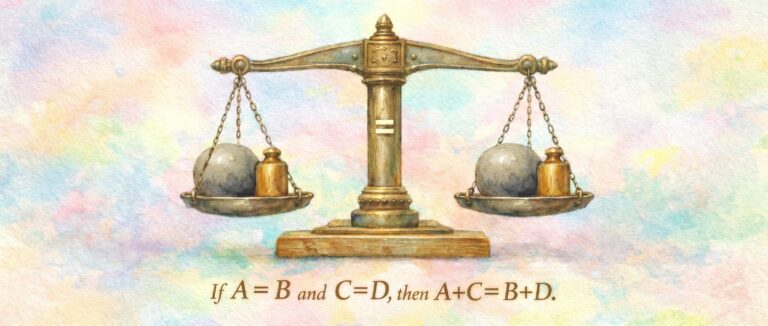
- If two quantities are equal and the same quantity is added to both of them, then the resulting quantities are also equal.
From just a few such statements, Euclid built nearly all of classical geometry. For more than two thousand years, Euclid’s Elements was one of the most influential textbooks ever written and became the model for how mathematics should be structured: start with axioms, then definitions, then theorems, then proofs.
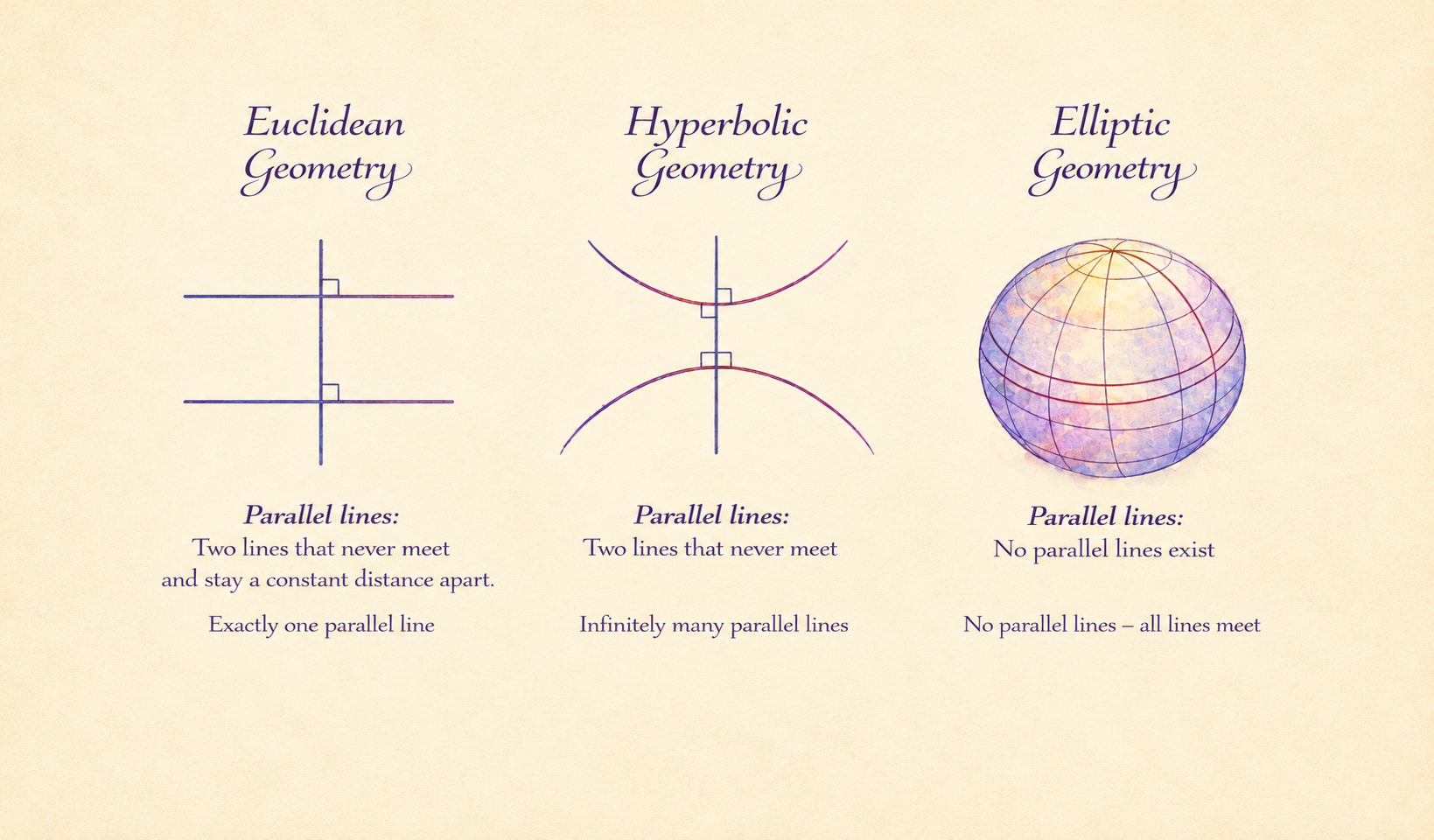
For a long time, mathematicians believed that Euclidean geometry described the only possible geometry of space. However, in the nineteenth century, mathematicians discovered that if one of Euclid’s axioms — the parallel postulate — was changed, entirely new geometries could be created. (The parallel postulate stated that through a point not on a given line, there is exactly one line parallel to the given line.) This led to the development of non-Euclidean geometry by mathematicians such as Lobachevsky, Bolyai, and Riemann. This discovery was extremely important because it showed that axioms are not necessarily self-evident truths about the physical world, but rather starting assumptions that define a logical system. Changing the axioms creates a different mathematical world with different properties.
In the late nineteenth century, mathematics became more formal and more abstract, and mathematicians began to develop axiom systems for areas beyond geometry. The Italian mathematician Giuseppe Peano developed axioms for the natural numbers. The Peano axioms define what numbers are and how they behave, starting from basic ideas such as the existence of zero and the idea that every number has a successor. From these simple axioms, arithmetic and number theory can be developed logically.
Around the same time, the German mathematician David Hilbert worked on formalising geometry and mathematics more generally. Hilbert wanted mathematics to be built on complete and consistent axiom systems so that every mathematical statement could, in principle, be proved from clearly stated assumptions. His work helped move mathematics toward the modern view of mathematics as a formal logical system built from axioms and rules of inference.
In the early twentieth century, mathematicians Ernst Zermelo and Abraham Fraenkel developed axioms for set theory, now known as Zermelo–Fraenkel set theory. Set theory became the foundation for most of modern mathematics because numbers, functions and many mathematical objects can be defined in terms of sets. This means that much of modern mathematics can be built from a single underlying system of axioms.
One of the most important conclusions from this historical development is that mathematics is not built on one single set of axioms. Different branches of mathematics use different axiom systems, and each set of axioms defines a different logical world. Euclidean geometry, non-Euclidean geometry, number theory and set theory all begin with different starting assumptions, and therefore each develops its own structures and results.
This led mathematicians to a very important realisation: mathematics is not just the study of numbers or shapes, but the study of logical structures that follow from different sets of axioms. When mathematicians choose a set of axioms, they are in a sense defining a world, and then exploring what must be true in that world. Different axioms create different worlds, and mathematics becomes the exploration of the consequences of different starting assumptions.
Seen in this way, the development of axioms through history represents the gradual discovery that mathematics is a logical universe built from foundations, and that by changing those foundations, entirely new mathematical worlds can be created.
The Structure of a Mathematical Proof
Axioms → Definitions → Previously proven theorems → Logical reasoning → Conclusion
Now that we have discussed axioms, logical structure, and how mathematical systems are built from foundational assumptions, we can look more carefully at the structure of a mathematical proof. Many students initially think that a proof is simply a sequence of clever steps or algebraic manipulations, but a proof is actually something much more structured and systematic than that.
A mathematical proof is a logical argument in which a statement is shown to be true by starting from accepted truths and moving step by step through logical reasoning until the conclusion is reached. The accepted starting points are usually axioms, definitions, and previously proven theorems. From these, new statements are derived through logical inference, and each step must follow logically from what came before. If every step is logically valid and the starting statements are accepted as true, then the final conclusion must also be true.
This means that the most important part of a proof is not the manipulation of symbols, but understanding the starting point of the reasoning. The axioms, definitions, and given information define the world in which the proof takes place. They determine what objects exist, what operations are allowed, and what properties can be used. Once this world is clearly understood, the proof becomes a process of logical movement within that world, where each statement follows from the previous ones according to the rules of logic.
In this sense, a proof is not just a calculation or a trick. It is a carefully structured argument that begins with foundational truths and proceeds through a chain of logical inferences until a conclusion is reached. The conclusion is therefore not guessed or assumed, but logically forced by the starting assumptions and the rules of reasoning.
Understanding this structure is one of the most important lessons for students learning mathematics. When faced with a proof, the first step is not to start manipulating symbols immediately. The first step is to understand the premises, the definitions, and the axioms that define the situation. Once the starting assumptions are clear, the rest of the proof becomes a process of logical reasoning that moves step by step toward the conclusion.
Seen in this way, mathematics does not begin with answers; it begins with assumptions. From these assumptions, logical reasoning builds definitions, theorems, and entire mathematical theories. From a small number of starting statements, large and complex structures of knowledge are constructed. Mathematical proofs are therefore not isolated arguments, but part of a much larger logical structure that grows from foundational axioms through definitions and theorems to new conclusions.
This perspective also helps explain why mathematics is so precise and reliable. Each result is not based on intuition or opinion, but on a chain of logical reasoning that begins with clearly stated assumptions and proceeds step by step according to logical rules. The certainty of mathematics comes from this structure: if the starting assumptions are accepted and the reasoning is correct, then the conclusion must follow.
So when we study mathematical proofs, we are not only learning how to prove individual statements. We are learning how entire systems of knowledge can be built from a small number of starting ideas through careful reasoning and logical structure.
Final Thoughts
One of the most profound ideas in mathematics is this:
Mathematics does not begin with answers.
It begins with assumptions.
And from those assumptions, entire worlds are built.
And perhaps this is true beyond mathematics as well.
The assumptions we accept – consciously or unconsciously – define the boundaries of our world, the choices we believe we have, the risks we take and the lives we build.
So in mathematics, and perhaps also in life, one of the most powerful questions we can ask is:
What are the axioms I am building my world on?
This article forms part of a series of nine articles tracing how language becomes mathematics. All nine articles are now available together in a 57-page PDF for your convenience – for the price of a coffee, US$4.